
I remember spending countless nights reading about early Mars mission concepts and always hitting the same frustrating wall: How are we ever going to carry enough fuel for a round trip? Traditional chemical rockets are incredible machines, but let’s be honest—when it comes to deep space exploration, they are basically dinosaurs. They burn too fast, weigh too much, and severely limit how far and how fast we can go.
But while diving into NASA’s latest propulsion tests this week, I genuinely got goosebumps. The Jet Propulsion Laboratory (JPL) just fired up a prototype that feels like it was pulled straight out of a sci-fi novel: a lithium-fueled nuclear plasma engine.
I’m not exaggerating when I say this test shifts our timeline for human Mars exploration from a distant “maybe someday” to a very tangible “we are building the engine right now.” Here is my deep dive into why this technology changes the rules of the game entirely.
Breaking Records: 120 Kilowatts of Pure Power


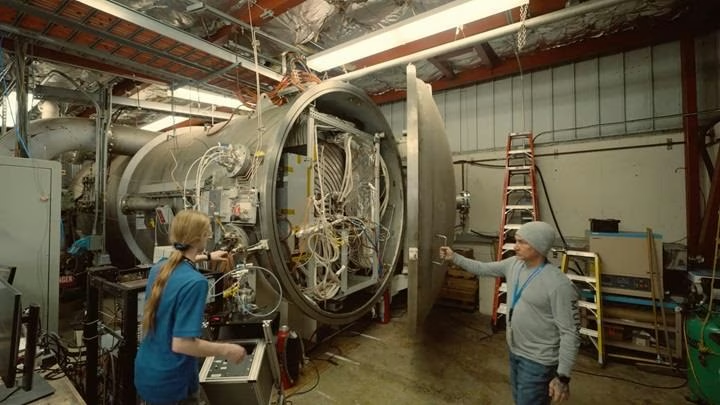
Inside a massive vacuum chamber, NASA successfully tested a new generation MPD (Magnetoplasmadynamic) thruster, and the numbers are absolutely staggering.
During the test, this electromagnetic beast reached a power level of 120 kilowatts. To put that into perspective, that makes it the most powerful electric propulsion system ever tested in the United States. If you followed the Psyche mission launched back in 2023, its electric thrusters were groundbreaking at the time. This new MPD prototype? It is packing roughly 25 times more power.
What fascinated me the most was the visual data from the firing sequence. The engine was fired up five times, and the temperatures inside skyrocketed past 2,800 degrees Celsius.
- The outer electrode of the engine glowed a deep, intense red.
- The central tungsten electrode emitted a blinding, brilliant white light.
That visual alone is a testament to the sheer, raw energy of the high-density plasma being generated. It’s not just a theoretical concept anymore; it’s raw power contained in a lab.
Why MPD Technology is a Game-Changer
You might be wondering, “Don’t we already have ion engines?” Yes, we do. Ion and Hall-effect thrusters are amazing for keeping satellites in orbit or slowly pushing probes across the solar system using solar power. But they have a major bottleneck: the amount of power they can process is severely limited. They offer a gentle, continuous push, but they won’t get heavy human habitats to Mars in a reasonable timeframe.
This is where the Magnetoplasmadynamic (MPD) thruster completely rewrites the playbook.
Instead of just ionizing a heavy gas and pushing it out the back, MPD thrusters use massive electric currents interacting with magnetic fields to electromagnetically accelerate lithium plasma.
Here is why this matters to us space geeks:
- Extreme Power Density: MPDs can handle and process vastly higher amounts of power compared to traditional ion engines.
- Mind-Blowing Efficiency: According to NASA, this class of electric propulsion can consume up to 90% less fuel than traditional chemical rockets.
- Heavy Lifting: Because they can process megawatt-class power, they can actually move the massive payloads required for human survival on another planet.
Lithium and Nuclear Fission: The Deep Space Dream Team

When I first read about the test, my immediate question was, Why lithium? It turns out, lithium has incredible plasma properties and offers incredibly high efficiency when ionized and accelerated. But the real magic happens when you pair this lithium plasma engine with a nuclear power source.
If we want to go beyond Mars, or even just set up a reliable highway to the Red Planet, solar panels aren’t going to cut it. The further you get from the Sun, the less energy you can harvest. By coupling MPD thrusters with onboard nuclear fission reactors, we completely eliminate our dependency on sunlight. We get a constant, reliable, massive power output regardless of where we are in the dark void of space.
The Road Ahead: The 23,000-Hour Hurdle

As much as I’m celebrating this milestone, my research also highlights the massive engineering mountains we still have to climb.
NASA’s ultimate goal, funded under their nuclear propulsion program, is to scale this up to megawatt-class systems. A fully crewed Mars mission won’t just need 120 kilowatts; it will require an estimated 2 to 4 megawatts of total power.
To achieve that, we will need multiple MPD thrusters firing continuously for over 23,000 hours. That is nearly three straight years of non-stop operation at temperatures melting down traditional metals. The biggest challenge over the next decade won’t just be generating the thrust, but proving that our material sciences can build components durable enough to survive the journey without melting or degrading.
Keep Your Eyes on 2028
We won’t have to wait decades to see the next big step. NASA is already planning an early-stage pioneer mission called the SR-1 Freedom. Scheduled for launch in December 2028, this spacecraft will carry a 20-kilowatt fission reactor specifically to test how advanced electric thrusters perform in deep space when fed by nuclear power.
I’ll be watching that launch like a hawk, because the data from the SR-1 Freedom will lay the final groundwork for the massive megawatt engines that will eventually carry humanity to Mars.
Chemical rockets gave us the Moon, but nuclear plasma is going to give us the solar system.
When you think about the sheer extreme temperatures and the concept of riding a nuclear reactor across the solar system, it sounds wild. But that’s what it takes to become an interplanetary species. I’d pack my bags for a ride on a nuclear plasma ship, but what about you? Would you trust a 2,800-degree plasma engine to carry you safely to Mars? Let’s talk about it in the comments!
You Might Also Like;
- Samsung Enters the Robotics Arms Race: Inside the New RX Unit
- The Danger of AI Confidence: Why We Are More Wrong Than Ever
- The Hidden Threat Above Us: Are We Facing a Nuclear Arms Race in Space?
-
-

-

-

-

-

-

-

-

-

-
-