Imagine looking up into the clear blue sky, watching a massive aircraft glide through the clouds. Now, imagine that same aircraft isn’t running on jet fuel, but carries a live, fully operational nuclear reactor right above your head.
Yes, they actually tried this.
When I was diving deep into the history of aviation and Cold War tech for this piece, my mind was absolutely blown. I always thought I knew the limits of mid-century engineering, but the idea of slapping a nuclear power plant into a bomber took my understanding of “extreme tech” to a whole new level. We are talking about sky monsters with infinite range, machines designed to stay airborne for weeks, or even years, without ever touching the tarmac.
Let me take you through one of the most insane, brilliant, and ultimately terrifying engineering projects in human history.
The Paranoia of the 1950s: Chasing the Infinite Range

To understand why anyone would think a flying nuclear reactor was a good idea, I had to put myself in the shoes of military strategists in the 1950s. The Cold War was freezing over, and the biggest logistical nightmare for the United States was range.
Jet engines of that era were notorious fuel guzzlers. If a conflict broke out, keeping a fleet of heavy bombers airborne near enemy borders required an impossibly complex ballet of mid-air refueling and forward airbases.
The military wanted a silver bullet. They wanted an aircraft that could take off from the US, loiter over the oceans for days or weeks, and strike anywhere on the globe at a moment’s notice. The solution they landed on? Nuclear propulsion. A single pound of uranium packs the energy equivalent of roughly 1.7 million pounds of jet fuel. On paper, it was the ultimate engineering hack.
Meet the Beast: The Convair NB-36H


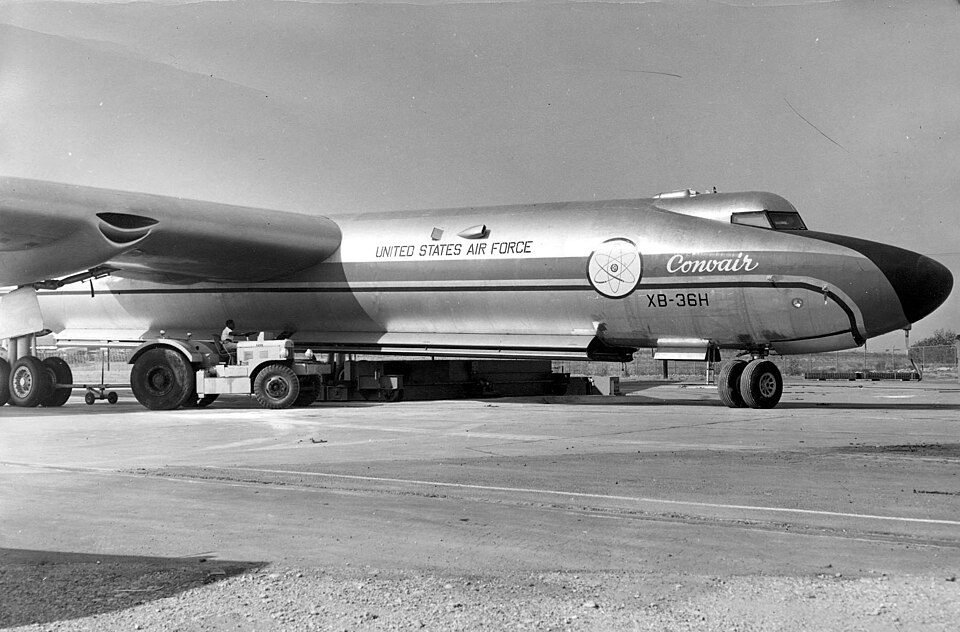
They didn’t just draw this up on a chalkboard; they actually built it. The aircraft chosen for this colossal experiment was the B-36 Peacemaker, an absolute behemoth of a plane that originally featured six propeller engines and four jet engines.
The modified version, dubbed the NB-36H “Crusader”, was a marvel of terrifying engineering. Here is how they made the impossible happen:
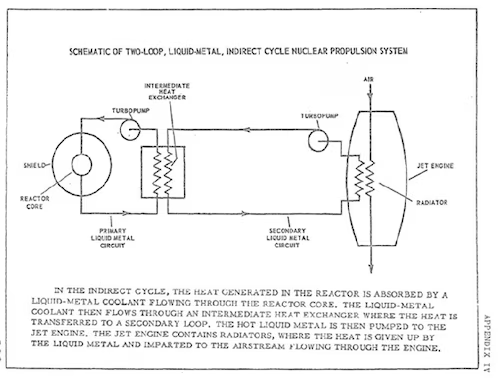
- The Reactor: They installed a 1-megawatt Aircraft Shield Test Reactor (ASTR) right in the bomb bay of the plane.
- The Shielding: Radiation was obviously the biggest hurdle. Instead of shielding the entire massive reactor, engineers decided to shield the crew. They built a customized, 11-ton cockpit lined with lead and specialized rubber to keep the pilots from being cooked alive by gamma and neutron radiation.
- The Payload: The reactor was designed to be easily winched out of the aircraft upon landing and stored in a specialized underground pit, surrounded by thick concrete.
Between 1955 and 1957, this nuclear beast completed 47 test flights over Texas and New Mexico. And from a purely technical standpoint, it was a massive success. The reactor went critical in the air, the shielding worked, and the crew survived without radiation poisoning.
The “Flying Chernobyl” Scenario

But this is where my fascination turned into sheer horror. While reading through declassified documents, I hit the exact same realization that the engineers of the era did: What happens when things go wrong?
- The Crash Risk: Airplanes crash. It’s an undeniable fact of aviation. If a conventional bomber goes down, you have a tragic fireball. If a nuclear-powered bomber goes down in a populated area, you literally have a flying Chernobyl disaster. It would scatter highly radioactive debris and contamination across miles of civilian territory.
- Combat Vulnerability: These planes were designed for war. What if an enemy anti-aircraft missile struck the reactor mid-flight? The skies would be poisoned.
- Maintenance Nightmares: Even on the ground, handling a radioactive aircraft required terrifying logistics. If an engine part broke, mechanics couldn’t just walk up with a wrench. They would need robotic arms, heavy shielding, and incredibly hazardous protocols.
The risks were astronomically high. No amount of infinite range could justify the threat of accidentally nuking your own countryside during a routine test flight.
Sanity Prevails: The Project is Grounded
Thankfully, humanity dodged a massive radioactive bullet. The project was heavily scrutinized and eventually bled dry of funding.
The final nail in the coffin wasn’t just the safety risk; it was the rapid evolution of other technologies. Intercontinental Ballistic Missiles (ICBMs) and nuclear-powered submarines entered the chat. Submarines could hide underwater for months using nuclear power without the risk of dropping out of the sky, and ICBMs could strike a target halfway across the world in 30 minutes without needing a human pilot.
In 1961, President John F. Kennedy officially canceled the nuclear aircraft program. The dream of the infinite bomber was dead.
Could the Sky Monsters Return?
When I look at today’s technological landscape, I can’t help but wonder if we really left this idea in the past. We are currently seeing a massive resurgence in nuclear innovation.
- Compact Reactors: Startups are developing micro-reactors that are safer, smaller, and more efficient than anything the 1950s engineers could have dreamed of.
- Space Exploration: NASA and DARPA are actively developing nuclear thermal propulsion for spacecraft (like the DRACO project) to get us to Mars faster.
- Unmanned Systems: While a crewed nuclear bomber is highly unlikely, what about autonomous drones? Could a military superpower be tempted to build a nuclear-powered, high-altitude surveillance drone that flies for a decade without landing?
Personally, while I am a huge advocate for next-generation nuclear energy on the ground and in deep space, keeping reactors strictly out of our atmosphere feels like the most basic form of common sense. The margins for error in the sky are just too thin.
But human ambition has a funny way of ignoring common sense when ultimate power is on the table.
What about you? Knowing the advancements in modern fail-safes and materials, do you think humanity will ever take this colossal risk again and bring nuclear-powered aircraft back to our skies? Let me know your thoughts down below!
You Might Also Like;
- The Terrifying Reality of Flying Nuclear Bombers
- How Long Does It Really Take to Travel to Mars?
- 10 Dark Mars Secrets That Will Terrify You
-

-

-

-

-

-

-

-

-

-

-

-