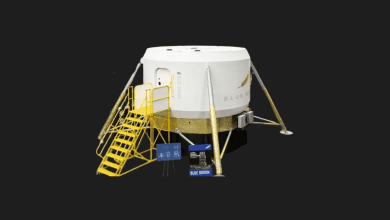
I’ve spent countless hours reading about our grand plans to return to the Moon, and there is always one glaring issue that most sci-fi movies conveniently ignore: the lunar night. Imagine trying to survive in a freezing, unforgiving vacuum where the sun sets and doesn’t rise again for two entire Earth weeks.
When I first started looking into how space agencies planned to keep astronauts alive in the dark, I honestly assumed we would just build massive solar farms and pack thousands of next-generation batteries. But the math simply doesn’t add up for a permanent, industrial-scale base. That’s why the latest news from Lockheed Martin completely caught my attention. They aren’t looking at the sun for our lunar future; they are looking at splitting the atom.
Lockheed Martin, in collaboration with NASA and the U.S. Department of Energy, is developing a Fission Surface Power (FSP) system. Their goal? To deploy a working nuclear reactor on the Moon. Let’s break down why this is happening, how the technology works, and what it means for the future of a permanent lunar economy.
The Dark Side of Lunar Survival


To understand why Lockheed Martin is betting on nuclear fission, you have to understand the brutal reality of the lunar environment.
The most valuable real estate on the Moon is currently at the poles, primarily because we’ve found water ice in permanently shadowed craters. We need that ice to drink, but more importantly, to split into hydrogen and oxygen for rocket fuel.
Here is the catch:
- The 14-Day Night: A single night on the Moon lasts about 350 hours.
- The Cold: Temperatures can plummet to around -130°C (and even colder in shadowed craters).
- The Shadow Problem: If you are mining in a crater that never sees sunlight, your shiny new solar panels are completely useless.
Solar power is great for short missions or orbital satellites, but if we want to build habitats, run continuous mining operations, and keep rovers alive through the freezing dark, we need an energy source that doesn’t care if the sun is shining. Nuclear fission provides that uninterrupted, reliable, and weather-independent power.
Enter the Fission Surface Power (FSP) Concept

When I first read the specs of what Lockheed Martin was planning, I was actually a bit surprised by how modest the starting point is. They aren’t trying to build a massive, city-powering plant right out of the gate.
Instead, they are taking a highly practical, scalable approach:
- The Starting Line: The initial system will generate between 5 to 10 kilowatts (kW) of power. To put that in perspective, 10 kW is roughly what it takes to run a couple of heavy household appliances simultaneously.
- The Immediate Goal: On the Moon, that 5-10 kW is a lifesaver. It is exactly enough to heat a small habitat, keep life support systems running, and ensure a lunar rover doesn’t freeze to death during the long night.
- The Long-Term Vision: Once the baseline technology is proven, Lockheed plans to scale the architecture up to 25 kW, 50 kW, and eventually a robust 100 kW grid.
Why Scaling Up Isn’t Just “Making It Bigger”
You might think, “If we can build a 10 kW reactor, why not just build a bigger one right away?” If only space engineering were that easy!
Upgrading to a 100 kW system introduces terrifying thermal management problems. In space, getting rid of excess heat is incredibly difficult because there is no air to carry the heat away (convection). Lockheed Martin is heavily focusing on advanced Brayton motor technology to solve this.
For the massive power loads, they have to:
- Control high-temperature Brayton cycles efficiently.
- Invent and implement entirely new materials capable of surviving these extreme operational temperatures.
- Develop fully autonomous operational systems so the reactor can run safely without a human constantly turning dials.
The Race to the Next Decade

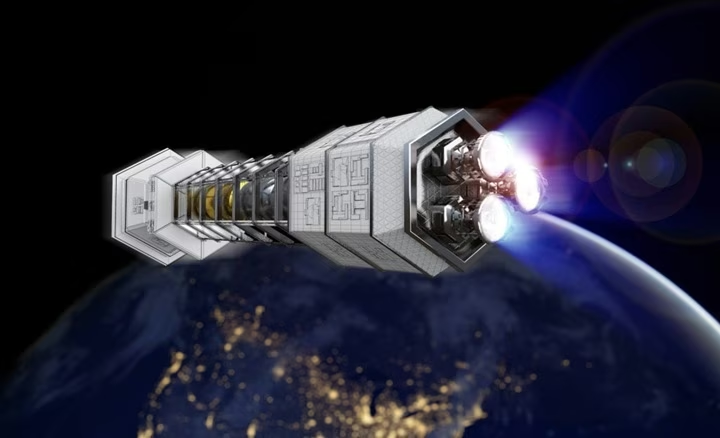
This isn’t just a wild concept sitting on a drawing board. The project is actively moving forward under Phase 1 contracts with NASA and the Department of Energy, with a very real launch target set for the end of the decade.
In fact, developing nuclear power for space has officially become a U.S. national priority, backed by a recent White House Executive Order. The government knows that whoever establishes a reliable power grid on the Moon will control the future of commercial space mining and deep-space exploration.
Interestingly, Lockheed Martin isn’t just focusing on the dirt. Their roadmap includes building a 10-25 kW orbital power system first. I think this is a brilliant move. By testing the reactor, heat dissipation, and autonomous controls in lunar orbit first, they can drastically lower the risk before trying to land and deploy a nuclear core on the dusty surface. It also helps streamline the massive regulatory nightmare of launching nuclear material from Earth.
A New Era of Space Exploration
We are witnessing a monumental shift in how we approach space. We are moving away from the “plant a flag and go home” era and stepping into the “build a foundation and stay” era. A reliable nuclear reactor is the absolute bedrock of that foundation. Without it, there is no permanent moon base, no lunar fuel refineries, and no stepping stone to Mars.
It’s mind-blowing to think that in just a few years, we might look up at the Moon and know there is a tiny, autonomous nuclear reactor humming away in the dark, keeping the lights on for humanity’s furthest outpost.
I’m curious to know where you stand on this. If you were an astronaut chosen for a long-term lunar mission, would you feel comfortable sleeping in a habitat powered by a nuclear fission reactor just a few hundred yards away, or does the idea make you nervous? Let me know your thoughts in the comments!
You Might Also Like;
- Ask YouTube: The End of Traditional Video Search
- The Biggest Google Search Evolution in 25 Years
- Google’s Universal Cart Will Change How You Shop Forever
-
-

-

-

-

-

-

-

-

-
-

-