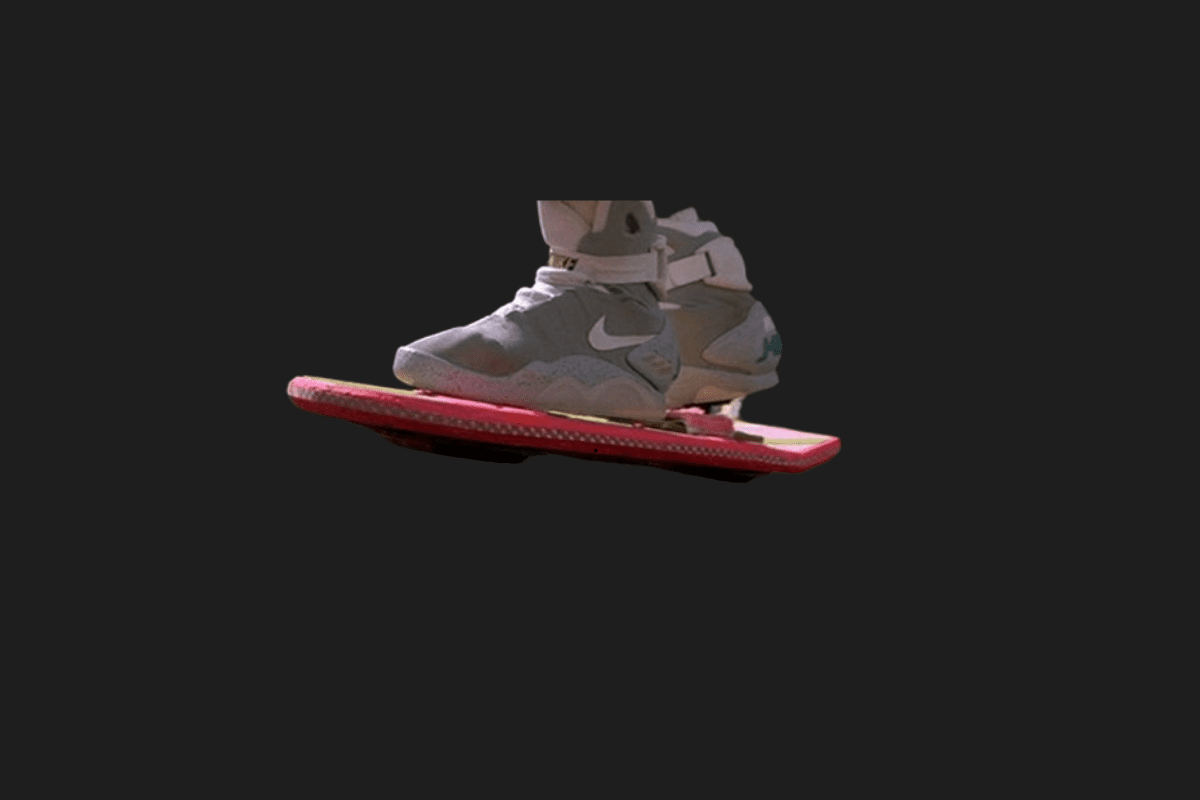
I still vividly remember the first time I watched Back to the Future Part II. Seeing Marty McFly borrow that bright pink Mattel hoverboard to escape Griff Tannen completely rewired my brain. For kids growing up in the 90s, the promise was clear: by the time we reached adulthood, we wouldn’t need wheels anymore. We were going to glide over the pavement, defying gravity with casual coolness.
Then the actual future arrived, and let’s just say, reality delivered a pretty massive disappointment. Flying cars, four-day workweeks, and true anti-gravity skateboards remained stuck on the waiting list of science fiction promises. But recently, while diving into the latest engineering experiments online, I came across a project that genuinely gave me a glimmer of hope.
A mad-genius inventor on YouTube has actually built a functional, magnetically suspended skateboard. It’s not CGI, and it’s not a cheap parlor trick. Let’s dive into how close we actually are to kicking the tires off our skateboards forever.
The Great “Hoverboard” Deception


Before we look at the new breakthrough, I need to get something off my chest. We were completely robbed during the mid-2010s “hoverboard” craze.
You probably remember it. Pop culture was obsessed. We even saw them peak in mainstream media—like that iconic scene in the hit TV show Empire, where the youngest son of the Lyon family dramatically rolled into the office on a shiny gold device.
Marketed as a technological revolution, these gadgets were meant to be a direct homage to the fictional tech of Marty McFly. But there was one glaring issue: they didn’t hover.
- They had wheels: They were essentially just miniature Segways without handlebars.
- They relied on gyroscopes: You shifted your weight to move forward or backward.
- They were terrestrial: They never left the ground, and quite frankly, they had a nasty habit of catching fire.
As a tech enthusiast, I found it incredibly frustrating that we accepted the name “hoverboard” for something that rolled on the dirt. Real levitation seemed like an impossible physics problem that big tech companies had simply given up on.
Enter Colin Furze and the Magnetic Suspension Deck


Just when I thought the dream was dead, I saw the latest project from Colin Furze. If you aren’t familiar with him, he is a legendary British YouTuber and inventor known for building utterly insane, borderline dangerous gadgets in his shed.
Furze decided he was tired of waiting for anti-gravity tech to be invented. Instead, he took a highly practical, brute-force approach to the problem by combining a traditional skateboard with magnetic levitation (maglev) principles.
He didn’t build a board that hovers over the concrete—physics won’t let us do that without a specialized magnetic track. Instead, he built a board where the rider hovers over the wheels.
How the Magnetic Build Actually Works


Furze completely dismantled the concept of a standard skateboard and split it into two distinct layers:
- The Bottom Chassis: This is the part that actually touches the ground. It features standard skateboard wheels and trucks attached to a metal frame.
- The Top Deck: This is the wooden board where the rider stands.
- The Invisible Cushion: Between these two layers, he installed incredibly powerful rare-earth neodymium magnets.
By aligning the magnets so they repel each other, the top deck is literally pushed away from the bottom chassis. When you stand on the board, your body weight is fighting against the massive repulsive force of the magnets. You are essentially floating on an invisible cushion of magnetic energy.
The Nightmare of Magnetic Physics

When I first looked at the design, I thought, “Why hasn’t anyone mass-produced this yet?” Then I dug into the physics, and I realized the absolute nightmare Furze had to navigate.
There is a concept in physics called Earnshaw’s theorem, which essentially states that you cannot achieve stable levitation using only permanent magnets. If you put two repelling magnets on top of each other, the top one won’t just sit there—it will violently shoot off to the side to escape the magnetic field.
Furze quickly discovered this. The massive repulsive force meant the top deck desperately wanted to launch itself horizontally away from the wheels.
The Engineering Compromise
To keep the board from ripping itself apart, he had to introduce physical restraints. He went through a brutal trial-and-error process:
- He tried basic vertical bearings.
- He experimented with heavy-duty rear hinges.
- He even attempted complex cable rigging systems to keep the deck tethered.
Ultimately, the most efficient solution was a system of linear rail guides. These rails physically connect the top deck to the bottom chassis, locking the board into a vertical path. The magnets handle the suspension (the up and down), while the rails prevent the board from sliding sideways.
So, Is It a True Hoverboard?
I have to be honest here: Not quite. Because of those linear rails, there is still a physical connection between the street and the rider’s feet. When the wheels hit a crack in the pavement, some of that vibration travels up the rails and into the top deck. It isn’t a 100% frictionless, buttery-smooth flight. It acts more like an incredibly stiff, magnetic shock absorber.
However, if we are looking at this from an innovation standpoint, it is a massive leap forward.
If engineers can figure out a safe, reliable way to lock the top deck in place using only magnetic fields—perhaps through active electromagnets or advanced quantum locking—without needing those physical metal rails, we will be one giant step closer to the cinematic magic of Back to the Future.
The Road Ahead
For now, this “semi-hovering” skateboard remains a wildly exciting, slightly dangerous prototype built in a garage. You won’t be finding it on store shelves this holiday season.
But watching a creator hack together maglev technology to recreate a piece of our childhood gives me chills. It proves that the spirit of invention isn’t just about practical utility; sometimes, it’s about forcing science fiction into reality just because we think it looks cool. Who knows? This weird, magnetic suspension deck might just be the precursor to the street-style mobility gadgets we’ll all be riding a decade from now.
I find myself wondering about the practical applications of this. Imagine magnetic suspension applied to wheelchairs, delivery carts, or even running shoes to completely eliminate joint impact. The possibilities are huge once we tame the magnetic fields.
What do you think? If this magnetic suspension skateboard ever hits the market, would you be brave enough to step onto a deck floating on raw magnetic power, or are you perfectly happy keeping all four wheels firmly bolted to the wood? Let’s debate this in the comments—I want to hear your thoughts!
You Might Also Like;
- Extracting Memories After Death: Sci-Fi Dream or Imminent Reality?
- The Unsolved Mystery of Lightning Energy: Why We Can’t Catch It
- The Terrifying Reality of Flying Nuclear Bombers
-

-
-

-

-

-

-
-

-
-

-

-