When I was a kid, my friends and I used to spend hours plotting out ridiculous survival scenarios. We’d look at our quiet suburban street and argue over exactly which rooftop would make the best vantage point during a zombie apocalypse, or how our local grocery store would look if it were transported into a dark fantasy RPG. If you grew up playing video games, I know for a fact you’ve done the exact same thing.
Well, Google just took a massive step toward making those childhood daydreams an actual reality.
At the latest Google I/O event, they announced a mind-blowing update to Project Genie, their interactive generative world-building tool. They are officially integrating Google Street View directly into the engine. This means you aren’t just generating random, fictional fantasy landscapes anymore. You can now take real-world geometry—like the very street you walk down every morning—and instantly convert it into a fully playable interactive environment.
Your Street, Your Rules: How It Actually Works

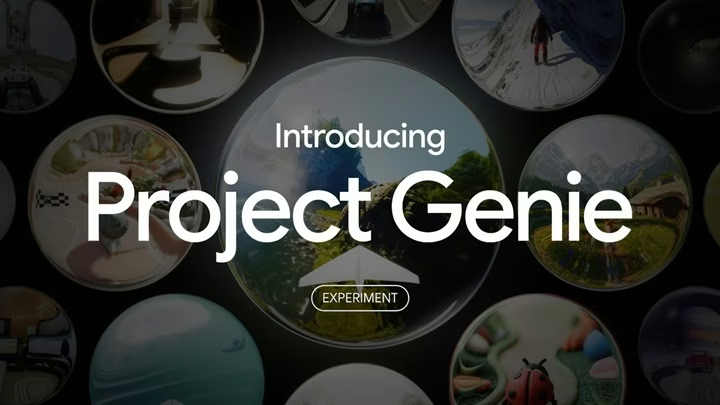
When Project Genie first surfaced earlier this year, I thought it was a neat experimental tech demo. It could generate simple 2D or basic 3D platforming spaces based on text prompts. But this new upgrade shifts the entire paradigm by grounding the AI in real-world data maps.
The system is powered by Google’s advanced Nano Banana Pro generative models, and the workflow is shockingly seamless:
- Drop a Pin: You select a location on the map (the feature is currently rolling out across the US first).
- Apply a Prompt Theme: You type in an environmental filter. Want your street buried under miles of apocalyptic desert sand? Done. Want to turn your downtown area into a prehistoric Stone Age jungle? Just type it in.
- Design Your Avatar: You can drop a custom character into the scene—whether it’s a sleek cyberpunk hero or a bizarre creature made of clay.
- Take the Controls: Project Genie ingests the Street View imagery, synthesizes it with your thematic prompt, and renders a playable mini-world that you can explore using standard WASD keys in either first-person or third-person perspective.
Seeing a familiar corner store seamlessly reskinned with alien architecture while maintaining its exact physical proportions is one of the most surreal tech demos I have seen in a very long time.
The Technical Reality Check: Heavy Compute & Gated Access


As incredible as this sounds, I always like to look under the hood and address the infrastructure constraints. Rendering a fully interactive, walkable 3D environment on the fly from flat photographic data is a monumental computational nightmare.
To keep the simulation running smoothly at a playable 20 to 24 FPS (Frames Per Second), Google’s cloud servers have to process, interpolate, and generate hundreds of contextual visual assets simultaneously every single second. The sheer amount of raw server power required for this is astronomical.
Because of this intense compute load, Google is keeping the keys to Project Genie heavily guarded for now:
The Catch: The Street View integration is strictly limited to AI Ultra subscribers. Furthermore, your generated gaming sessions are currently capped at 60-second intervals.
While a one-minute limit might sound frustratingly brief, experiencing a hyper-personalized, dynamically generated digital twin of a real location for even 60 seconds is a massive proof of concept. It gives us a clear look at where interactive entertainment is going over the next decade.
My Take: The End of Static Level Design
As someone deeply fascinated by the intersection of AI, gaming, and the evolution of the Metaverse, I think Project Genie represents a massive turning point. We are moving away from traditional, static game engines where developers have to manually code every single asset, wall, and texture.
We are entering an era of ambient, procedural world generation. Imagine future open-world games where, instead of exploring a fictional city designed by a studio, the game engine simply streams your actual city and turns it into the map. The lines between our physical reality and our digital playgrounds are completely evaporating.
Even with the current 60-second limit and the subscription paywall, the underlying infrastructure is set. Once cloud computing costs drop and these models become more optimized, the gaming landscape will never be the same.
So, I have to ask you: If you could load up Project Genie right now, what is the very first real-world location you would choose to alter, and what crazy theme would you throw on top of it? Let me know in the comments below!
You Might Also Like;
- Google Unveils Pics: The Canva Killer Built Directly into Workspace
- Turning Your Real Neighborhood Into a Video Game
- Android Halo: Tracking AI Agents in Real Time
-

-
-

-

-

-

-

-

-

-
-

-