
I still can’t believe what I just read. Hollywood isn’t just making movies anymore; they are literally raising the dead with AI.
When I first found out that the legendary Val Kilmer was being digitally cloned for the new movie As Deep as the Grave, my jaw completely dropped. I had to sit back, refresh the page, and make sure I wasn’t reading some elaborate sci-fi fan fiction. I mean, sure, the family gave their official permission, and the legal teams have everything signed in ink, but I can’t stop thinking about how inherently creepy this entire concept is.
I am seriously wondering if the future of cinema will just be digital ghosts instead of real, living, breathing actors. As someone who spends hours every day diving into the latest tech and metaverse developments, I honestly find this both incredibly fascinating and completely terrifying. Let’s really break down what is happening behind the scenes, why studios are pushing for this, and what it means for the movies we love.
The Evolution of the Digital Clone

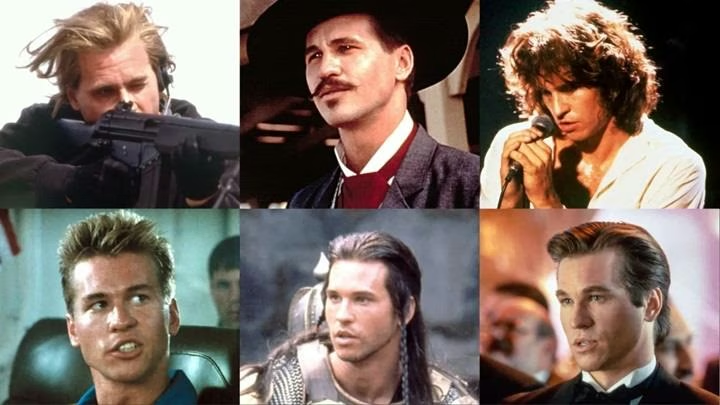
We need to clear something up right away: this is not just advanced CGI. For years, we’ve seen Hollywood use digital de-aging or body doubles to finish a film when tragedy strikes mid-production. But what I am looking at now is an entirely different beast. We have crossed the line from visual effects into generative AI resurrection.
When I researched the tech stack being used for these new projects, I was blown away by the sheer computational power involved. Studios are no longer just mapping a 3D face onto a stunt double. They are feeding decades of a human being’s life into neural networks.
The Mechanics Behind the Magic
Here is what goes into creating a modern “Digital Ghost”:
- Volumetric Facial Mapping: AI doesn’t just copy a face; it learns it. Algorithms scan thousands of hours of old footage to understand exactly how an actor’s specific muscles moved, how their eyes reacted to different lighting, and the exact asymmetry of their smile.
- Neural Voice Synthesis: Audio models are trained on past interviews, movie dialogue, and even outtakes. The AI learns the exact timbre, breathing patterns, and emotional inflection of the actor. We saw a touching, early version of this with Val Kilmer in Top Gun: Maverick, but the technology I am seeing now has leaped lightyears ahead.
- Behavioral Emulation: This is the part that gives me chills. The newest algorithms attempt to predict how an actor would deliver a line they never actually read, mimicking their unique artistic choices and mannerisms.
As a tech enthusiast, I have to applaud the raw engineering behind this. It is a modern miracle of data processing. But as a guy who loves going to the movies? It makes my stomach tie in knots.
The Ethical Tightrope: Who Owns a Legacy?


The loudest argument defenders of this technology use is consent. For As Deep as the Grave, Val Kilmer’s estate signed off. They gave the green light, and they are compensated for it.
But I keep asking myself: does legal permission automatically make it artistically ethical?
When a human actor delivers a performance, they are making hundreds of micro-decisions based on their lived experience, their mood that morning, and the unscripted chemistry they share with their co-stars. A digital clone doesn’t feel any of that. It just computes the most statistically probable facial expression based on a dataset.
Are We Buying Tickets for a Parlor Trick?
If I go to the theater to watch a digitally cloned legend, what am I actually paying for?
- Pure Nostalgia Bait: Am I just being emotionally manipulated by my love for an actor’s past work?
- A Technical Showcase: Am I marveling at the AI rendering rather than actually engaging with the emotional core of the story?
- The Erasure of New Talent: This is my absolute biggest fear.
Why would a major movie studio take a multi-million dollar financial risk on an unknown, rising actor when they can just license the digital likeness of a proven box-office legend? Think about it from a corporate perspective: a digital ghost never ages, never demands a bigger trailer, never gets involved in a PR scandal, and never goes on strike.
This isn’t a sci-fi hypothetical anymore. When I followed the recent SAG-AFTRA strikes, this exact nightmare scenario was at the heart of the protests. Actors were literally fighting on the picket lines for the right to own their own faces.
The Metaverse Connection: Immortal IP

Since we talk about the Metaverse a lot here, I can’t ignore how this AI cloning tech ties into virtual worlds. We are standing on the edge of a massive paradigm shift in how entertainment IP is handled.
I can easily imagine a future—maybe only five or ten years from now—where you put on a VR headset and act alongside a digitally resurrected Marlon Brando, Marilyn Monroe, or Heath Ledger in a fully interactive metaverse environment.
The companies that own the rights to these digital likenesses are going to make an absolute fortune licensing these AI ghosts out for:
- Immersive VR Video Games
- Interactive Digital Movies
- Virtual Brand Ambassadors The potential for monetization is endless. But while the business model is brilliant, the cultural impact feels a bit hollow. We are turning human beings into software updates.
Finding Our Bearings in the Uncanny Valley
I am genuinely torn. Part of me is eager to see As Deep as the Grave just to witness the sheer capability of this technology on the big screen. I want to see if the AI can actually make me feel genuine emotion, or if I’ll just feel like I’m staring at a highly rendered video game character pretending to be a Hollywood legend.
But the other part of me feels like we are opening Pandora’s Box. Once mainstream audiences accept digital ghosts as leading men and women, the film industry will never be the same.
I love the beautiful, messy unpredictability of human acting. I love seeing an actor make a strange, weird choice that no algorithm could ever predict. I love the happy accidents that happen on a chaotic movie set. AI can perfectly mimic the past, but I am not convinced it can create the raw, emotional lightning in a bottle that makes true cinematic magic.
I’ve been reading the early reactions online, and the internet is completely split down the middle. Some people are calling it a beautiful, touching tribute to immortalize our favorite stars, while others are calling it straight-up digital necromancy.
I will be reading all the comments because I really need to know which side to choose in this technological revolution!
So, be honest with me: If your absolute favorite actor passed away tomorrow, would you buy a ticket to see their AI clone star in a brand-new movie, or should we let sleeping legends lie?
You Might Also Like;
- Samsung Enters the Robotics Arms Race: Inside the New RX Unit
- The Danger of AI Confidence: Why We Are More Wrong Than Ever
- The Hidden Threat Above Us: Are We Facing a Nuclear Arms Race in Space?
-

-

-
-
-
-
-
-

-
-
-
-

