I was digging through some recent aerospace reports this morning, and I stumbled across something that honestly made me do a double-take. We spend decades trying to figure out how to prevent disasters in space, yet NASA is now gearing up to intentionally start a fire on the Moon.
It sounds like the plot of a sci-fi thriller, but it’s actually one of the most critical steps we need to take before establishing a permanent human presence off-world. Let me break down why the upcoming Flammability of Materials on the Moon (FM2) mission is a massive game-changer, and why the physics of it are more intense than you might think.
Why Play with Fire on the Moon?

When I first read about this, my immediate thought was, “Why take the risk?” But the truth is, the Moon is a completely alien environment when it comes to fundamental physics, and we have a glaring blind spot in our safety data.
To understand why this is so important, we have to look at how fire behaves differently depending on where you are in the universe:
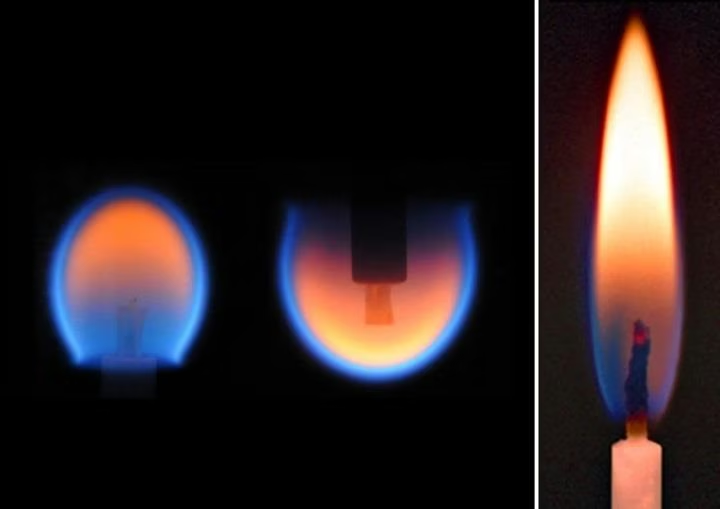
- Earthly Flames: Down here, fire behaves predictably. Hot gases are lighter, so they rise rapidly, while cold, dense air sinks. This constant cycling feeds oxygen into the fire, creating that classic, flickering teardrop shape we all know.
- Microgravity Flames: Aboard the International Space Station, things get weird. Without gravity to drive convection (that rising and sinking of air), a flame doesn’t point upward. It turns into a slow-burning, eerie blue sphere that starves itself of oxygen much faster.
- Lunar Flames: This is the great unknown. The Moon has about 1/6th of Earth’s gravity. It’s not zero, but it’s far from normal. How does a flame act when it’s caught right in the middle? That’s what we are finally going to find out.
The FM2 Mission: Lighting the Match

The FM2 mission is going to be humanity’s first controlled combustion experiment in a partial-gravity environment. They aren’t just lighting a campfire in the dust, obviously.
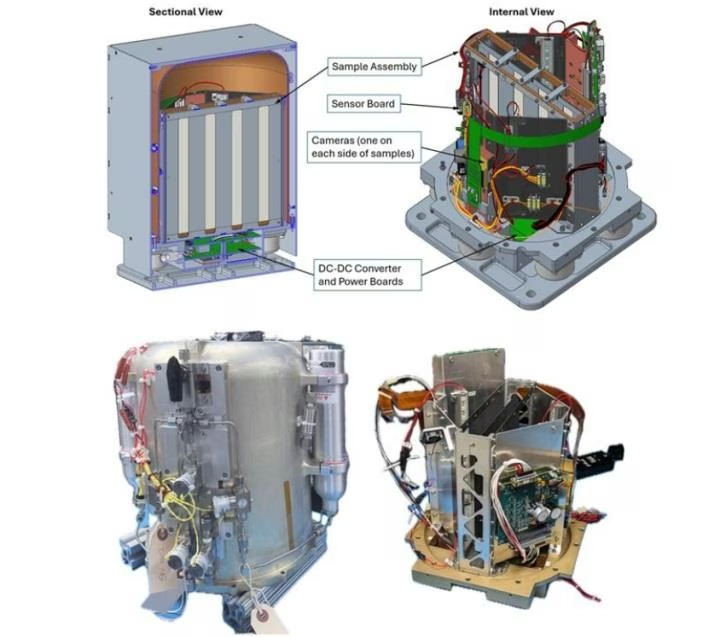
NASA is sending up four specific solid fuel samples. Once on the lunar surface, these will be ignited inside a highly controlled, automated chamber. High-speed cameras and sensors will track the flame’s spread rate, its shape, and its overall thermal behavior over an extended period.
The Terrifying Physics of Partial Gravity
Here is the part that genuinely spooked me while I was researching: lunar gravity might actually make fires more dangerous than they are on Earth.
According to the FM2 project reports and current numerical models, the precise level of gravity on the Moon might hit a terrifying “sweet spot.” It creates just enough convection to pull fresh oxygen into the fire and keep it alive, but not enough to dissipate the heat quickly. Researchers are warning that flame spread rates could actually peak in lunar gravity environments. Imagine a fire that spreads faster and burns hotter just because the gravity is perfectly wrong.
Artemis and the Real-World Stakes

I look at this and immediately think about the Artemis missions. We aren’t just planting flags and taking photos anymore; we are actively designing habitats and next-generation spacesuits for long-term stays.
For decades, NASA has relied on the NASA-STD-6001B standard for testing material flammability. The problem? Almost all of those tests were based on microgravity data or Earth-based simulations. We have been designing lunar gear with a massive gap in our knowledge. If a fire breaks out inside a lunar module, astronauts won’t have time to consult a physics textbook. They need materials engineered specifically to resist lunar-gravity combustion.
Long-term, NASA engineers want to conduct material tests directly on the lunar surface with actual human crews present. But until we have a permanent base, these robotic, automated tests are our best line of defense.
The Devil is in the Details
For me, this mission is a brilliant reminder that conquering the cosmos isn’t just about massive rockets and orbital mechanics. It’s about re-learning the most basic elements of human survival. Fire kept our ancestors alive in caves, but on the Moon, it could be our biggest unseen enemy. We have to learn to tame it all over again.
So, I have to ask you: knowing that something as simple as a spark could behave completely unpredictably, how comfortable would you feel sleeping in a pressurized lunar base? Drop your thoughts below—I really want to know if I’m the only one slightly terrified by the idea of lunar fire!
You Might Also Like;
- Microsoft Copilot Drops the Flashy Colors for a Serious New Look
- The Four-Armed Helios Robot is Rewriting the Rules of Space Exploration
- Apple Glass Leaks Reveal the Master Plan to Dethrone Meta Ray-Ban
-
-

-

-
-
-
-
-

-
-

-
-