Have you ever felt like time was playing tricks on you? Sometimes an hour feels like a minute, and a minute can feel like an agonizing hour. While that’s just our human perception, I’ve recently stumbled upon something that completely broke my brain—and it’s not science fiction.
If you know me, you know I can talk for hours about movies like Interstellar and the mind-bending realities of black holes and time dilation. The idea that time is flexible, bending around gravity and speed, is fascinating. But physicists are now taking this a massive step further. I was diving into a recent paper published in Physical Review Letters, and it poses a question that sounds like it belongs in The Matrix: What if time itself has a quantum nature?
Could time literally flow at two different speeds at the exact same moment?
Let’s unpack this together, because if these scientists are right, everything we thought we knew about the universe is about to get an incredible update.
The Clash of Two Titans: Relativity vs. Quantum Mechanics

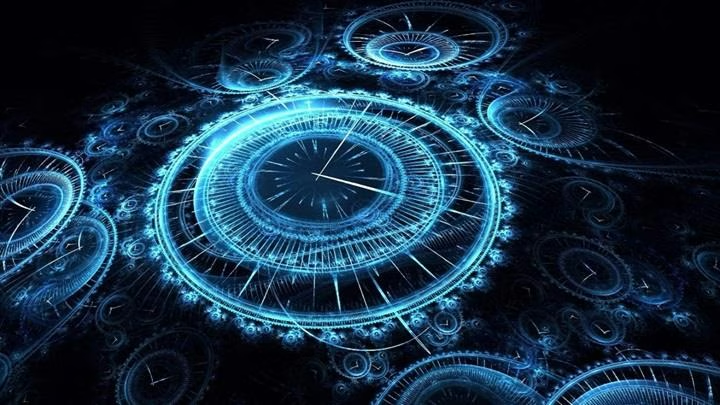
To really grasp how wild this new research is, we need to look at the two absolute heavyweights of modern physics, which honestly, hate playing nice with each other.
- Einstein’s General Relativity: This is the physics of the massive. Planets, stars, black holes. Einstein taught us that time is not a constant ticking clock in the background of the universe. It’s relative. If you move incredibly fast, or if you are near a massive gravitational pull, time slows down for you compared to someone standing still. We’ve proven this with classic atomic clocks—it’s an undeniable fact of our reality.
- Quantum Mechanics: This is the physics of the microscopic. Atoms, electrons, photons. Down here, the rules are pure chaos. Particles can instantly teleport (quantum tunneling), they can be mysteriously linked across the universe (entanglement), and most importantly for our topic, they can exist in multiple states at once. We call this superposition.
So, here is the million-dollar question I kept asking myself while reading this study: If the fundamental building blocks of our entire universe follow these crazy quantum rules, why wouldn’t time itself follow them too?
Schrödinger’s… Time?

We’ve all heard of Schrödinger’s cat—the famous thought experiment where a cat in a box is simultaneously alive and dead until you open it and look.
Now, imagine applying that exact same logic to the flow of time.
The research team—led by theoretical physicist Igor Pikovski at the Stevens Institute of Technology, alongside experimental teams directed by Christian Sanner (Colorado State University) and Dietrich Leibfried (NIST)—is suggesting exactly this. They are proposing a concept I can only describe as a “quantum time superposition.”
If a highly advanced clock is subject to quantum rules, its physical movement and state can exist in a superposition. Therefore, the time it measures could theoretically flow at different rates simultaneously.
- Imagine a clock moving at 10 meters per second. According to relativity, it will lose about 1 second every 57 million years compared to a stationary clock.
- Now, imagine that clock is in a quantum superposition, meaning it is both moving and stationary at the exact same time.
- The mind-blowing result: The clock experiences two distinct timelines, measuring two different flows of time at once.
We used to think of the “Twin Paradox” (where one twin travels to space and comes back younger) as the ultimate time anomaly. But this new “Quantum Twin Paradox” suggests a single entity could experience multiple aging processes simultaneously. It’s absolutely wild to think about.
The Hardware: How Do We Actually Test This?


I know what you are thinking: “This sounds great on paper, Ugu, but how on earth do you test something so abstract?”
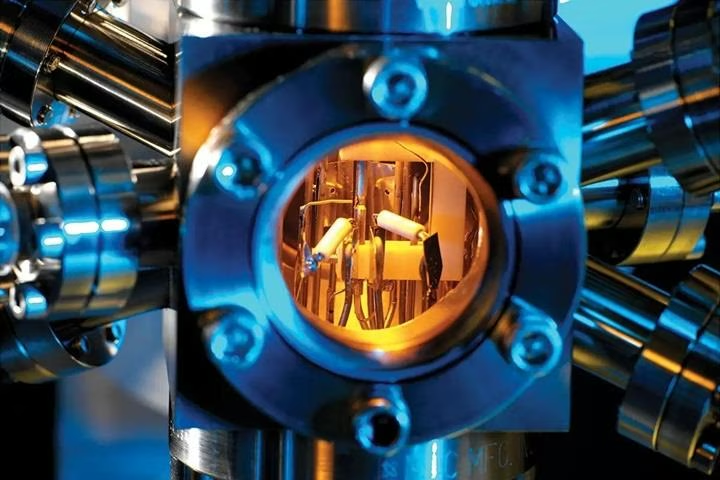
This is where my inner tech geek gets really excited. We aren’t talking about stopwatches here; we are talking about the most sophisticated machines humanity has ever built: Trapped-Ion Atomic Clocks.
These devices are the cousins of the hardware running modern quantum computers. Here is how they pull it off:
- The Trap: Scientists use complex electromagnetic fields to trap individual ions (usually aluminum or ytterbium).
- The Big Chill: They cool these trapped ions down to temperatures hovering just a fraction of a degree above absolute zero. We are talking about the coldest environments in the known universe, right there in the lab.
- Laser Precision: Once the ions are nearly frozen in place, they use highly calibrated lasers to manipulate and measure their quantum states.
According to the research team, these trapped-ion atomic clocks have become so absurdly precise that they can detect the microscopic time dilation caused by the mere thermal vibration of atoms at absolute zero. Even when the atoms are as still as the laws of physics allow, quantum fluctuations still affect the flow of time.
Squeezing the Vacuum

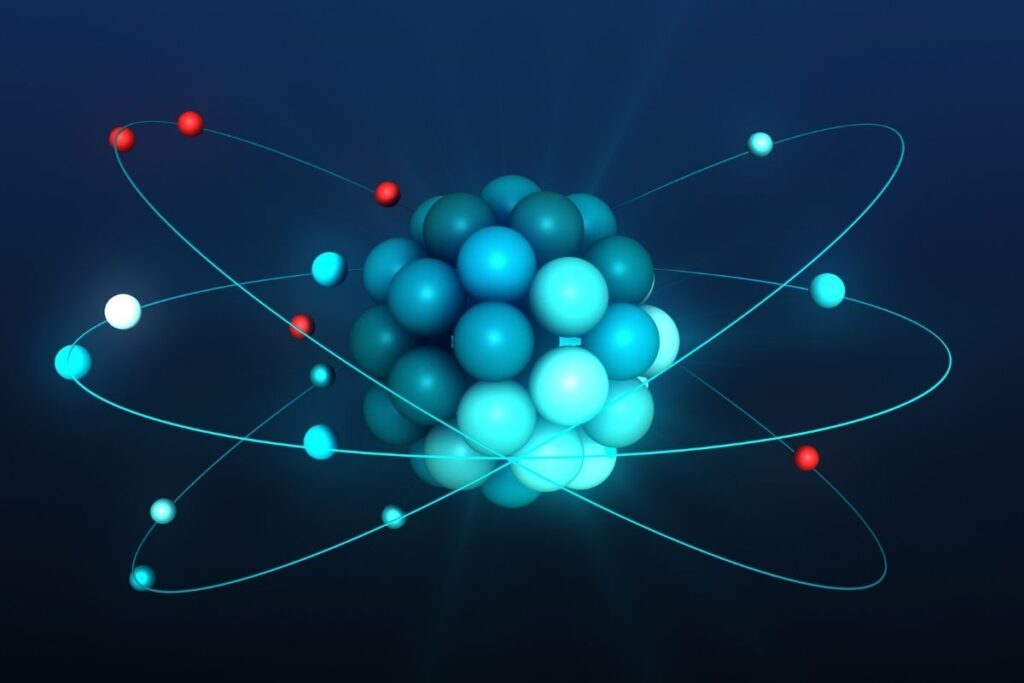
Just building a hyper-accurate clock isn’t enough to catch time acting like a quantum particle. The team is proposing a next-level technique that sounds like pure magic: manipulating the quantum vacuum itself.
Instead of just cooling the atoms down, they plan to create what physicists call “squeezed states.” By manipulating the empty space around the clock, they can force the clock’s position and movement to exhibit highly pronounced, exaggerated quantum properties.
If they can successfully “squeeze” the state of the atomic clock, a single clock could theoretically measure its own time flowing at different speeds and even become quantumly entangled with its own movement. Christian Sanner noted that the technology to create these squeezed states already exists, and there is a clear roadmap to upgrading ion clocks to the required sensitivity.
Why This Changes Everything
I love digging into these complex topics because they remind us of how little we actually know about the reality we live in.
For nearly a century, the holy grail of physics has been the Theory of Everything—finding a way to bridge the gap between Einstein’s relativity and quantum mechanics. The biggest roadblock has always been time. Relativity treats time as a smooth, bendable fabric. Quantum mechanics treats time as a rigid, ticking metronome in the background.
If Pikovski and his team can experimentally prove that time itself can exist in a quantum superposition, it could be the key to finally merging these two worlds. It wouldn’t just change textbooks; it would change our fundamental understanding of existence.
It makes me wonder about the distant future. If we can manipulate the quantum nature of time on a microscopic level today, what kind of macroscopic technologies might the “Spartans” of the future be building centuries from now? Quantum time-drives? I wouldn’t rule anything out.
I’m going to be following this experiment very closely as the NIST teams begin their physical trials, and I’ll keep you all updated on the progress right here.
What do you guys think? Does the idea that time might be an illusion acting on quantum rules mess with your head as much as it does mine? Drop your thoughts in the comments below—I’d love to hear your theories!
You Might Also Like;
- Extracting Memories After Death: Sci-Fi Dream or Imminent Reality?
- The Unsolved Mystery of Lightning Energy: Why We Can’t Catch It
- The Terrifying Reality of Flying Nuclear Bombers
-
-

-

-

-
-
-

-

-

-
-
-