
I’ve watched countless sci-fi movies, played dozens of space exploration games, and I’ve always wondered why Hollywood and pop culture are so relentlessly obsessed with the classic alien design. You know the one: the “little green men” with giant, pitch-black eyes. For the longest time, I thought it was just a lazy, overused stereotype.
But recently, I started digging into the actual origins of this specific cliché, and I literally got chills. It turns out, this whole image didn’t just pop out of a movie director’s imagination to sell comic books. It actually started with our early, terrifyingly logical scientific theories about Mars.
Let me take you on a journey into how hard astrobiology created the most famous pop-culture monster in human history.
The Martian Survival Blueprint

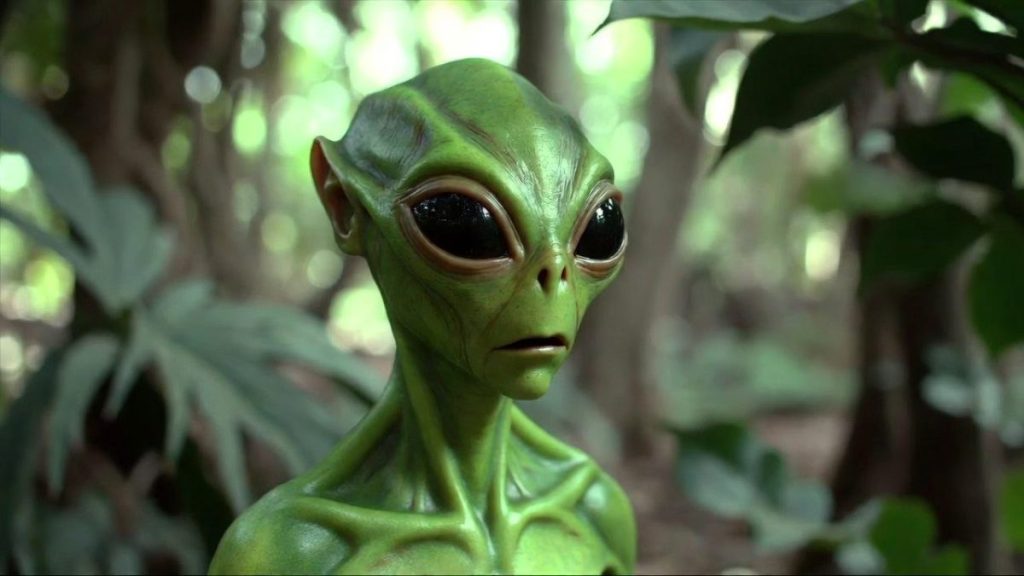
When early scientists, astronomers, and theorists looked at Mars through their telescopes, they didn’t just see a dead, rusty rock. They saw a harsh, extreme environment and actively tried to figure out how life could possibly adapt and survive there.
Mars is a toxic landscape. Its atmosphere is incredibly thin and composed of about 95% carbon dioxide. For us humans, taking a breath on Mars is a quick death sentence. But for plant life? That atmospheric makeup is basically an all-you-can-eat buffet.
This realization led to some wild, yet biologically grounded, theories about what a Martian animal would look like.
Breathing CO2: The Photosynthetic Alien
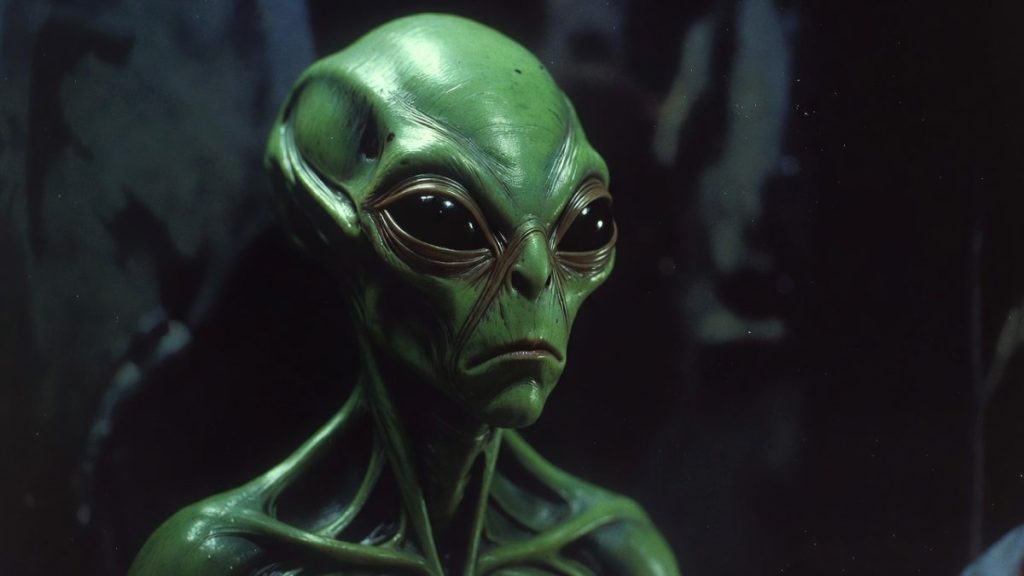
I found out that because of this heavy CO2 atmosphere, early theorists believed that any mobile creatures evolving on Mars would have to rely on photosynthesis just to survive the harsh conditions and the severe scarcity of traditional food sources.
Here is how that biological leap works:
- Chlorophyll Dependence: To process massive amounts of ambient carbon dioxide and convert it into usable energy, these creatures would need chlorophyll, just like the plants in our backyards.
- Symbiotic Evolution: Imagine an evolutionary path where an animal essentially merges with plant biology. (Fun fact: We actually have a creature on Earth that does this! The Elysia chlorotica, or solar-powered sea slug, steals chloroplasts from algae to photosynthesize).
- The Green Hue: This means a Martian creature’s skin wouldn’t be pale, grey, or brown. It would be a vibrant, highly functional green. They literally use their skin to “eat” the Martian air and sunlight. The green isn’t cosmetic; it’s a vital survival mechanism.
The Void Stare: Evolving for the Shadows
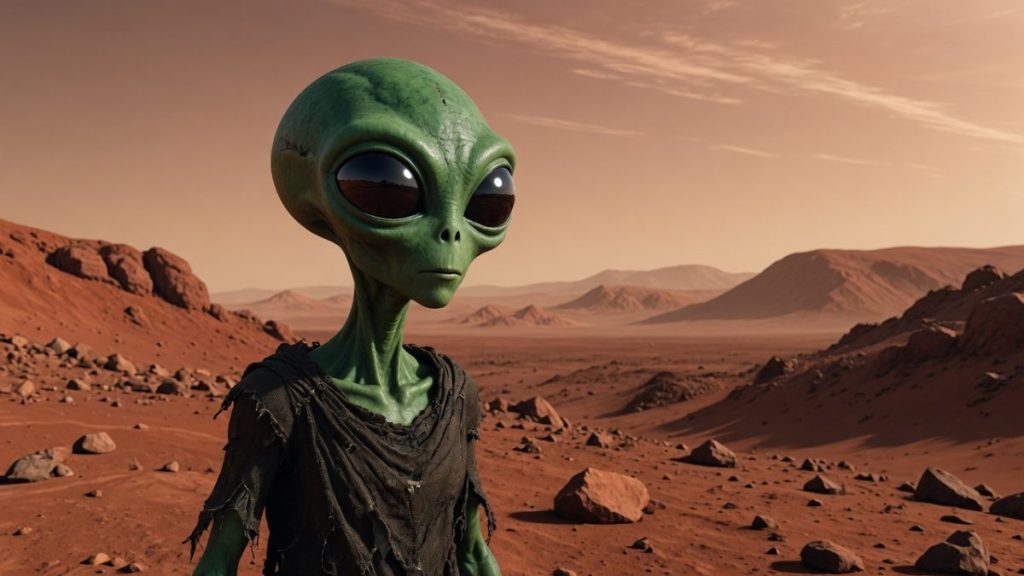
Okay, so that explains the green skin. But what about those enormous, empty, jet-black eyes that stare right through your soul in every UFO documentary? This is the part of my research that absolutely blew my mind.
- The Solar Distance: Mars is significantly farther from the sun than Earth is. Because of this distance, it receives only a fraction of the sunlight we do. A bright day on Mars looks like a dim, cloudy twilight here on Earth.
- Extreme Pupil Dilation: If you are a creature trying to hunt, navigate, or just avoid predators in a perpetual, shadowy twilight, evolution is going to force a massive physiological change. The eyes of a Martian creature would need to evolve to capture every single stray photon of light available.
- Pitch-Black Appearance: Over millions of years of evolution, their pupils would dilate to cover almost the entire visible surface of the eye. Those aren’t empty voids or sunglasses; they are highly advanced, hyper-sensitive biological lenses designed to see in near-total darkness. We see the exact same evolutionary trait on Earth with deep-sea creatures like the giant squid!
How Science Became a Spooky Cliché
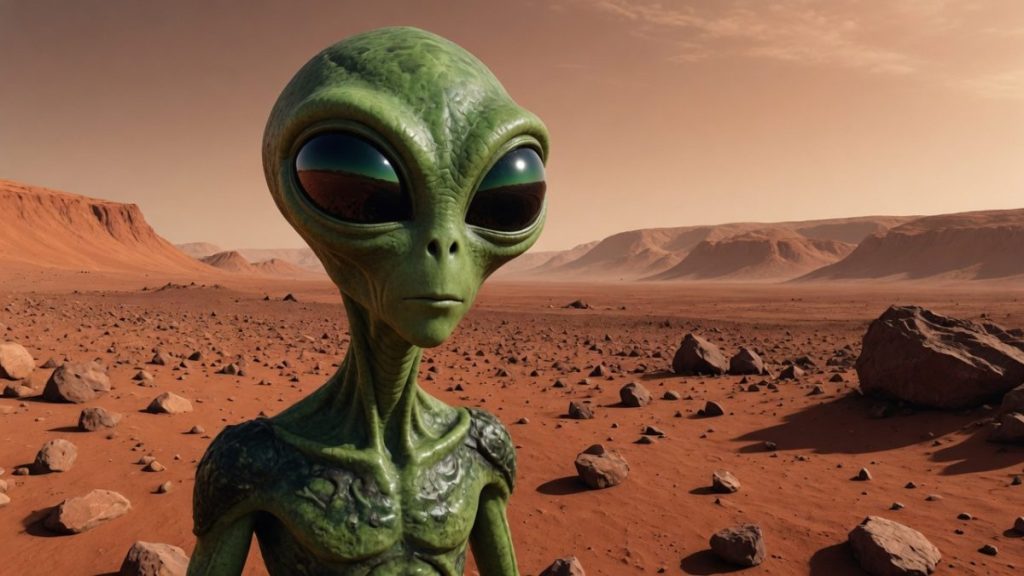
I think it is absolutely fascinating—and a little bit sad—how a brilliant theory of extreme survival morphed into a spooky pop-culture trope.
Somewhere along the way, the pulp science fiction magazines of the 1920s and 30s took these hard scientific theories and plastered them on their covers to sell dime novels. Then came the Roswell crash rumors in 1947, the classic B-movie UFO thrillers of the 1950s, and suddenly, the scientifically accurate “little green man” became a universal joke.
We completely forgot that the original concept was rooted in genuine astrobiology. It was our very first real attempt to map out convergent evolution on another planet!
Why This Matters for Modern Astrobiology
While we now know that there aren’t little green men running around the surface of Mars, these early theories are actually more relevant today than ever before.
As we look deeper into the universe with telescopes like James Webb, we are discovering thousands of exoplanets. Many of the most promising, potentially habitable planets are orbiting Red Dwarf stars (like TRAPPIST-1).
- Red dwarfs are incredibly dim.
- Any life evolving on planets around them would absolutely need massive, hyper-dilated black eyes to see.
- If their atmospheres are rich in CO2, they might just be green, photosynthetic hybrids.
Looking back at it, those early scientists were incredibly visionary. They looked at a hostile, dim, CO2-choked world and imagined life that adapted perfectly to those exact parameters.
So, the next time you see a classic alien emoji 👽 or watch an old sci-fi flick, don’t just see a little green monster. See an evolutionary masterpiece of photosynthesis and low-light adaptation. It makes the universe feel a lot more real, and a lot more wild.
I can’t stop thinking about the billions of exoplanets sitting in the habitable zones of distant, dim stars right now.
Do you believe there is a planet out there in the deep universe where this exact evolutionary survival story actually happened?
You Might Also Like;
- The New Era of Space Mechanics: Extending Satellite Lifespans
- AI Discovers Groundbreaking Non-Opioid Painkiller
- Mind Over Matter: What Neuralink’s First Human Trial Really Means for Our Future
-
-
-

-

-
-
-

-
-
-

-
-

