I’ve been tracking space exploration for a long time, but every now and then, NASA drops a piece of media that just makes me drop whatever I’m doing and stare at the screen. This week, it was a mesmerizing timelapse of Mars, courtesy of the Psyche spacecraft.
But here is the fascinating part: Psyche wasn’t sent to explore Mars. The Red Planet was just a pit stop—a very strategic one—on a much longer, far weirder journey deep into our solar system. When I watched the footage, I realized this wasn’t just another pretty space video; it’s a masterclass in cosmic navigation and a perfect test run for one of the most exciting missions of this decade.
Let’s break down exactly what we are looking at, why this spacecraft was flying past Mars in the first place, and what it means for the future of space exploration.
The Cosmic Slingshot: Why Psyche Visited Mars

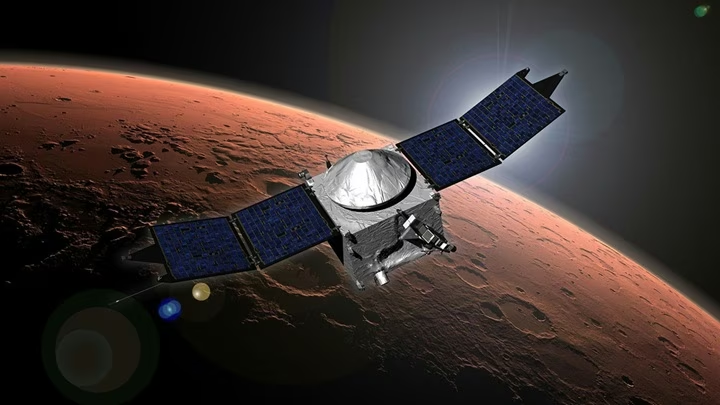
If you want to travel deep into the solar system, you have two options: pack an impossible amount of heavy rocket fuel, or use the planets themselves to pull you along. NASA went with the latter.
The Psyche spacecraft is currently on a multi-year journey to a very specific destination: the Psyche asteroid, a massive, metal-rich rock floating in the main asteroid belt between Mars and Jupiter. To get there efficiently, the spacecraft executed a gravity assist maneuver around Mars in May.
By flying incredibly close to the Red Planet, the spacecraft allowed Mars’ immense gravitational pull to grab it, swing it around, and slingshot it out the other side. This maneuver did two crucial things:
- Increased Speed: It gave the spacecraft a massive velocity boost without burning precious onboard propellants.
- Altered Trajectory: It perfectly aligned Psyche’s flight path to intercept its final asteroid target.
Space travel is essentially a game of high-stakes cosmic billiards, and this was a perfect trick shot.
What the Timelapse Reveals

While Psyche was busy stealing some momentum from Mars, its onboard multispectral imaging system went to work. The team at NASA stitched together thousands of individual frames captured during the flyby to create a stunning timelapse.
Here is what really caught my eye in the footage:
- The Crescent Approach: Because of the angle of the sun, Mars first appears as a razor-thin, glowing crescent. It’s an incredibly rare and haunting perspective that we don’t often see from standard orbiters.
- Surface Details: As the spacecraft zoomed closer (reaching its closest point on May 15), the deep craters, canyons, and dusty plains of the Martian surface came into sharp focus.
- The Frozen South Pole: As Psyche accelerated away, it looked back to capture the bright, ice-covered southern polar region of the planet, standing out in stark contrast to the red dust.
Jim Bell, the principal investigator for the Psyche imaging system at Arizona State University, confirmed that the cameras performed flawlessly. As someone who appreciates the hardware side of tech, hearing that an instrument survived the harshness of deep space and worked exactly as designed is always a massive win.
Hunting for Hidden Moons
There is a brilliant secondary reason NASA turned the cameras on during this flyby. Aside from looking at Mars, the research team actively scanned the area and successfully captured distant images of Mars’ two tiny moons: Phobos and Deimos.
Why does this matter? Because they were practicing.
When Psyche finally arrives at its namesake metal asteroid in 2029, there is a chance the giant rock might have its own tiny, undiscovered moons orbiting it. By successfully spotting and tracking Phobos and Deimos from a distance, the team essentially proved that their software, cameras, and tracking methods are ready to hunt for hidden satellites in deep space.
My Take: Preparing for the Main Event
Looking at this Mars footage, I can’t help but feel a sense of anticipation. This flyby was just the warm-up act.
The actual Psyche asteroid is thought to be the exposed metallic core of an early planet—a planet that was shattered by violent collisions in the early days of our solar system. By studying it, we aren’t just looking at a rock; we are looking at the bare heart of a world, something we could never do with Earth since our core is buried thousands of miles beneath our feet.
Furthermore, as we look toward a future where asteroid mining transitions from science fiction to reality, understanding the composition and structure of metal-rich bodies like this is going to be incredibly valuable. The tech being tested here paves the way for the orbital industries of tomorrow.
We have a long wait until 2029, but if the rehearsal looks this good, the main event is going to be spectacular.
I’m curious to hear your thoughts on this: Does the idea of exploring—and potentially one day mining—massive metallic asteroids excite you, or do you think we should focus our resources on terraforming planets like Mars first? Drop your perspective in the comments below!
You Might Also Like;
- Samsung Enters the Robotics Arms Race: Inside the New RX Unit
- The Danger of AI Confidence: Why We Are More Wrong Than Ever
- The Hidden Threat Above Us: Are We Facing a Nuclear Arms Race in Space?
-
-

-

-
-

-
-

-
-

-
-
-