I’ve always looked up at the night sky and imagined a future filled with lunar bases, Mars colonies, and endless discovery. For years, the new space race felt like a thrilling competition of innovation. But after reading a deeply unsettling warning from renowned physicist and nuclear security expert Laura Grego, I realized I’ve been ignoring a much darker reality unfolding right above our heads.
Major global powers aren’t just exploring space anymore; they are actively transforming it into the ultimate military high ground. With thousands of satellites now in Low Earth Orbit (LEO) managing everything from our daily communications to critical military targeting, the stakes have never been higher. Let me break down why the militarization of space is something we all need to be paying close attention to right now.
The Nightmare Scenario: Orbital Nuclear Weapons

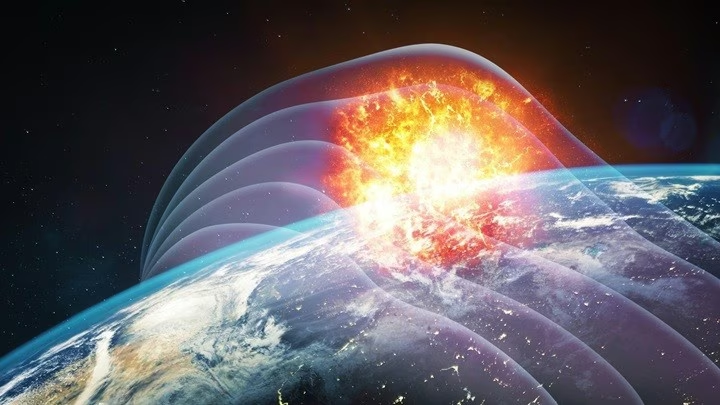
What really sent a shiver down my spine was Grego’s focus on the rumored space-based Anti-Satellite (ASAT) systems. If you follow international intelligence reports, you might have caught the claims that Russia is developing a nuclear system designed to be stationed in orbit and detonated in space if necessary.
If these claims hold any truth, it completely shatters the fragile peace we’ve maintained above the atmosphere. While international law doesn’t ban all military activity in space, the longstanding Outer Space Treaty strictly prohibits placing nuclear weapons or weapons of mass destruction in Earth’s orbit.
Crossing this red line wouldn’t just be a political statement; it would be the installation of a literal doomsday device suspended over our planet.
The Domino Effect of a Space Detonation

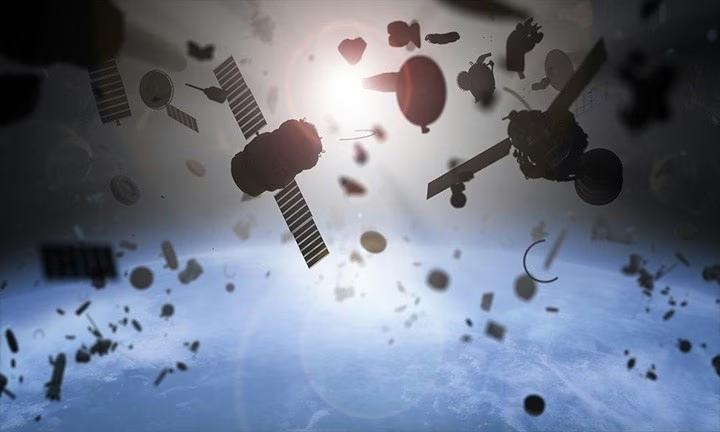
You might be thinking, “If a nuke goes off in space, at least there’s no shockwave to destroy cities, right?” True, but the reality is just as catastrophic for modern civilization. Grego points out that a nuclear detonation in space would trigger a devastating chain reaction.
Here is exactly what would happen:
- Instant Electronic Wipeout: The blast would release massive amounts of X-rays and gamma rays, creating immense Electromagnetic Pulses (EMPs). This would instantly fry the delicate electronic systems of any satellite within the line of sight.
- Radiation Trapping: A high-altitude detonation would inject a massive amount of high-energy particles into the Van Allen radiation belts that surround Earth. Since LEO satellites constantly pass through these belts, this artificial radiation spike would rapidly degrade their hardware and drastically shorten their lifespans.
- Indiscriminate Destruction: This is the most critical point. Space doesn’t care about borders. A blast like this wouldn’t just take out enemy military assets; it would indiscriminately destroy friendly, neutral, and commercial satellites alike.
Think about your daily life. GPS navigation, global banking, weather forecasting, and internet routing all rely on this infrastructure. We are completely dependent on these invisible floating servers.
A Stark Lesson from the Past
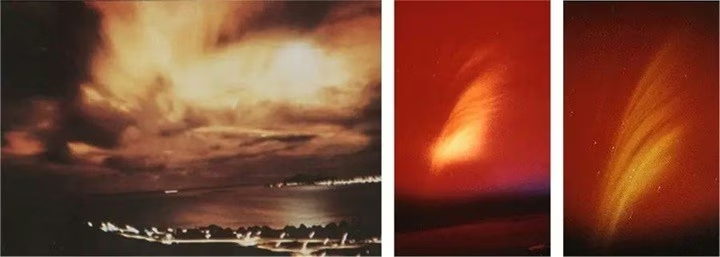
To understand the sheer scale of this threat, we have to look back at the Starfish Prime test conducted by the US military in the early 1960s. They detonated a 1.4-megaton nuclear bomb about 400 kilometers above the Pacific Ocean.
The result? Out of the roughly 24 satellites in orbit at the time, eight were damaged or destroyed by the resulting radiation.
Now, let’s fast forward to today. We don’t have two dozen satellites up there anymore; we have nearly 7,000 active satellites in Low Earth Orbit alone, largely driven by massive mega-constellations like SpaceX’s Starlink. If a similar blast happened today, the amount of orbital infrastructure destroyed would be catastrophic.
The Unseen Risks of “Parked” Nukes

Even if a space-based nuclear weapon is never actually fired, its mere existence in orbit is a ticking time bomb.
When you park a nuclear warhead in space, you lose the ability to physically inspect it, perform routine maintenance, or easily dismantle it if something goes wrong. What happens if a piece of space debris collides with it? What if there’s an onboard technical malfunction? Or worse, what if a rogue state or hacker group launches a cyberattack on its command-and-control systems?
The variables are too high, and the environment is too hostile to safely store the most destructive weapons humanity has ever created.
While I genuinely hope the intelligence rumors remain just that—rumors—I agree with Grego: we cannot afford to ignore this possibility. The expansion of nuclear arsenals back into orbit is easily one of the most severe threats to global security we face today.
I’m curious to hear your take on this. If keeping space completely demilitarized meant slowing down the deployment of global satellite networks like Starlink, would you be willing to make that trade-off? Drop your thoughts below!
You Might Also Like;
- Samsung Enters the Robotics Arms Race: Inside the New RX Unit
- The Danger of AI Confidence: Why We Are More Wrong Than Ever
- The Hidden Threat Above Us: Are We Facing a Nuclear Arms Race in Space?
-
-

-

-
-

-

-

-
-

-

-
-