
I have spent a lot of time poring over the mind-bending images sent back by the James Webb and Hubble space telescopes, but the latest update from NASA actually gave me goosebumps. When I first read about the Nancy Grace Roman Space Telescope, I knew it was going to be a game-changer, but the recent announcement regarding its launch schedule and final testing phases just made it all feel incredibly real.
NASA has officially targeted August 30, 2026 for the launch of the Roman Space Telescope. What really surprised me while researching this update is that this date is actually about eight months earlier than the initially planned schedule. In the world of aerospace engineering—where delays are practically the norm—moving a timeline forward is a massive testament to the dedication of the teams involved.
Let’s dive deep into why I believe the Roman Space Telescope isn’t just another piece of hardware in orbit, but the missing puzzle piece in our quest to understand the universe.
Why the Roman Space Telescope Matters to Me (And Why It Should to You)

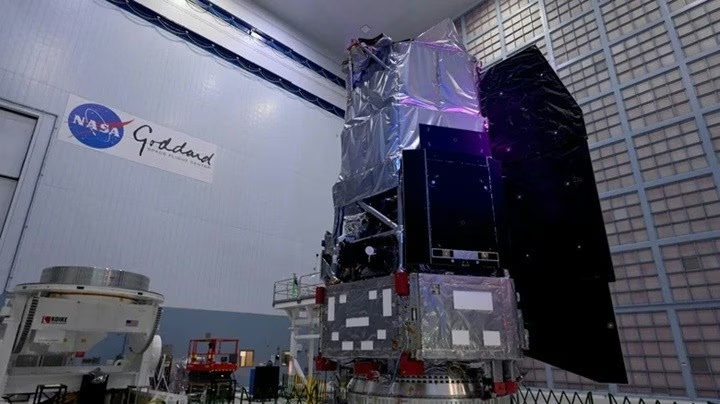
We often think of space exploration as a linear progression: we build a telescope, then we build a bigger one. But the Roman Space Telescope represents a completely different philosophy. While James Webb acts like a high-powered magnifying glass focusing intensely on specific, tiny patches of the sky, Roman is going to be our ultimate wide-angle lens.
A Panoramic Window to the Cosmos
To put things into perspective, the Roman Space Telescope will have a field of view that is roughly 100 times wider than the Hubble Space Telescope.
- The Hubble Experience: Imagine looking at a beautiful landscape through a small straw. You get incredible detail, but only of a tiny fraction of the scene.
- The Roman Experience: Now, imagine putting down the straw and looking through a massive bay window.
This means Roman can map out huge swaths of the universe in a fraction of the time it would take Hubble. For researchers, and for space enthusiasts like me, this is revolutionary. We are going to see wide-field panoramas of galaxies, stellar nurseries, and cosmic structures at a scale we’ve never witnessed before.
The Engineering Marvel: Preparing for the Final Frontier

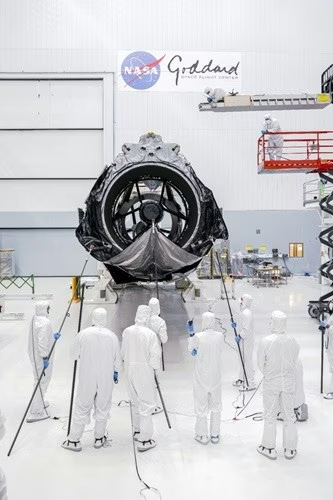
Moving a multi-billion dollar, hyper-sensitive optical instrument from a clean room to the vacuum of space is a logistics nightmare, which is why I find the testing phase so fascinating.
Surviving the “Shake, Rattle, and Roll”
Right now, the engineering teams at the Goddard Space Flight Center in Maryland have just wrapped up the critical final inspections on the telescope’s 2.3-meter primary mirror. Size-wise, this mirror is comparable to Hubble’s, but its capabilities are vastly different due to modern sensors and optics.
Before anything goes into space, it has to survive the brutal acoustics and vibrations of a rocket launch. I was thrilled to read that the recent “shake tests” (which simulate the mechanical stress of riding a SpaceX Falcon Heavy rocket) were a complete success. The optical alignment held perfectly, and the mirror remained free of any microscopic dust or contamination.
The Ultimate Road Trip
The next big step is packing up this delicate behemoth for its trip to the Kennedy Space Center in Florida.
- Specialized Transport: They don’t just put this on a standard flatbed truck. The telescope requires a custom-built, climate-controlled container with advanced shock absorbers.
- Re-Verification: Once it arrives in Florida, the engineers have to test everything all over again to ensure absolutely nothing shifted during the journey.
It takes an incredible amount of patience and precision, and honestly, I have massive respect for the engineers who carry this heavy responsibility.
Solving the Universe’s Biggest Mysteries: Dark Energy


If you ask me what excites me most about the Roman Space Telescope, it isn’t just the pretty pictures—it’s the deep, existential questions it aims to answer.
One of the primary missions of Roman is to investigate Dark Energy. We know the universe is expanding, and we know that this expansion is actually accelerating. But why? What is pushing everything apart? Dark energy makes up roughly 68% of the universe, yet it remains modern astronomy’s greatest ghost story.
Because Roman can capture such incredibly wide fields of view, it will be able to measure the distribution of galaxies across vast distances and map out the cosmic web. By analyzing how these structures have evolved over billions of years, Roman will give us the raw data needed to test our current theories about dark energy. It might just force us to rewrite the physics textbooks entirely.
The Hunt for New Earths
Beyond dark energy, Roman is going to be a powerhouse for finding exoplanets (planets outside our solar system). Using a technique called gravitational microlensing, Roman will stare at millions of stars toward the center of our Milky Way, waiting for a hidden planet’s gravity to briefly bend and magnify the light of a background star. I expect we are going to find thousands of new worlds, bringing us one step closer to answering that age-old question: Are we alone?
The Perfect Tag-Team at L2
Once it launches on that SpaceX Falcon Heavy, Roman isn’t staying in Earth’s immediate orbit. It is heading for Lagrange Point 2 (L2), located about 1.5 million kilometers away from Earth.
This is the exact same gravitational “parking spot” where the James Webb Space Telescope currently resides. This proximity is not a coincidence; it is a brilliant strategy.
- The Discoverer: Roman will act as the scout. With its massive field of view, it will quickly sweep the cosmos, identifying strange anomalies, new exoplanets, and distant galaxies.
- The Inspector: Once Roman finds something fascinating, James Webb can pivot its incredibly powerful, narrow-focused instruments to examine that specific object in microscopic detail.
Together, they are going to form the most powerful astronomical tag-team in human history.
Honoring a Legend: Who Was Nancy Grace Roman?
I think it is incredibly fitting that this observatory is named after Nancy Grace Roman. She was NASA‘s first Chief Astronomer and is widely affectionately known as the “Mother of Hubble.” Back in an era when women faced immense barriers in the sciences, she relentlessly championed the idea that astronomy needed to move beyond the blurring effects of Earth’s atmosphere. Without her vision, we might never have had the Hubble Space Telescope, and by extension, we wouldn’t be building this one. Naming this sweeping, wide-eyed telescope after her is a beautiful tribute to her legacy.
As we count down the months to August 2026, I can’t help but feel a sense of profound anticipation. We are standing on the edge of a new era of cosmic mapping.
But enough from me—I’m curious to hear your thoughts. With a telescope capable of mapping the universe 100 times faster than Hubble, what is the first cosmic mystery you hope the Roman Space Telescope solves? Let me know in the comments below!
You Might Also Like;
- The New Era of Space Mechanics: Extending Satellite Lifespans
- AI Discovers Groundbreaking Non-Opioid Painkiller
- Mind Over Matter: What Neuralink’s First Human Trial Really Means for Our Future
-
-

-

-
-
-
-

-
-

-

-

-

