“Spiderweb” Designed Floating Solar Energy System Developed

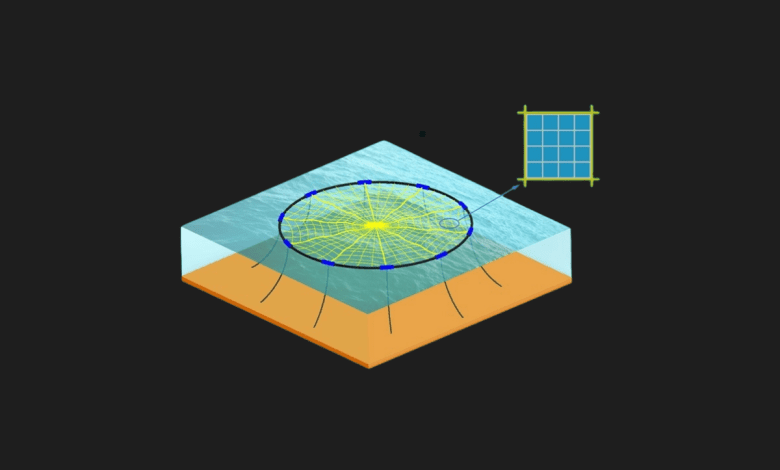

A spiderweb designed floating solar panel system, developed in the UK, enables safe and efficient energy production in the open sea by adapting to waves.
Scientists in the UK have developed a design inspired by spiderwebs for new-generation floating solar energy systems that can be installed on the sea. Researchers at the University of Strathclyde in Scotland propose a flexible web structure that supports the solar panels and can flex with the waves.
This structure, just like a spiderweb, consists of flexible ropes in both spiral and radial patterns, allowing the panels to stand securely in the open sea. The system is found suitable particularly for installation in spiral and radial arrangements or between offshore wind turbines.
Both Flexible and Durable
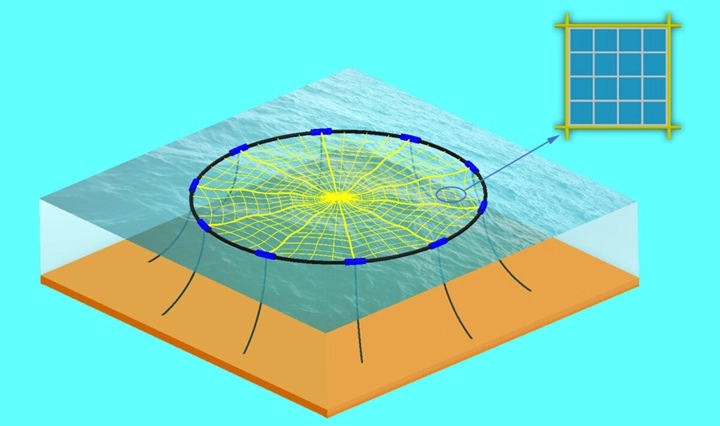
The researchers used the Morison model and Riflex simulations to test the design’s durability in marine conditions. The modular system can be tested in different configurations, ranging from $1\times 1$ to $3\times 3$, with panels of various sizes. Each panel is $2$ meters long and wide, $0.8$ meters high, with a $1$ meter gap left between the panels. The system flexes according to wave directions and sizes, preventing the panels from breaking.
Flexible ropes are used as load-bearing components in the system. This design allows the panels to move along with the waves. Thus, sudden pressures on the ropes and panels are prevented, resulting in a much more durable structure in offshore conditions. The system, thanks to its modular structure, can be scaled from small installations of a few megawatts to large projects at the gigawatt level. Additionally, a secondary design allows the web structure to be placed between wind turbines for added support.
You Might Also Like;
- The Dark Side of Nanotechnology: Could Microscopic Swarms Erase Billions?
- The Illusion of Digital Immortality: Are You Really Uploading Your Mind?
- The View That Changes Everything: Artemis 2’s Deep Space Eclipse