Scientists Announce New Nanogenerator Producing Electricity from Vibration


Scientists have introduced a new silicon triboelectric generator that generates electricity by passing water through small pores. The technology could reduce the need for batteries in small devices.
A European-based research team has produced a new triboelectric generator that could reduce battery usage in small devices. A joint effort of DESY and Hamburg University of Technology, this system converts the friction created by water passing through nanoscopic pores into electricity. The team’s goal is to create a maintenance-free power source using basic materials like silicon and water.
Electricity from Water and Silicon
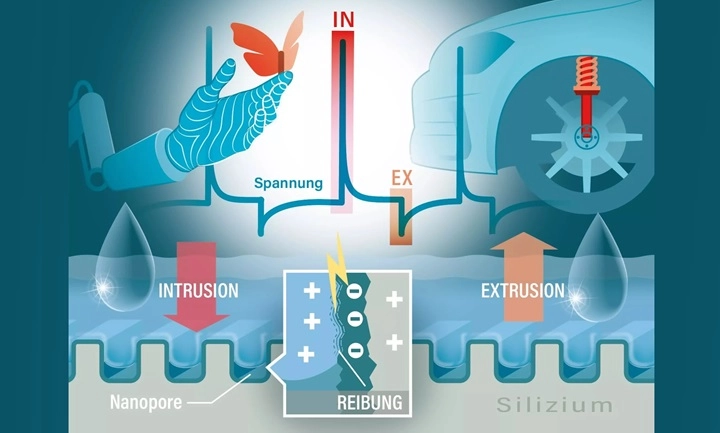
At the center of the device is a silicon structure processed with nanometer-sized pores that conducts electricity and repels water. Thanks to this structure, the entry and exit speeds of water into the pore network are controlled, and the triboelectric effect is revealed in a stable manner.
When water is pushed into the pores and withdrawn, the contact between the liquid and the solid surface creates a charge. The device converts this charge into usable electricity without losing it. The research team says they have reached a conversion efficiency of approximately 9 percent. This figure is quite high for triboelectric systems and allows it to approach real usage scenarios in low-power electronics. Let us also mention that it could be an important alternative for battery-free sensor systems.
Could Be an Alternative for Small Devices
Likewise, it will be able to work by generating its own energy in environments that constantly produce pressure, movement, or vibration, such as water sensing, sports tracking, smart textiles, or robotic touch sensors.
For example, it may be possible to generate electricity from vibrations occurring in vehicle suspension systems, and this energy could power sensors monitoring tire, brake, or road conditions. One of the remarkable aspects of this work is the use of abundant and cheap-to-produce silicon and water instead of advanced materials. This situation could facilitate the widespread use of the technology and reduce its cost.


You Might Also Like;