Spartans, I was diving deep into the latest Google I/O announcements this week, and while everyone was distracted by the flashy new video generation tools, one specific update completely grabbed my attention. If you are tired of getting lost in dozens of browser tabs, hunting down expired discount codes, or spending hours researching if two tech components are actually compatible, everything is about to change.
Google just unveiled Universal Cart and Agentic Commerce, powered by their most advanced Gemini models. This isn’t just another digital shopping basket; it is a highly intelligent, proactive shopping assistant that tracks prices, checks hardware compatibility, and can even execute purchases on your behalf using a strictly controlled budget. Let’s break down why this is a massive leap forward for e-commerce.
The End of the Multi-Tab Nightmare
Picture this familiar scenario: You spot a fresh pair of sneakers on Google Search, you see a friend’s recommended t-shirt while chatting with Gemini, you notice an amazing gaming headset while watching a tech review on YouTube, and a promotional email drops into your Gmail. In the past, you had to visit four different websites, create multiple accounts, and manage four separate shopping carts.
That chaotic fragmentation is officially dead.
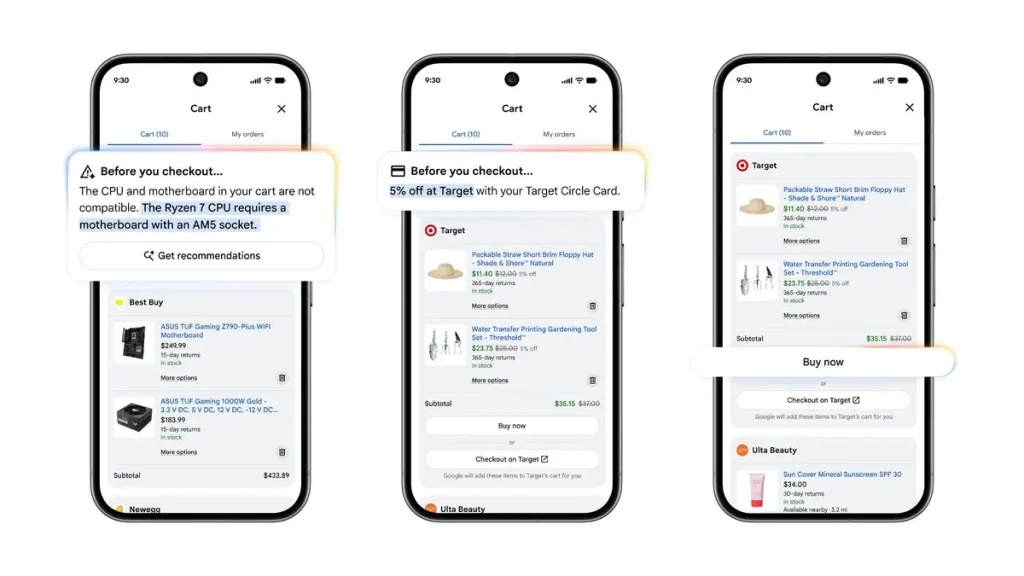
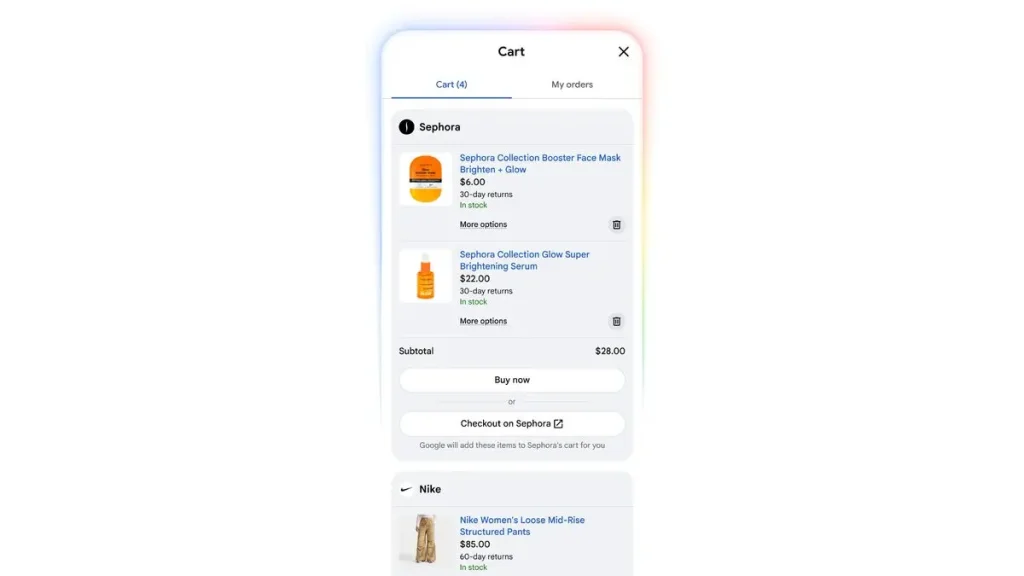
With the Universal Cart, you now have a single, unified basket that follows you quietly in the background across the entire internet. The moment you drop an item into this cart, the AI goes to work. It silently:
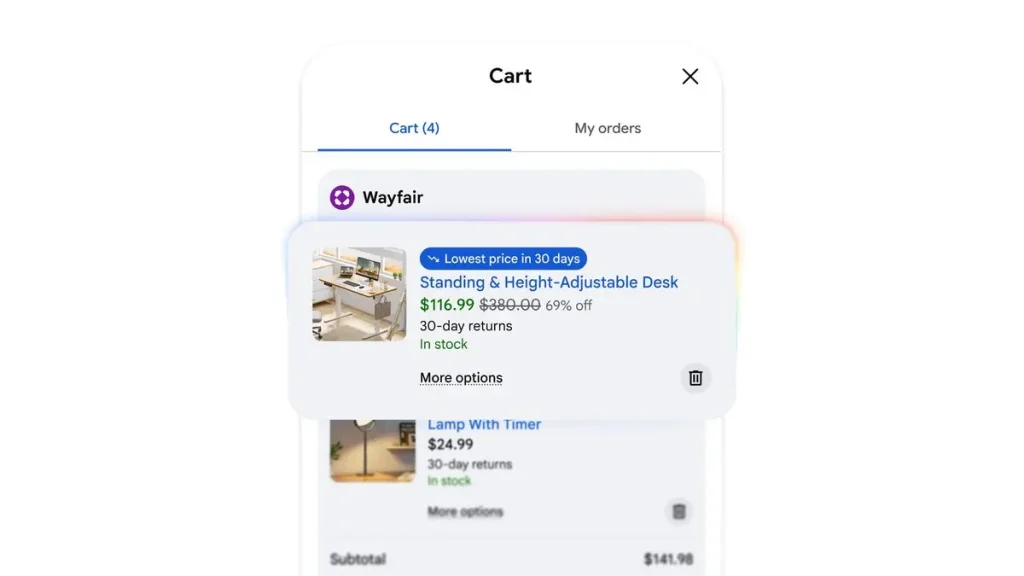
- Hunts for the best deals and sudden price drops across the web.
- Analyzes historical pricing data to tell you if you are actually getting a good deal.
- Sends instant stock alerts the second a sold-out item is available again.
Agentic Commerce: An AI That Actually Thinks
What makes this system genuinely revolutionary is its reasoning capability. It doesn’t just hold items; it analyzes them.


Let’s say you are building your first custom desktop PC. You are pulling parts from various retailers and tossing them into your Universal Cart. Instantly, Gemini will step in and warn you: “Hey, the processor you selected is not compatible with that motherboard. Here are three alternatives that will actually work.” It completely eliminates the costly mistakes that happen when buying complex tech.
Furthermore, it seamlessly integrates with Google Wallet. Even if you forget about the air miles, loyalty points, or specific bank campaigns tied to your credit cards, the AI doesn’t. It automatically calculates the best possible payment method to maximize your rewards and discounts.
Setting Budgets for AI: The Agent Payments Protocol (AP2)
Now, let’s talk about the most futuristic—and for some, the most terrifying—part of this announcement.
Imagine finding a highly sought-after pair of sneakers, but they are currently way out of your budget. Soon, you will be able to tell your AI agent: “The moment the price of these shoes drops below $100, buy them for me immediately.”
Dealing with payment security protocols daily, the idea of giving an AI autonomous access to a credit card initially sets off major alarm bells for me. However, Google built the Agent Payments Protocol (AP2) specifically to address this.
You aren’t just handing Gemini an open checkbook. AP2 allows you to set incredibly strict, unbreachable parameters. The AI can only execute a payment if your exact criteria for the brand, specific product, and maximum budget are met perfectly. The entire transaction leaves a fully encrypted, immutable digital footprint between you, the merchant, and the payment processor. The fear of waking up to unauthorized charges is effectively engineered out of the system. We will see this secure purchasing infrastructure roll out first with Gemini Spark in the coming months.
When Can We Actually Use It?
The heavy hitters are already on board. Global retail giants like Nike, Sephora, Target, Walmart, and independent brands powered by Shopify have lined up to support this ecosystem.
Google is kicking off tests for the Universal Cart in the US this summer across Search and the Gemini app, with YouTube and Gmail integrations following closely behind. And they aren’t stopping at retail; the roadmap includes expanding to the UK, Australia, and Canada, while pushing into complex bookings like hotel reservations and food delivery.
We are rapidly approaching a reality where we no longer actually “shop.” We simply declare what we want, and the AI handles the logistics.
So, I have to ask you: Are you comfortable handing over your credit card limits to an AI like Gemini to catch those midnight price drops, or do you prefer to click that final “Buy Now” button yourself? Let’s debate this down in the comments!
You Might Also Like;