
I’ve always looked at the stars and wondered just how much we’re missing simply because we don’t have enough eyes on the sky. Well, it turns out the “eyes” were there all along—they were just buried under mountains of data.
For 35 years, the Hubble Space Telescope has been snapping photos of the cosmos, creating one of the wealthiest archives in human history. But here’s the catch: there is so much data that human astronomers couldn’t possibly look at every single frame. Enter AnomalyMatch, a custom-built AI that just did the impossible. It scanned Hubble’s entire 35-year archive in just two and a half days.
To put that in perspective, if I sat down to do that manually, I’d probably need several lifetimes and a lot of caffeine.
What Did the AI Actually Find?
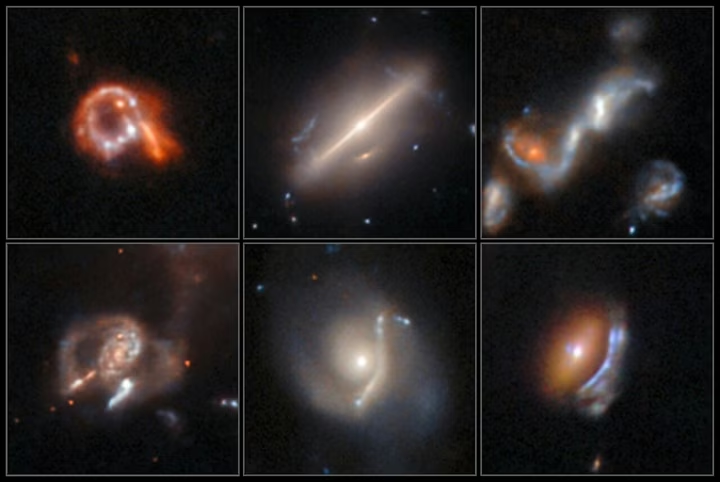
The results, published in Astronomy & Astrophysics, are nothing short of a cosmic goldmine. Researchers David O’Ryan and Pablo Gómez from the European Space Agency (ESA) trained this system to spot things that “don’t look right”—the anomalies.
The AI flagged over 1,300 rare cosmic objects, including:
- 138 Gravitational Lenses: These are places where gravity literally warps space-time, acting like a natural magnifying glass for the distant universe.
- 417 Galaxy Mergers: Giant celestial collisions that I find both terrifying and beautiful.
- 18 “Jellyfish” Galaxies: These are galaxies with long “tentacles” of gas trailing behind them.
- Protoplanetary Disks: Shapes that look like butterflies or even hamburgers, which are basically the nurseries of future planets.
The 65% Mystery: Science’s New Frontier
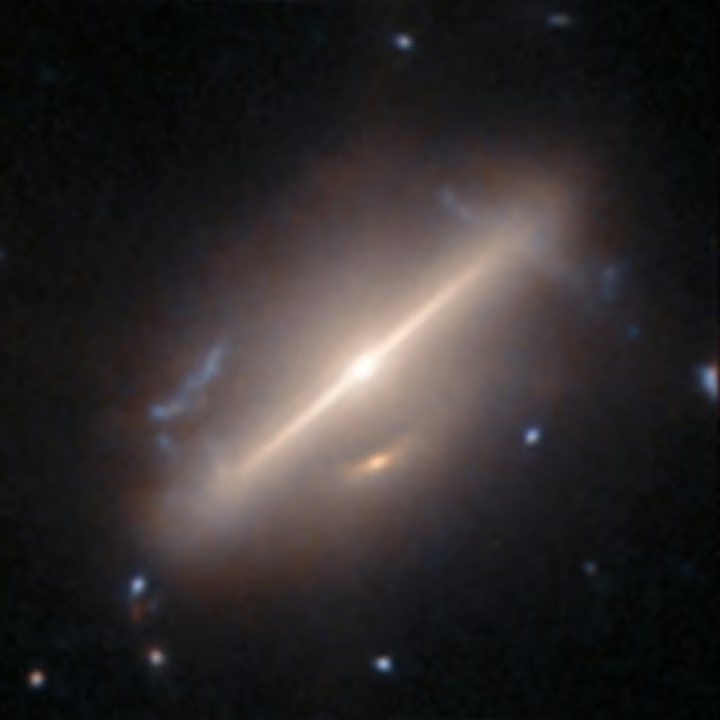
The part that really gave me goosebumps? About 65% of these anomalies don’t fit into any existing scientific database. We aren’t just finding more of what we already know; we are finding things we can’t even name yet.

I’ve always felt that the “Data Crisis” in astronomy was our biggest hurdle. We have the telescopes to see the universe, but we didn’t have the “brainpower” to process it all. David O’Ryan hit the nail on the head when he called the Hubble archive a “treasure waiting to be discovered.” AI isn’t replacing the astronomer here; it’s acting like a high-speed metal detector on a vast beach, pointing out where the gold is buried so the humans can start digging.
Why This Matters for the Future

This isn’t just a one-time win for Hubble. This is a roadmap for the next decade of space exploration. With the Euclid mission already scanning billions of galaxies, and the Vera C. Rubin Observatory set to dump 50 petabytes of data on us soon, we need AI like AnomalyMatch more than ever.
By the time the Nancy Grace Roman Space Telescope launches (hopefully by 2027), we won’t be looking for needles in haystacks anymore. We’ll have AI “magnets” pulling the needles out automatically.
It makes me realize that the “Final Frontier” isn’t just out there in the stars—it’s also inside our hard drives, waiting for the right algorithm to wake it up.
If AI starts identifying objects that defy all our current laws of physics, do you think we should trust the machine’s “eyes” immediately, or should we remain skeptical until a human can verify it?
You Might Also Like;