Hydrogen Combustion: The Engine That Finally Rivals Diesel


I spend a lot of time analyzing the shift toward electric vehicles, but whenever the conversation turns to heavy-duty trucks and commercial transport, I always hit a wall. Batteries are incredibly heavy, and asking a massive commercial truck to sacrifice payload capacity for a giant battery pack just doesn’t make economic sense for most logistics companies.
That’s why I’ve been keeping a close eye on hydrogen. Most of the time, when we talk about hydrogen, we are talking about fuel cells. But researchers at the Southwest Research Institute (SwRI) in the US have just pulled off something entirely different—and honestly, much cooler. They’ve developed a hydrogen internal combustion engine (H2-ICE) that actually matches the low-end torque of traditional diesel engines.
Instead of throwing out a century of mechanical engineering, they found a way to make traditional pistons work with a zero-carbon fuel. Here is a deep dive into how they did it and why I think this could be a massive lifeline for the internal combustion engine.
It Is Combustion, Not a Fuel Cell
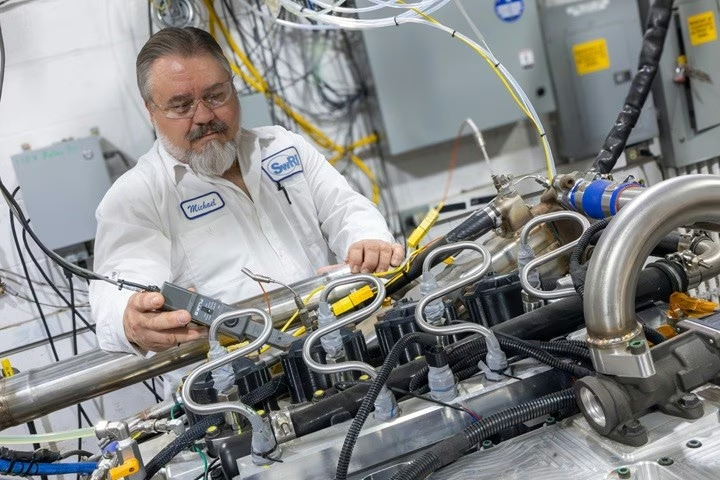
When I first read the technical breakdown of the SwRI project, the immediate standout was the architecture. This isn’t a delicate fuel cell system that converts hydrogen into electricity to drive a motor.
This is old-school mechanical power, completely reimagined.
- Direct Injection: Just like a traditional gas or diesel engine, the hydrogen is injected directly into the cylinders.
- Piston Power: The gas is ignited, creating an explosion that drives the pistons down, generating mechanical force.
The engineering team started their testing on a single-cylinder engine to perfectly optimize the combustion and injection strategies. Once they nailed the physics, they scaled it up to a multi-cylinder setup to tackle the real-world headaches like combustion stability and system synchronization.


Solving the “Torque” Problem
If you’ve ever driven a diesel vehicle, you know it’s all about low-end torque—that immediate pulling power you need to get a heavy load moving. Hydrogen burns very differently than diesel, which initially made hitting those high torque numbers incredibly difficult.
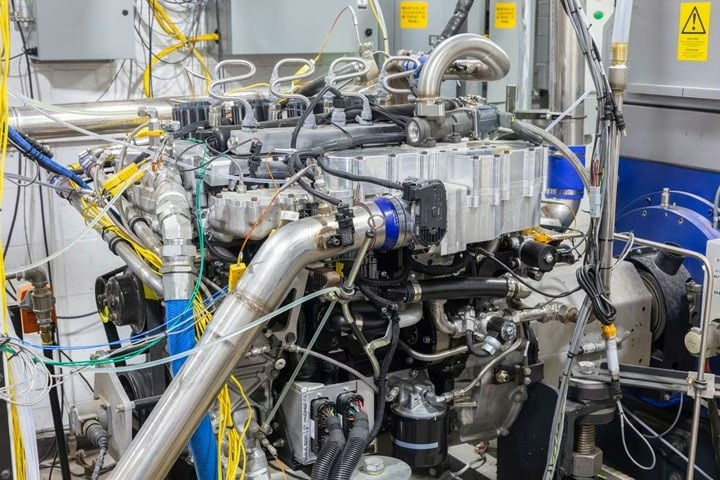
To solve this, the SwRI team engineered a custom turbocharging system. By forcing a massive amount of dense air into the engine, they could inject and burn a significantly larger volume of hydrogen per cycle. But they couldn’t just use standard parts. Hydrogen burns much faster than gasoline or diesel, meaning the airflow had to be entirely redesigned. They developed a unique intake port geometry, larger intake valves, and highly specialized hydrogen injectors to guarantee the air-fuel mixture was perfect before ignition.
Everything is managed by a heavily calibrated electronic control system that monitors injection timing, turbo pressure, and spark delivery in real-time.
The Pre-Ignition Hurdle
Of course, burning hydrogen in a metal box isn’t without its dangers. Because hydrogen is so highly reactive, I wasn’t surprised to see that pre-ignition was one of their biggest headaches.
- The Threat: If a surface inside the engine gets too hot, or if residual exhaust gases linger in the cylinder, the hydrogen can explode before the spark plug even fires.
- The Consequence: This causes severe engine knock, massive power loss, and can literally tear the engine apart from the inside.
The SwRI engineers had to meticulously design their thermal management and software control systems to mitigate this risk, allowing them to harness hydrogen’s insanely fast burn rate without blowing the block to pieces.
A Look at the Specs: H2-ICE vs Traditional Diesel
To give you a clearer picture of how this stacks up, I put together a quick comparison based on the engineering parameters of this new tech versus standard commercial diesel.
Let’s Be Real About the Emissions
I want to be completely transparent here—this engine is not a magic, 100% pollution-free silver bullet.
Yes, burning hydrogen produces almost zero CO2 at the tailpipe, which is incredible. But, because the combustion temperatures are so high, the nitrogen and oxygen in the air react to create Nitrogen Oxides (NOx). It still requires exhaust after-treatment systems to scrub those pollutants before they hit the atmosphere.
Furthermore, we have to look at the fuel source. If this engine runs on “gray hydrogen” (which is produced using natural gas), the overall carbon footprint is still massive. The only way this technology actually saves the planet is if we scale up “green hydrogen” production using solar, wind, or nuclear power.
Seeing brilliant minds adapt internal combustion rather than abandoning it entirely gives me a lot of hope for the commercial transport sector. It proves that the old ways can still learn some cutting-edge new tricks.
What do you guys think? Is retrofitting internal combustion engines to burn hydrogen the smartest way to save the trucking industry, or should we just bite the bullet and wait for solid-state batteries to get lighter? Drop your thoughts down below!
You Might Also Like;