
Regenerative braking, often cited as the biggest shortcoming of electric bicycles, may finally be resolved thanks to this smart and simple solution. Here is the clever innovation developed by the company CHARGE.
A smart and simple solution has been developed to enable regenerative braking, a feature long missing from most e-bikes.
The most common motor type in electric bicycles is hub motors placed in the center of the wheel. It has long been accepted that e-bikes cannot perform regenerative braking. In reality, they can, but this usually requires heavy and inefficient direct drive motors. Major manufacturers have largely avoided these motors for years. Today, almost all brands use smaller, lighter motors with freewheeling gears. This allows electric bicycles to coast freely like normal bicycles.
Because of this freewheeling structure, the motor cannot be driven in the reverse direction by the wheel, making regenerative braking impossible. Theoretically, a controlled clutch system could be designed to solve this, but until now, no one had managed to put such a system into mass production in a way that is both simple and low-cost.
Moving the Brake Disc Inside the Motor
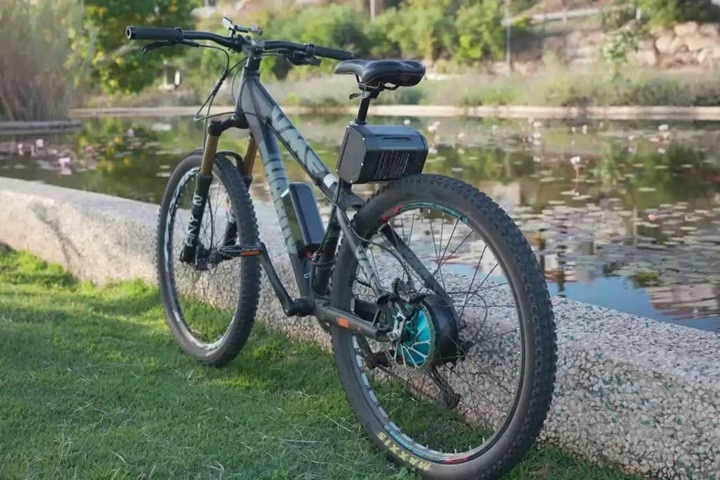
The solution that sets the startup CHARGE apart lies in a very simple modification. Traditionally, brake disc rotors are fixed to the outer casing of the motor. CHARGE, however, attaches the disk rotor to the carrier plate holding the planetary gears inside the motor. This requires a small design change in the motor casing, but it is quite easy to adapt for production. The brake system itself is preserved exactly as is. When the rider squeezes the brake, the pads grip the disk in the familiar way. However, this time, the slowing of the disk rotor forces the internal mechanism of the motor to spin. Thus, the motor switches to generator mode, slowing the bike down while simultaneously generating electricity. In short, the disk rotor takes on the role of a “driver-controlled clutch,” which has been missing for a long time.
The motor controller remains in constant communication with the motor. The harder the driver squeezes the brake, the more the system increases the regenerative braking. The small amount of slip between the disk rotor and the pads becomes the main element determining the applied regenerative braking power.


Another clever detail is this: Since the disk rotor is now connected to the gears, the motor can directly detect the rotation speed of the rotor. If the rotor approaches slowing down or locking up, the system interprets this as a request for “more braking” and increases the regenerative braking power. This prevents the rotor from locking up completely. Moreover, all of this is done using the speed sensors already found in every hub motor, so no extra sensors are needed.
Brake Pads Do Not Wear Out
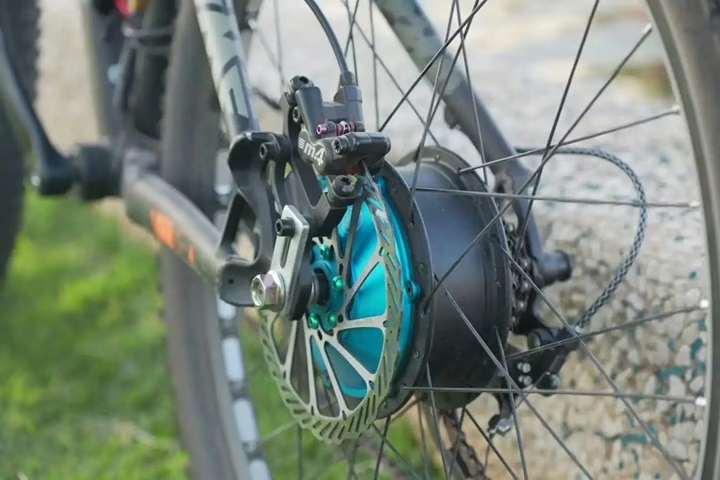
In this system, the brake pads barely wear out. This is because the pads essentially squeeze the disk lightly not to stop the bike via friction, but to send a braking command to the motor. The motor undertakes the actual work of slowing down. The pads only perform classic friction braking when the battery is completely full and regenerative braking is not possible. This is a situation rarely experienced, usually only at the very beginning of a ride. The most interesting part is that Alon Goldman, the CHARGE engineer who found this solution, had never ridden an e-bike before developing the idea. Approaching the problem with an outsider’s perspective perhaps led him to a solution so simple yet effective that no one had thought of it for years. Changing the way the disk brake connects to the wheel has made regenerative braking, which was called impossible for years, a reality.
With this solution, it becomes possible to bring regenerative braking to the vast majority of geared hub motor e-bikes currently in use. The only thing required is a small mechanical modification and CHARGE‘s smart control software.
Up to 30% Energy Savings
Regenerative braking is standard in almost all electric vehicles, from cars to trains. In electric bicycles, however, it has been ignored until now on the grounds that the range gain would be low. However, even in city riding, 5–10% extra range can be achieved. On long descents, this rate can rise to 20–30%. Additionally, less brake pad wear and lower maintenance requirements are significant advantages.
So, will we see this technology used in new electric bicycles soon? Since it does not bring huge costs to manufacturers and provides significant advantages, it is quite possible that we will see this technology in future electric bicycles. The brand that adopts this could gain a serious advantage in terms of both technical capability and marketing.
You Might Also Like;