

NASA’s SPHEREx telescope has completed the universe’s first unique cosmic map by scanning the entire sky in 102 distinct infrared wavelengths. The telescope revealed the 3D distribution of galaxies.
Following its launch in March 2025, NASA’s SPHEREx telescope completed the first infrared map of the entire sky in 102 color wavelengths. These wavelengths, which are invisible to the human eye, represent rays that are commonly found throughout the universe.
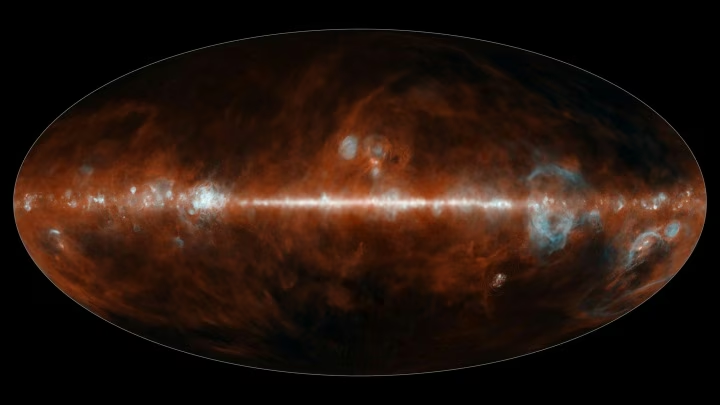
Observing the entire sky in this manner will help scientists understand how dramatic events in the universe’s first moments, right after the Big Bang, affected the 3D distribution of hundreds of millions of galaxies. Additionally, SPHEREx data offers the opportunity to study the nearly 14-billion-year evolution of galaxies and discover the distribution of life’s building blocks within our own galaxy.
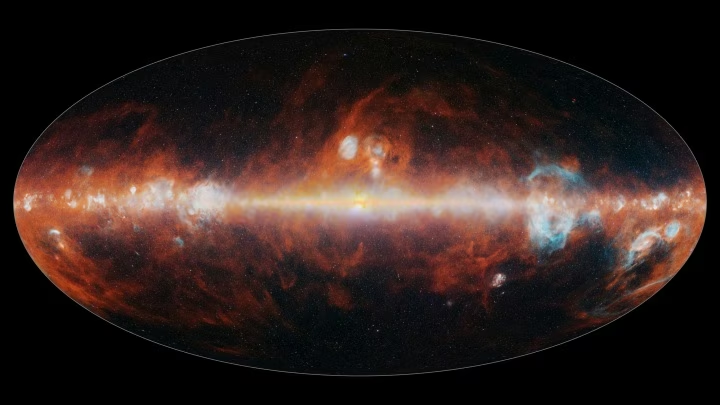
First Map Recorded SPHEREx is a spacecraft that orbits from the North Pole to the South Pole approximately 14.5 times a day. Every day, it captures 3,600 images along a single circular strip in the sky and constantly updates its field of view based on Earth’s movement around the Sun. At the end of this six-month process, the telescope looked in all directions of the sky, creating a comprehensive 360-degree map.
The mission, managed by NASA, began operations in May and completed the first all-sky mosaic map by December 2025. During its two-year primary mission, SPHEREx will perform three additional all-sky scans, and these will be combined to further increase the precision of the measurements. The collected data will be accessible to both scientists and the public.
Observation Has Never Been This Detailed The power of SPHEREx distinguishes it from previous all-sky mapping missions. Missions like NASA’s Wide-field Infrared Survey Explorer also scanned the entire sky but could not do so in as many color wavelengths as SPHEREx. Although the James Webb Space Telescope can perform spectroscopy in many more wavelengths, its field of view is thousands of times smaller than SPHEREx’s. This color diversity and wide field of view make SPHEREx unique.


The telescope achieves this success through a combination of six detectors, each equipped with 17-color special filters. Consequently, every image taken contains 102 colors, meaning each sky map actually represents 102 separate maps. SPHEREx will use these colors to measure distances to hundreds of millions of galaxies. While the positions of most of these galaxies were previously mapped in two dimensions, SPHEREx’s data will allow the subtle differences in the universe’s galaxy distribution to be measured in 3D. These measurements will shed light on the moment of inflation during the universe’s expansion process immediately after the Big Bang.
You Might Also Like;