I’ve been tracking the evolution of humanoid robotics for years, mostly discussing how they will help us in factories, clean our homes, or manage logistics. But we all knew this day was coming. The line between science fiction and modern warfare just officially blurred.
US-based startup Foundation Future Industries has announced that the first weaponized tests of their humanoid robot, Phantom, are slated to begin. What caught my attention isn’t just the timeline—it’s the fact that these machines have already quietly finished their first field deployments in an active war zone.
Let’s break down exactly what is happening, why this isn’t quite the “Terminator” scenario you might be picturing, and what it means for the future of geopolitical conflict.
From the Lab Straight to Ukraine
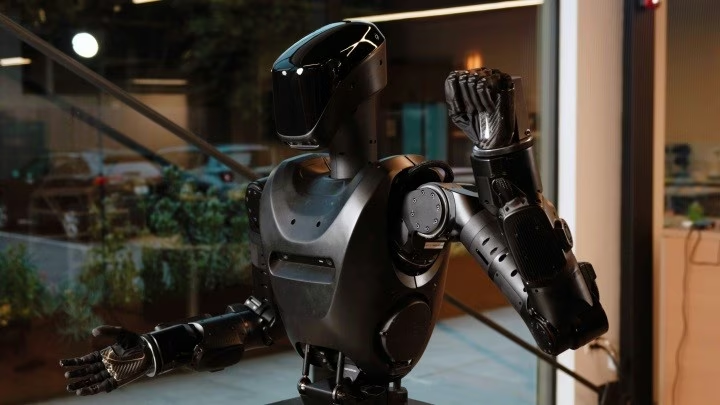
While many tech companies spend years testing prototypes in sterile, controlled laboratories, Foundation took a radically different approach. They deployed two Phantom MK-1 units directly to an undisclosed location in Ukraine.
This marked the first-ever operational use of humanoid robots in a combat zone.
- The Initial Mission: The MK-1 units weren’t carrying rifles. Instead, they were tested for logistics, reconnaissance, and navigating unpredictable, ruined terrain.
- Brutal Feedback: The battlefield is unforgiving. Real-world testing revealed major design flaws, leading to rapid engineering overhauls for the next generation.
- The Upgrade (Phantom 2): Based on combat data, the new model saw its payload capacity skyrocket from 30 kg to 80 kg. Even more impressive is its structural durability—its impact resistance jumped from a fragile 12G to a staggering 100G, meaning it can survive massive drops, explosions, and debris. It also runs on a rugged 3 kWh battery enclosed in a dust- and waterproof frame.
Precision Operations vs. Mass Destruction

Whenever someone mentions weaponized robots, our minds instantly jump to a dystopian wasteland. However, Foundation’s CEO, Sankaet Pathak, brought up a very cold, pragmatic point that made me look at this differently.


If a military wants mass destruction, traditional bombs and drones are vastly cheaper and more effective. Humanoid robots are being built for a completely different purpose: extreme precision.
“The true advantage of humanoid robots lies in executing complex, close-quarters tasks with high accuracy—minimizing infrastructural damage and reducing civilian casualties.”
Instead of replacing aerial drones, these humanoids are designed to fill the incredibly dangerous gap between human soldiers and unmanned aircraft. We are talking about tasks that usually cost human lives: breaching buildings, indoor mapping, clearing out hostile structures, and close-range reconnaissance.
The Tech Under the Hood: The “World Model” AI
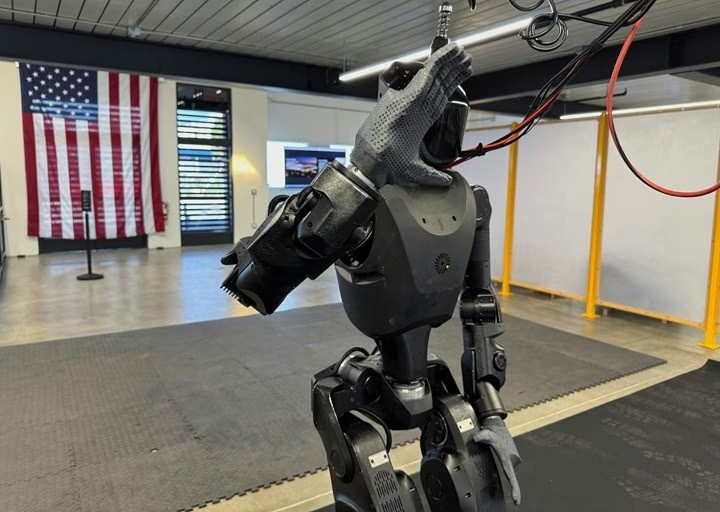
What separates the Phantom from a standard remote-controlled drone is its brain. It doesn’t just react to commands; it understands its surroundings using a “world model” AI architecture.
Unlike large language models (LLMs) that predict the next logical word in a sentence, a world model ingests video feeds, real-time spatial data, and physics simulations to build a digital representation of the physical environment.
In simple terms, the robot can predict how objects will move through space over time. It anticipates physics, plans its footing before stepping on rubble, and dynamically reacts to shifting environments without needing a human operator guiding every single muscle movement.
Silicon Valley Backing and The Pentagon Scale
This isn’t an underfunded passion project; the political and financial weight behind Foundation is massive. The company boasts backing from high-profile figures like Eric Trump, fintech giant Stripe, and venture firm Define.
Furthermore, they have already secured $24 million in research contracts with the Pentagon, working directly across the US Army, Navy, and Air Force to test the feasibility of weaponized deployment.
The long-term business model is where the scaling gets aggressive:
- Current Rate: Phantoms are currently leased to commercial clients for roughly $100,000 annually.
- The Goal: Foundation aims to manufacture 40,000 units per year, driving the unit cost down to under $20,000.
At that price point, a rugged, autonomous humanoid soldier becomes cheaper than training, equipping, and deploying a human asset—a shift that will permanently alter military economics.
Seeing tech leap from an concept directly into an active conflict zone is soberingly fast. The engineering achievement here is undeniable, but it opens a massive ethical Pandora’s box about the future of automated warfare.
If deploying these machines means fewer human soldiers lose their lives on the frontlines, it sounds like a net positive. But when the cost of entry drops to $20,000 per autonomous unit, I can’t help but wonder: does reducing the human cost of war make nations more willing to start one? What do you think?
You Might Also Like;