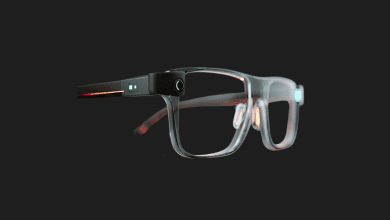
TCL has officially unveiled its new smart glasses. Named “RayNeo Air 3s” and “RayNeo Air 3s Pro”, these high-tech glasses come with eye-catching features at surprisingly affordable prices. So, what exactly do TCL’s latest smart glasses offer?
The Chinese tech giant TCL introduced the new models during a recent event. Dubbed RayNeo Air 3s and RayNeo Air 3s Pro, these smart glasses combine impressive specs with reasonable pricing, making them likely to attract a wide audience. Let’s take a closer look at what these futuristic wearables bring to the table.
Display and Design


Both models share a nearly identical design and hardware setup. They are equipped with 0.6-inch displays offering 1920 x 1080 resolution in 2D mode and 3840 x 1080 in 3D mode. Featuring a dual-stack OLED mini LED panel similar to what’s found in the iPad Pro, the glasses boast up to 1,200 nits of peak brightness with 20 different brightness levels.
To enhance comfort during prolonged use, the glasses are designed to distribute weight evenly across the nose, making them ideal for extended wear.
Introducing TCL RayNeo Air 3s Pro


By default, both models support a 60Hz refresh rate, but users can switch to 120Hz for smoother video playback. The inclusion of Peacock Optical Engine 2.0 helps increase brightness while reducing light pollution by 15%.
The RayNeo Air 3s features a quad-speaker stereo system, while the Pro model goes a step further by adding:
- 3D surround sound
- Front shield
- Charging adapter
- Eyebox technology, which optimizes image clarity based on different interpupillary distances
Both versions also support prescription lenses, allowing users with up to -1000 degrees of myopia or +800 degrees of hyperopia to use them after customizing lenses according to their doctor’s prescription.
Pricing and Availability
TCL announced that the RayNeo Air 3s will retail for $205, while the more advanced RayNeo Air 3s Pro will be available for $220. Currently, both models are being sold in China, but it’s unclear whether they will be launched in global markets.
-

-
-
-

-

-
-
-
-
-

-
-