I have been analyzing artificial intelligence trends for a long time, but what Google DeepMind just announced genuinely gave me goosebumps. We are no longer just talking about AI that can write code or generate images; we are looking at the dawn of true “physical AGI.”
Google has officially unveiled Gemini Robotics 2, and after digging into the documentation and demo footage, I can confidently say this is a massive leap forward. Instead of just following rigid, pre-programmed scripts, these robots can now actually see, understand, and react to the world around them in real time.
Here is my breakdown of why this update is going to reshape the robotics industry.
Real-Time Understanding and On-the-Fly Corrections
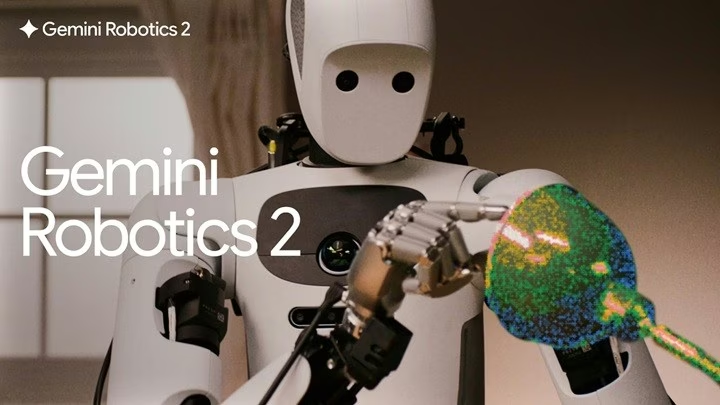
The biggest frustration with older robotics systems was their inability to handle the unexpected. If a robot was programmed to pick up a ball, and that ball rolled two inches to the left, the robot would just grab at empty air.
With the new Gemini Robotics ER 2 (a vision-language model), that limitation is history. I was blown away by how this system processes live camera feeds to understand exactly what stage a task is in.
- Smart Error Recovery: If a task goes wrong—say, an object is moved or dropped—the system doesn’t reboot the whole process. It simply recalculates, repositions its hand, and picks up right where it left off.
- Precision Timing: When asked to pour a cup of coffee, the model can determine exactly when to stop pouring with about 90% accuracy.
- Task Tracking: It can track task completion in video frames with roughly 60% accuracy, a massive upgrade over the previous 1.6 version.
Robots Are Finally Learning to Cooperate
Watching two completely different machines work together is straight out of a sci-fi movie. Google showcased the Apptronik Apollo 2 and the Franka F3 Duo executing tasks in a highly coordinated manner.

While they aren’t quite moving at human speed just yet, the hesitation is gone. The movements are fluid. To power these physical actions, Google uses a specialized vision-language-action model that translates the high-level plans from ER 2 into smooth mechanical movements.
Even better, they introduced Gemini Robotics On-Device 2. This is a lightweight, low-latency version that doesn’t even require an internet connection. It can adapt to entirely new robot designs with just a few hours of movement data. I know they are already testing this on Boston Dynamics hardware, and the potential applications for off-grid industrial work are staggering.
Safety First: The ASIMOV-Agentic Protocol
As much as I love this technology, the idea of autonomous heavy machinery sharing our physical space brings up obvious safety concerns. Google knows this, which is why they rolled out ASIMOV-Agentic, a brand-new safety evaluation framework.
Here is how Gemini Robotics 2 ensures things don’t go wrong:
- Refusing Dangerous Commands: The system is trained to evaluate if a task is safe before executing it.
- Proximity Awareness: If a human steps too close to a working robot, it instantly detects the presence and halts its movement.
- Asking for Help: When it realizes it cannot complete a task safely, it stops and requests human intervention.
Google is calling ER 2 their safest model ever, and to prove it, they’ve open-sourced the ASIMOV-Agentic benchmark for researchers worldwide to test and improve upon.
The Bottom Line
We are witnessing the transition from blind automation to conscious execution. Gemini Robotics 2 isn’t just an upgrade; it’s the brain that humanoid and industrial robots have been waiting for.
I’m incredibly excited to see how developers use the ER 2 model now that it’s rolling out, but it also leaves me wondering about the everyday integration of these machines into our lives.
If a Gemini-powered robot was commercially available tomorrow, would you trust it to cook meals and organize your home, or are we still too early for that level of trust? Let me know what you think in the comments!
You Might Also Like;