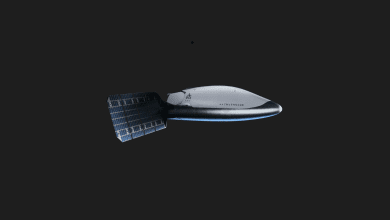
A massive spaceship named “Chrysalis” has been designed for a 400-year, one-way journey to Alpha Centauri, the closest star system to Earth. The vessel would carry 2,400 people at roughly 1% the speed of light.
Scientists have designed a massive spacecraft capable of making a one-way trip to Alpha Centauri. This ship, named Chrysalis, is designed to carry 2,400 passengers and is planned to sustain multiple generations over its roughly 400-year journey.
A Multi-Generational Ship with Artificial Gravity

The Chrysalis, which will be approximately 58 kilometers long, will constantly rotate to provide artificial gravity throughout the journey. The spaceship will consist of interlocking layers, much like Russian nesting dolls. These layers will house living quarters, gardens, agricultural areas, storage facilities, and communal spaces. The energy needs of each layer will be met by nuclear fusion reactors.
Building such a structure is not currently possible with our existing technology, and fusion is not yet practically usable. However, on the positive side, if we solve these problems, our ship design is ready.
A Society in Space

The very center of the ship will contain landing vehicles and communication systems to take passengers to a potentially habitable, Earth-sized planet called Proxima Centauri b. The innermost layer is designed for food production, where plants, fungi, microorganisms, insects, and livestock will be grown in controlled environments. To preserve biodiversity, different ecosystems like tropical and cold forests are planned.
An upper layer will contain communal living areas such as parks, schools, hospitals, and libraries. The next layer will house residential modules for individual families. A layer above that will be dedicated to industrial facilities for activities ranging from recycling to medicine and building material production. The outermost layer of the ship will be a huge storage area for resources, materials, and machinery. All of this will allow several generations of humans to live until the end of the journey.

Population Control and Artificial Intelligence

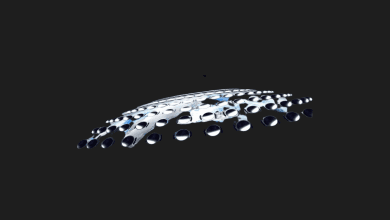
The “Cosmos Dome” is one of the ship’s most remarkable features. This dome, roughly 130 meters high and 360 meters in diameter, provides a zero-gravity environment, thermal insulation, and protection against harmful deep space radiation. Here, inhabitants can safely float in a weightless environment while observing the universe.
Population control is a crucial element on the Chrysalis. The plan is for an average population of 1,500 people, with a limit on the number of children each individual can have. The project states that the Chrysalis is designed for a multi-generational journey. Passengers between the ages of 28-31 will be encouraged to reproduce within three years, and each individual can have a maximum of two children. These children do not necessarily have to be from the same partner. The goal is to maintain a “stable population” of around 1,500 people over three generations.
The ship’s administrators will use AI support to increase the social system’s resilience, improve knowledge transfer between generations, and better understand the ship’s overall dynamics. The project won the Project Hyperion Design Competition, which was launched last year by a consortium of international scientists, engineers, and urban planners. The competition’s goal is to encourage teams to develop self-sufficient, multi-generational interstellar ship designs.
The Speed Challenge

For those curious, let’s do a small calculation for the 400-year journey. Alpha Centauri is 4.37 light-years away from us, which is roughly 41.34 trillion kilometers. For the Chrysalis to reach it in 400 years, it would need to travel at approximately 1% the speed of light. This is about 3,275 km/s (roughly 11.79 million km/h).
This brings up the question: what is currently the fastest spacecraft? The fastest object ever made by humanity is NASA‘s Parker Solar Probe. The probe reached a speed of 192 km/s (roughly 692,000 km/h) during a close pass of the Sun. This is only 0.064% the speed of light. If we were to travel at the speed of the fastest object we’ve ever built, the journey would take approximately 6,800 years.
You Might Also Like;
- The End of Chatbots: Why 2026 is the Year of AI Agents (And What It Means for Your Job)
- Would You Choose a Robot Body or a Digital Mind?
- Nano Banana Pro: Free 4K Photo Upscaling Tool
Follow us on TWITTER (X) and be instantly informed about the latest developments…