
I spent most of my week sifting through the noise of the tech world, and let me tell you, keeping up with artificial intelligence right now feels like drinking from a firehose. Almost every single day, a new threshold is crossed. While it’s easy to get lost in the sheer volume of new models dropping hourly, the developments we saw this week aren’t just incremental updates. They are massive shifts that are going to fundamentally rewrite how we interact with the internet, how we cure diseases, and even how we manage our planet’s physical resources.
Let’s skip the fluff and dive right into the stories that actually matter this week, and more importantly, why you should care about them.
Microsoft’s Build Event: Hardware Meets AI Agents
Microsoft held its Build event this week, and while developer conferences can sometimes be a snooze-fest of backend jargon, this one caught my full attention. They dropped seven new AI models, but the absolute standout was MAI-Thinking-1, their very first reasoning-focused model.
But what really stood out to me wasn’t just the software; it was the hardware. Microsoft unveiled the Surface RTX Spark Dev Box. It’s powered by Nvidia’s new Arm-based RTX Spark platform and is specifically built for heavy-duty, local AI development and model training. The days of relying entirely on cloud computing for AI development seem to be slowly shifting back to localized, absolute powerhouse machines.
Then there was Project Solara. Microsoft is positioning this as the foundation for future AI devices—essentially dedicated hardware for AI agents. They showed off a smart desktop display and, fascinatingly, a wearable smart badge. I’m still torn on whether I want to wear an AI on my chest constantly listening to me, but the push toward ambient computing is undeniable.
The Physical Cost of the Cloud: Data Center Backlash
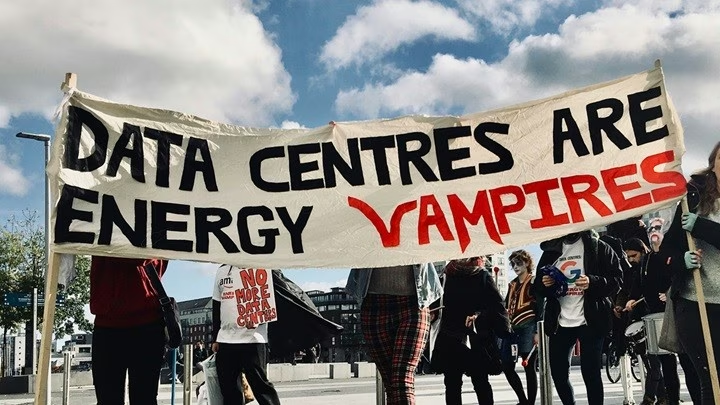
We talk so much about the “cloud” that it’s easy to forget that the cloud is actually just massive, hyper-consuming buildings sitting on land. The explosive growth of AI has turned data centers into the number one investment priority for global powers and tech giants alike. But the real-world pushback has officially begun.


Citizens are realizing the massive toll these facilities take on local electricity grids, water supplies, and land. We’ve been seeing anti-data center protests in places like Utah and California, but this week, New York took a historic step. The state legislature passed a bill that, if signed by Governor Kathy Hochul, will place a one-year moratorium on the construction of massive data centers. New York would be the first US state to implement a temporary ban.
And they aren’t wrong to be worried. The United Nations University Institute for Water, Environment and Health (UNU-INWEH) dropped a terrifying report this week. They warned that by 2030, the infrastructure powering AI could consume an amount of water equivalent to the annual basic water needs of 1.3 billion people. As much as I love AI, that statistic stopped me in my tracks. We can’t build a digital utopia if we drain the physical world to do it.
AI Designed a “Universal Vaccine” (And It’s In Human Trials)
This is the kind of news that reminds me why I’m so passionate about tech. Researchers at Cambridge University have officially completed the first human trials of a next-generation vaccine designed entirely by artificial intelligence.
The goal here is broad-spectrum protection against multiple viruses. The AI literally designed the antigen—the most critical component of the vaccine. It’s engineered to protect not just against current coronavirus variants, but also future mutations that could jump from animals to humans. While it’s still in the early stages, the team is already applying this exact same AI-driven approach to tackle Influenza and Ebola. This isn’t a chatbot writing a poem; this is AI potentially ending global pandemics before they start.
The Death of SEO and the Rise of “AEO”

If you’ve noticed Reddit feeling a bit… off lately, you aren’t imagining things. Reddit moderators have sounded the alarm on a massive influx of “AI-driven spam.”
Here is what’s happening: Large Language Models (LLMs) like ChatGPT and Claude frequently scrape Reddit for high-engagement discussions to form their answers. Because of this, companies have realized that traditional SEO (Search Engine Optimization) isn’t enough anymore. Instead, they are pivoting to AEO—Answer Engine Optimization.
Brands are deliberately creating fake posts, seeding artificial debates, and upvoting specific threads just to manipulate what AI models will say in the future. As someone who writes for the web, this genuinely terrifies me. We are watching the real-time pollution of human forums, all designed to trick the algorithms that we increasingly rely on for the “truth.”
ChatGPT Gets a Permanent Memory Update

OpenAI rolled out a massive update to ChatGPT’s memory architecture. They’ve fully integrated their “dreaming” approach—a background synthesis system that takes bits and pieces from all your different chats and weaves them together to understand who you actually are.
ChatGPT will now maintain a localized “memory summary” about you, drastically improving personalization and saving system resources. You can view this summary, edit it, and tell it what to forget. It’s incredibly convenient not having to repeat my preferences every time I open a new prompt, but reading the AI’s synthesized psychological profile of me is definitely a strange experience.
The Tool Drop: What Actually Matters This Week

Beyond the massive headlines, the open-source and proprietary tool space went absolutely crazy. Here is what I’m keeping an eye on:
- Ideogram v4: The new king of AI image generation just dropped. If you need text rendered perfectly inside an image, this is the tool to use right now.
- MiniMax M3: This open-source model is insane. It boasts a 1-million token context window and coding capabilities that rival the best closed models out there.
- Bernini by ByteDance: TikTok’s parent company released a tool that lets you edit videos purely through text prompts or reference images.
- Magenta RealTime 2 (Google): This isn’t just an AI music generator; it’s a real-time instrument. It adapts the song live based on your inputs as you play.
- StreamChar (Alibaba): You pick a digital avatar, give it a script, and adjust its mood and gestures via text. The virtual influencer market just got a lot more crowded.
Rapid-Fire Industry Shifts
To wrap things up, here are the quick hits from the business side of AI that you need to know:
- ChatGPT just hit 1 billion users, making it the fastest application in human history to reach that milestone.
- Google is renting SpaceX’s server infrastructure starting in late 2026 for a massive $920 million a month to keep up with AI demand.
- Alphabet (Google’s parent) is raising $80 billion strictly to accelerate AI infrastructure.
- Anthropic took its first official steps toward an IPO, right after their executives publicly suggested a global pause on advanced AI development, warning about models achieving self-improvement capabilities.
- A major security flaw in Meta AI allowed hackers to change Instagram passwords without proper user authentication.
- The US President signed a new executive order mandating that advanced AI models must be shared with federal agencies before they are released to the public.
Looking at the sheer scale of the investments and the terrifying reality of the water consumption reports, it feels like we are walking on a tightrope. We are building systems capable of curing diseases, but we are risking our physical infrastructure to do it.
I’m curious where you all stand on this. If a temporary ban on data centers meant a delay in AI progress but protected local water and power grids, would you support it? Or is the race for AGI too important to slow down? Drop your thoughts below; I genuinely want to read them.
You Might Also Like;