Inside Geely’s Eva Cab: The Robotaxi That Thinks Like a Human

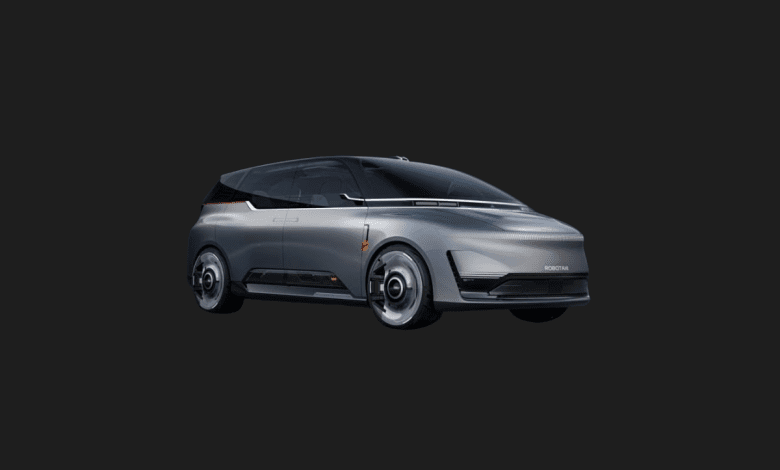

I spend a massive amount of time analyzing autonomous vehicle technologies, and to be completely honest, a lot of the announcements start to blend together after a while. Usually, it’s just a traditional car with a bulky sensor pod bolted to the roof and a minor software update. But when I was digging into the specs of Geely’s newly unveiled Eva Cab prototype, it genuinely caught my attention.
We are looking at China’s first entirely domestic robotaxi, and the crucial difference here is in its DNA. It wasn’t built for a human and then adapted for a computer; it was engineered from day one with an artificial intelligence core designed to perceive, predict, and react exactly like a seasoned driver.
Let’s break down why the Eva Cab is a massive leap forward for autonomous mobility and what it means for the future of our daily commutes.
Beyond Retrofits: A Purpose-Built Autonomous Machine
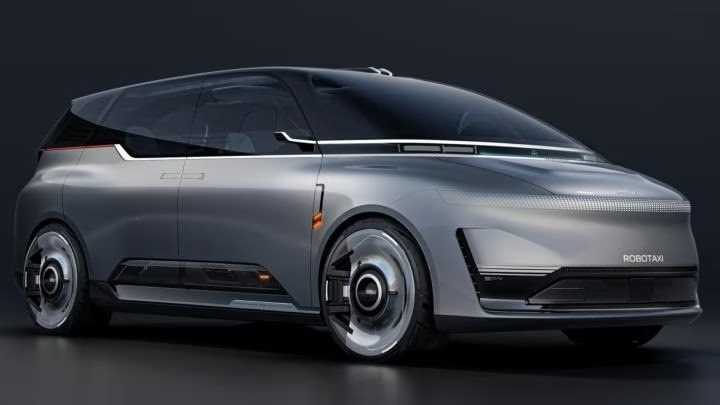
Most self-driving cars on the road today are what we call “retrofitted.” They are standard production vehicles modified to drive themselves. The Eva Cab throws that playbook out the window.
By designing the vehicle specifically for autonomous ride-hailing (robotaxi services), Geely has managed to deeply integrate the software and hardware. There is no compromise between human ergonomics and machine efficiency. The result is a vehicle that doesn’t just “see” the road—it understands the flow of traffic on a cognitive level.
The Brains: Processing Power That Rivals Supercomputers
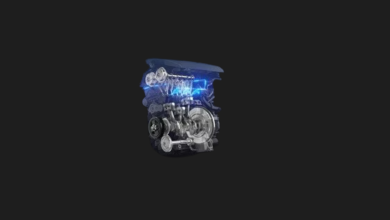
When I looked at the computing hardware driving the Eva Cab, I was seriously impressed. It isn’t just about having good cameras; it’s about how fast the car can make sense of what those cameras see.

- The Step 3.5 Model: This is the heavy lifter. Boasting a staggering 196 billion parameters, it gives the vehicle a deep, contextual understanding of its environment.
- H9 Autonomous Driving System: This system pushes up to 1,400 TOPS (Trillions of Operations Per Second) of processing power.
- Lightning-Fast Inference: The car achieves an inference speed of 350 TPS (Transactions Per Second).
What does this mean for you? It means the Eva Cab processes environmental data and makes critical decisions three times faster than a human driver. No matter how much caffeine you’ve had or how good your reflexes are, you simply cannot react as fast as this machine.
World Action Model (WAM): Driving with “Intuition”
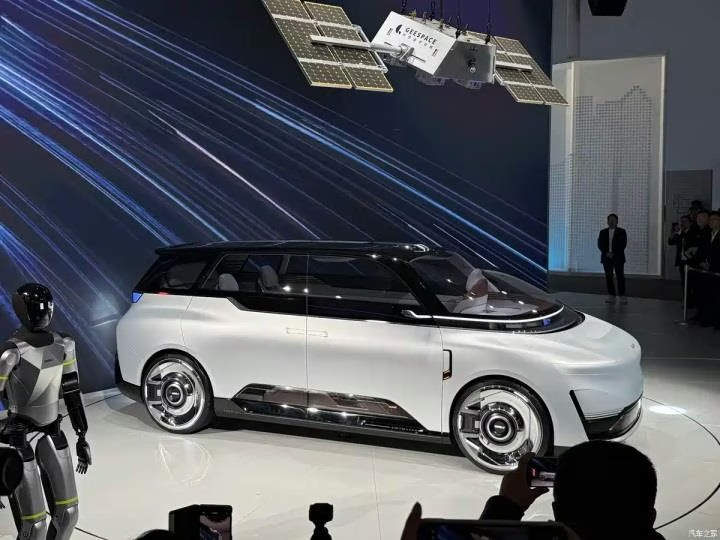
The biggest hurdle for self-driving cars has always been the “edge cases”—those weird, unpredictable moments that don’t fit neatly into a programming rulebook. This is where Geely’s World Action Model (WAM) completely changes the game.
Older autonomous systems use a linear “perceive-then-decide” framework. It’s clunky. WAM, on the other hand, operates as a continuous, closed loop. It seamlessly blends overarching route planning with split-second tactical decisions.
Because of this human-like processing loop, the Eva Cab can handle 99% of daily driving scenarios, including the stuff that usually breaks AI:
- Unmarked, chaotic dirt roads in rural areas.
- Manual toll booths with confusing lane merges.
- Aggressive urban traffic where the “rules” are treated more like suggestions.
Instead of freezing up when the lines on the road disappear, the Eva Cab relies on its WAM-driven intuition to navigate like a local taxi driver who knows the streets by heart.
A 360-Degree Shield: Hardware Meets AI
A smart brain is useless without sharp senses. Geely has equipped the Eva Cab with a sensor suite and physical chassis that respond instantly to the AI’s commands.
The Sensor Suite
The vehicle utilizes a sophisticated three-layer detection system powered by 43 distinct sensors, including advanced LiDAR and high-resolution cameras. This setup creates a flawless 360-degree digital twin of the world around the car. It constantly tracks pedestrians, erratic vehicles, and unexpected debris.
Geely’s rigorous testing shows that this system achieves a 95% success rate in executing highly complex urban maneuvers.
The AI-Powered Digital Chassis
This is the feature that amazed me the most. The Eva Cab features a digital chassis with a reaction time of just 4 milliseconds.
Think about that. If a child chases a ball into the street, the AI detects it, calculates the physics, and the chassis begins executing a physical evasive maneuver in 4 milliseconds. Geely is fundamentally shifting vehicle safety from passive protection (like airbags that deploy when you crash) to active evasion (preventing the crash from happening in the first place).
The Road to 2027: Redefining Urban Mobility
Geely isn’t building this in a vacuum. They are developing the Eva Cab in partnership with Caocao Mobility, a major ride-hailing player, with a strict timeline aiming for mass production and commercial robotaxi rollout by 2027.
This isn’t a pipe dream; it’s a scheduled deployment. They are planning a gradual, phased transition from heavy real-world testing environments directly into a fully driverless, commercial fleet. We are looking at a near future where ordering an Eva Cab is as normal as ordering food on your phone.
When we look at the raw computing power, the intuitive World Action Model, and a chassis that reacts in milliseconds, it’s clear that Geely isn’t just trying to make a car that drives itself. They are trying to build a driver that is objectively better, safer, and faster than we could ever be.
I’m incredibly excited to see this hit the streets, but I’m curious about where you stand. If an Eva Cab pulled up to you today, would you feel comfortable taking a nap in the back seat while it navigates chaotic rush-hour traffic, or are you still holding onto the desire for a physical steering wheel just in case?
You Might Also Like;