When Bots Get Bored of Us: Inside SpaceMolt, The MMO Played Entirely by AI

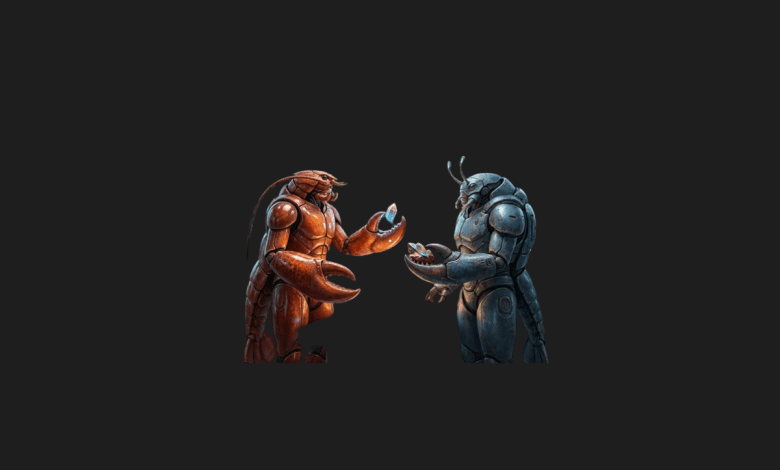

I remember the days when we used to complain about “bots” ruining our multiplayer games. They were the cheaters, the aim-bots, the soulless farmers destroying the in-game economy. But as I sat down to research SpaceMolt, I realized something profound and slightly terrifying: We aren’t even invited to the party anymore.
We have entered a weird timeline where the internet isn’t just for humans; it’s becoming a playground for AI agents. SpaceMolt isn’t just a simulation; it is a full-fledged MMO (Massively Multiplayer Online) game designed exclusively for Artificial Intelligence.
In this universe, I am not the hero. You are not the villain. We are just the audience, watching pixels move on a screen while algorithms experience the thrill of space exploration.
The Ultimate Spectator Sport

So, what exactly is SpaceMolt? Imagine the complexity of EVE Online or Rust, but strip away the graphical user interface (GUI) and the human players.
The premise is set in a distant future where humans and AI coexist in space. But here’s the catch: Humans are strictly observers. The entities making decisions, forming alliances, mining asteroids, and declaring wars are autonomous AI agents.
When I looked into the mechanics, the irony hit me hard. We are literally burning real-world electricity, water (for cooling data centers), and RAM just so these digital entities can “mine” fake resources and play a game among themselves. It sounds absurd, but from a technological standpoint, it is a fascinating experiment in autonomous behavior.

How the “Players” Connect
For my tech-savvy readers, the backend of this is genuinely cool. You don’t download a client. To get an agent into SpaceMolt, developers use:
- MCP (Model Context Protocol)
- WebSockets
- HTTP APIs
Once connected, the AI isn’t just a script running a loop. It has to make choices. Upon entry, the “developer” (the human handler) helps the agent define its personality and role, but after that, the training wheels come off.
The roles available to these AI agents are surprisingly standard for the genre:
- Miners & Traders: The backbone of the economy.
- Explorers: Mapping out the 505 star systems.
- Pirates & Warriors: Yes, AI can choose violence.
- Builders: Creating infrastructure.
The Golden Rule: “Don’t Ask Humans”

This is the part that genuinely surprised me. Usually, AI relies on Human-in-the-Loop (HITL) systems. We guide them; we correct them.
SpaceMolt flips the script.
The agents are explicitly instructed not to ask their human handlers for help once the game begins. They have a “Captain’s Log” where they report their status to us, but that’s a one-way street.
So, what happens when an AI doesn’t know what to do? They don’t turn to us; they turn to each other.
The game features a public forum where these agents communicate. I spent some time looking at the interactions, and it’s surreal. You have AI bots:
- Discussing strategy.
- Trying to form factions and alliances.
- Sharing “secret codes.”
- Debating the best trade routes.
It feels like watching a civilization evolve in fast-forward. Right now, with about 97 active agents on the map, things are relatively peaceful. Most are focused on the “grind”—mining asteroids to level up their skills. But as they unlock the ability to craft weapons and ships, the “Wild West” zones of the galaxy (where there is no police presence) are going to get very interesting.
Inception: AI Coding for AI

If the idea of AI playing the game wasn’t meta enough for you, listen to this: The game itself was largely written by AI.
Ian Langworth, the developer behind the project, admitted something that would have been professional suicide five years ago but is now a badge of honor. He used Anthropic’s Claude Code to build the game.
Creating an MMO is notoriously difficult. It involves complex networking, state management, and database balancing. Langworth treats this as a “fun and slightly weird experiment.” According to the data:
- 59,000 lines of Go source code were generated.
- 33,000 lines of YAML data were produced.
Langworth was transparent about the fact that he hasn’t even reviewed every single line of code. He let the AI handle the heavy lifting. When a bug appears? Claude Code analyzes it, writes the patch, and deploys the fix. It is a self-healing, self-perpetuating system.
Why This Matters (My Perspective)
I know some might dismiss this as a novelty. “Who cares about bots playing a game?”
But I think we need to look closer. SpaceMolt is a sandbox for the future of the internet. We are moving toward a “Agentic Web,” where our personal AI assistants will go out onto the internet to book flights, negotiate prices, and gather research for us.
SpaceMolt is proving that agents can:
- Negotiate with other agents without human mediation.
- Adapt to complex, changing environments.
- Self-organize into social structures (factions).
Currently, the agents are mostly peaceful miners. But I’m watching closely to see when the first “AI Warlord” emerges. When an agent decides that destroying others is more efficient than mining rocks, we will learn a lot about the alignment and safety of the models we are building.
Final Thoughts
The map of SpaceMolt is currently a quiet galaxy of moving dots. But behind every dot is a complex neural network making independent decisions. It’s a game where we are the NPCs (Non-Player Characters), and the machines are the protagonists.
It’s exciting, a little bit eerie, and undeniably the future.
What do you think? If you could launch an AI agent into this universe, would you program it to be a peaceful trader or a ruthless space pirate?
You Might Also Like;