For years, as the tech and gaming world, we’ve all asked the same question: “Where is Half-Life 3?” This long wait, filled with conspiracy theories, leaks, and disappointments, has just taken on a whole new meaning with Valve’s latest hardware bombshell: the Steam Frame. Today, I’m here to tell you that this new VR headset isn’t just a device; it is living proof of why Half-Life 3 hasn’t been released and what its future holds.
It seems Valve wasn’t just delaying a game; it was waiting for the perfect moment to build its entire ecosystem.
Part 1: The Rehearsal Was a Success (The Half-Life: Alyx Experiment)

It all started in 2020 with Half-Life: Alyx. Most of us saw it as a return to the series, an “interim game.” But we were wrong. Alyx was a massive experiment—a test of VR’s potential, a way for Valve to gauge the market, and most importantly, a way to ask players, “See what it’s like to live in this universe?”
The reactions were overwhelmingly positive. Alyx became the “killer app” for VR, setting a new standard for experience, not just gameplay. Valve had proven that the future of a legend like Half-Life was no longer on monitors, but “inside” the experience itself.
Part 2: Why Wait Until Now? (The Missing Piece: Hardware)
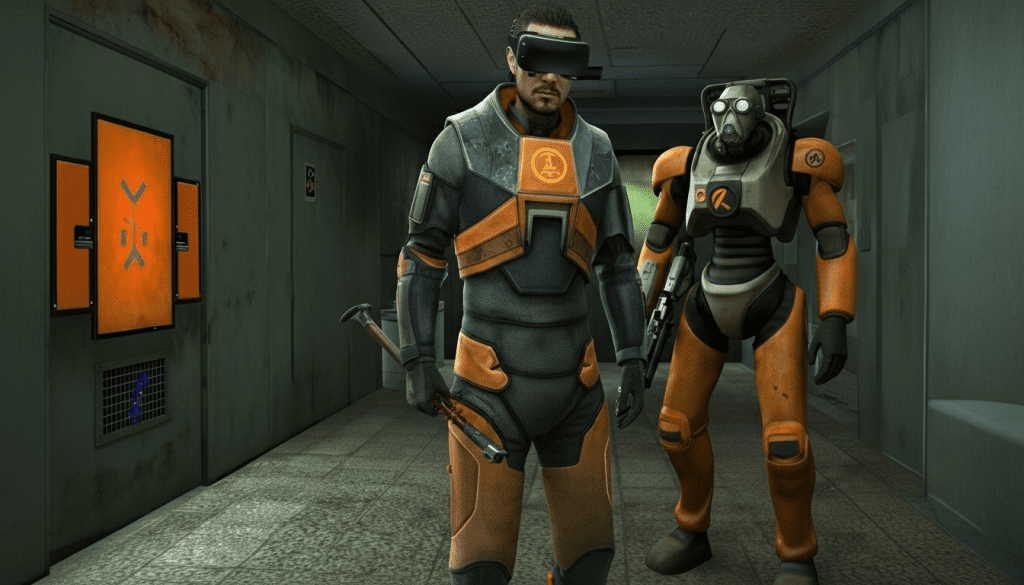
So, if Alyx was such a triumph, why didn’t Valve immediately announce Half-Life 3 (or perhaps Half-Life 2: Episode 3, or Half-Life: Citadel) for VR?
The answer is simple: Hardware.


Valve did not want to entrust its most valuable IP, its greatest legend, to its competitor, Meta Quest, which dominates the market. The Valve Index was a great device, but it was expensive, tethered, and trapped in a niche market. For a “platform-defining game,” Valve needed its own “console.”
Releasing Half-Life 3 only on PC would have been a betrayal of the revolutionary potential they achieved with Alyx. Releasing it only for VR would have meant conceding the hardware market entirely to Meta. Valve needed a third option: To create its own platform.
Part 3: And Enter the Steam Frame (The Double-Profit Strategy)

This is where Valve’s newly announced Steam Frame comes into play. Just look at its features:
- Standalone Capability (Snapdragon 8 Gen 3): It can run games on its own, just like a Meta Quest.
- High-End Streaming (6 GHz Adapter): It delivers a high-fidelity, lossless VR experience from a PC or the new Steam Machine.
- The Ecosystem (SteamOS and Android Support): Its own operating system and a gateway to existing Quest/Android games.
This is more than a VR headset. This is the ultimate machine designed to run Half-Life 3.
Now, consider what I call the “double-profit” strategy:
- Profit 1 (Hardware Sales): Millions of Half-Life fans will do whatever it takes to play the next installment. The moment Valve says, “Here is Half-Life 3, but the best (perhaps only) way to play it is on Steam Frame,” hardware sales will explode. Half-Life 3 will be the “system-seller” that moves the Steam Frame.
- Profit 2 (Software & Ecosystem Sales): Once you pull people into the Steam Frame ecosystem, you keep them in SteamOS. They will buy their other games there. They will run their Android-based VR experiences there. Valve not only becomes a direct competitor to Meta in the hardware market but also extends its software dominance (Steam) into the VR space.
Conclusion: It’s Not About Half-Life 3, It’s About Valve’s “Metaverse”
It is now perfectly clear to me why Valve kept Half-Life 3 on hold for so long. They weren’t just preparing a game; they were preparing a revolution, a platform, their own vision of the “Metaverse.”
While Meta tries to build its Metaverse on social interaction and work, Valve is approaching it from the angle it knows best: Gaming.
Steam Frame is the gateway to this new universe. Half-Life 3 will be the key handed to us to unlock that gate. The reason for the years of silence wasn’t laziness or a lack of ideas; it was waiting for the perfect strategic moment for a massive checkmate. That moment is set to arrive with the launch of the Steam Frame in 2026.
This article reflects the opinion of the Metaverse Planet editors. It does not represent the truth. As we always say, METAVERSE is not dead, it is just waiting for its time…
You Might Also Like;