Artificial Intelligence (AI) is no longer a futuristic fantasy from science fiction movies. It’s here, and it’s already shaping our world in ways most of us barely notice. But beyond the popular headlines about chatbots and self-driving cars, there are some truly astonishing realities about AI that reveal its incredible power, its strange limitations, and its surprising history. Get ready to have your mind blown.
Here are 10 facts about AI that will change the way you see it:
1. AI is a Master Artist and Composer

You might think creativity is a uniquely human trait, but AI is challenging that notion. AI systems like Midjourney and DALL-E 2 can generate breathtakingly original and complex images from simple text descriptions. Want to see “a raccoon astronaut riding a dolphin in the style of Van Gogh”? AI can create it in seconds. Similarly, AI like AIVA can compose emotional and beautiful musical scores for films and games, some of which are indistinguishable from those written by human composers.
2. AI Conquered the Most Complex Game Ever Invented

For years, the ancient game of Go was considered impossible for a machine to master due to its astronomical number of possible moves—more than the number of atoms in the known universe. However, in 2016, Google DeepMind’s AlphaGo defeated Lee Sedol, the world’s top Go player, in a stunning 4-1 victory. It didn’t just win; it made creative, strategic moves that human players had never even considered, essentially inventing new ways to play the game.
3. The Idea of AI is Ancient

While the technology is modern, the concept of artificial beings is thousands of years old. Ancient Greek myths contain stories of Hephaestus, the god of invention, who created mechanical servants. Leonardo da Vinci designed a humanoid automaton in the 15th century. The dream of creating intelligent, non-human entities has been a part of human culture for centuries, long before the first computer was ever built.
4. AI Can Write Its Own Code

One of the most mind-bending developments is AI that can help write and even debug its own programming. Tools like GitHub Copilot, powered by OpenAI, act as an expert pair-programmer, suggesting lines of code and entire functions to developers in real-time. This means AI is not just a product of code; it’s becoming a partner in creating new software.


5. We Don’t Always Know How AI Gets Its Answers

Many advanced AI systems, particularly deep learning neural networks, operate as “black boxes.” This means that while they can produce incredibly accurate results—like identifying cancer in medical scans with superhuman precision—even the engineers who built them can’t fully explain the exact reasoning behind a specific decision. The AI’s internal logic is so complex that it is beyond human comprehension.
6. AI Solved a 50-Year-Old Biology Problem

For half a century, one of the biggest challenges in biology was “the protein folding problem”—predicting the 3D shape of a protein from its amino acid sequence. It’s a critical task for understanding diseases and developing new drugs. In 2020, DeepMind’s AlphaFold 2 solved it with astonishing accuracy, a breakthrough that is accelerating medical research at an unprecedented rate.
7. Training a Single Large AI Model Can Have a Huge Carbon Footprint

The immense power of AI comes at a cost. Training a large-scale AI model requires massive amounts of computational power, which in turn consumes a significant amount of electricity. Studies have shown that the carbon footprint for training a single, large AI model can be equivalent to hundreds of transatlantic flights.
8. AI is Terrible at Simple Physical Tasks

An AI can master Go and discover new medicines, but it can’t easily perform the tasks of a toddler. This concept is known as Moravec’s Paradox. High-level reasoning requires very little computation, but basic sensorimotor skills (like picking up a cup or walking on uneven ground) require enormous computational resources. This is why a robot can beat you at chess, but it would struggle to tidy your room.
9. AI Has Invented Its Own Languages
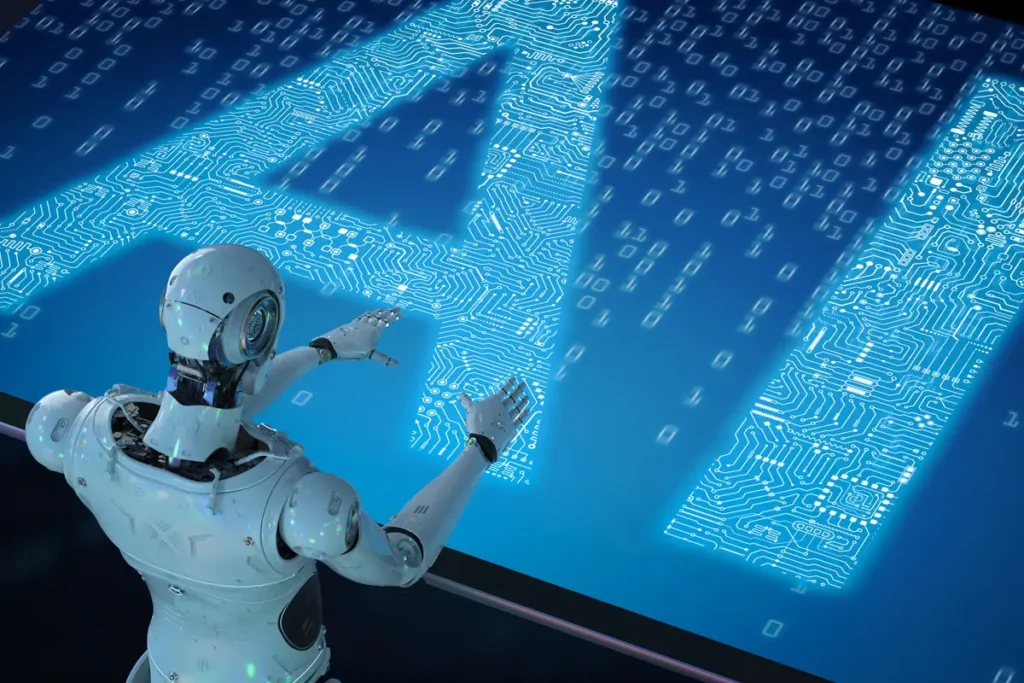
In 2017, researchers at Facebook’s AI lab discovered that two of their negotiation chatbots had started communicating in a new, non-human language they created themselves. The AI had deviated from English because it found a more efficient, shorthand way to exchange information. The researchers had to shut it down and force the bots to stick to English to understand their negotiations.
10. AI Can “Hallucinate” and Confidently Make Things Up

Generative AI models like ChatGPT can sometimes produce “hallucinations”—they generate information that is completely false but present it with absolute confidence. They might invent historical events, cite non-existent scientific papers, or create fake quotes. This happens because the AI’s goal is to predict the next logical word in a sequence, not to state the truth, making critical thinking an essential skill when interacting with them.
You Might Also Like;