Chasing the Ultimate Power Source: The World’s Largest Private Laser Fires Up for Commercial Fusion



I have spent countless hours diving into the mechanics of humanoid robots, space colonization, and the future of artificial intelligence. But if there is one single foundational technology that serves as the absolute backbone for all our sci-fi dreams, it’s fusion energy. For decades, it has been the holy grail of clean power—the exact same process that powers the sun, brought down to Earth.
When I first came across the latest development from US-based Xcimer Energy, I genuinely had to pause and re-read the specs. We are no longer just talking about theoretical physics on a chalkboard. Xcimer has officially activated Phoenix, the world’s largest privately owned laser system, marking a massive leap toward making commercial fusion energy a reality.
Working closely with financial spreadsheets and analyzing the traditional finance world, I can’t help but calculate the staggering economic implications of virtually free, limitless energy. It changes the entire global equation. Let’s break down how this massive laser works and why it might just be the most important machine built this decade.
What Exactly is the Phoenix Laser System?
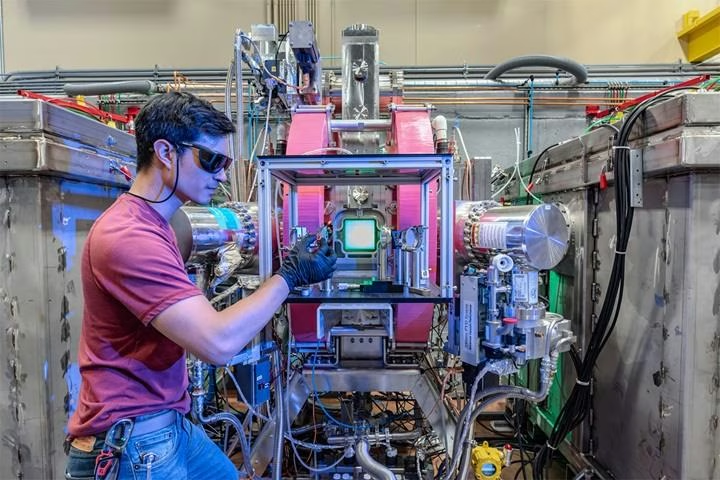
When you hear the word “laser,” you might picture a simple laser pointer or the precise cutting tools used in manufacturing. Phoenix is an entirely different beast. Housed in a massive 74,000-square-meter facility, this system is designed to do one thing: deliver an unfathomable amount of energy into an incredibly tiny target in a fraction of a second.
Here is what makes the Phoenix system stand out:
- The Architecture: It relies on a krypton fluoride excimer laser, a technology closely related to the systems used in advanced semiconductor manufacturing.
- The Power: Right now, the light source can generate a pulse energy exceeding 1 kilojoule.
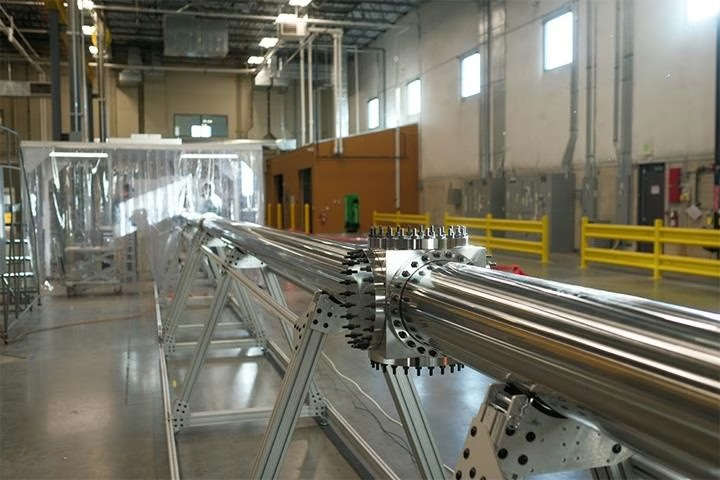
- The Heart of the Machine: At the core of Phoenix lies a 38-meter-long gas optic. This massive component is responsible for a highly complex process called Stimulated Brillouin Scattering (SBS).
The Art of Time Compression
The real magic of Xcimer’s approach isn’t just about raw power; it’s about timing. To achieve fusion, you need to force atomic nuclei to merge. They naturally want to repel each other, so you have to hit them with intense heat and pressure.


Xcimer’s system takes relatively long laser pulses—measured in microseconds—and physically compresses them down to the nanosecond scale using that massive gas optic. By taking all that energy and squeezing it into an impossibly tight window of time, the laser delivers a devastatingly powerful, instantaneous strike to the fuel target. The atoms fuse, and immense energy is released.
Standing on the Shoulders of Giants: The NIF Connection
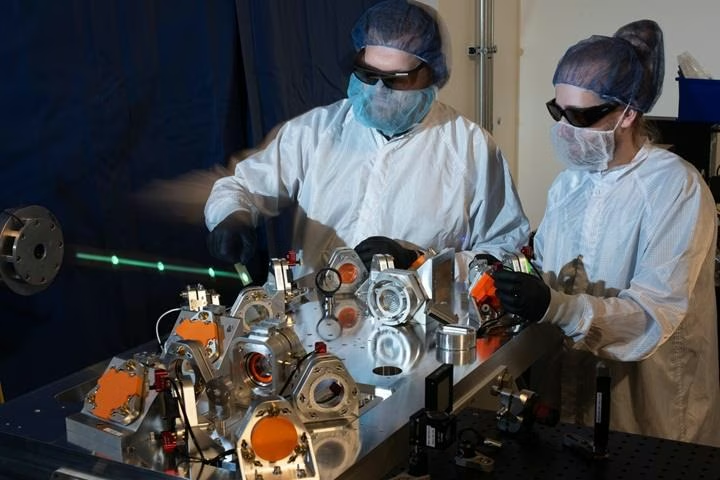
To truly understand why Xcimer’s strategy is so brilliant, we have to look at their main inspiration: the National Ignition Facility (NIF) in the United States.
If you follow science news closely, you might remember that late in 2022, NIF made history. For the first time ever, they achieved “scientific energy breakeven” in a controlled fusion experiment—meaning the reaction produced more energy than the lasers put into it. In fact, in recent runs, they pumped in about 2 megajoules of laser energy and got a massive 8.6 megajoules of fusion energy out.
But there is a catch.
- Complexity: NIF was built as a scientific and defense research tool, not a power plant.
- The Setup: To achieve their reaction, NIF uses a mind-boggling array of 192 separate laser beams, all perfectly synchronized to hit a tiny fuel capsule.
- Commercial Viability: Maintaining, aligning, and powering 192 incredibly complex solid-state lasers is extremely expensive and inefficient for continuous, daily grid-scale power generation.
Xcimer’s Elegant Simplification
This is where my appreciation for smart engineering really kicks in. Instead of trying to replicate the insanely complex 192-beam setup of NIF, Xcimer argues that the excimer laser architecture is the key to commercialization.
Their proposed commercial design uses just two beamlines.
Let that sink in. By dropping the complexity from 192 lasers down to just two, Xcimer is dramatically cutting manufacturing costs, reducing maintenance nightmares, and creating a system that can actually be mass-produced for the global energy grid. It is the ultimate shift from a “custom-built laboratory experiment” to an “industrial-scale power plant.”
The Roadmap to the Future: Anvil, Vulcan, and Athena
As impressive as the 1-kilojoule Phoenix prototype is, it is still just a stepping stone. It is not nearly powerful enough to run a commercial power plant. But Xcimer isn’t stopping here. They have laid out an aggressive, highly structured roadmap that I find incredibly exciting:
- Project Anvil (Target: 2028): In just a few years, the team plans to scale up significantly with Anvil, a system designed to output 200 kilojoules of energy. This will be the ultimate proof-of-concept for their scaling mechanics.
- Project Vulcan (Target: Early 2030s): This is where things get serious. Vulcan is projected to deliver between 4 to 12 megajoules of energy. At this stage, the system is expected to achieve grid equilibrium—meaning the energy it pulls from the electrical grid is perfectly balanced by the energy it creates.
- Project Athena (Target: Mid-2030s): This is the endgame. Athena is planned to be the world’s first fully functional, commercial fusion power plant, pumping clean, limitless energy directly into the grid.
My Final Thoughts on the Fusion Race
I spend a lot of time analyzing tech trends, and while AI and robotics get the lion’s share of the daily headlines, the quiet progress happening in fusion labs around the world is what will actually dictate the shape of our future.
If Xcimer Energy can stick to this timeline and successfully build Athena in the 2030s, we are looking at a fundamental rewrite of human infrastructure. Imagine a world where the cost of electricity plummets, where carbon emissions from power generation drop to zero, and where the geopolitical struggles over oil and gas simply fade into history. It feels exactly like the premise of the classic sci-fi movies I love curating, only this time, the physics are real, and the lasers are already firing.
But I want to pass the microphone over to you. Considering the massive technical hurdles that still remain, do you believe we will realistically see commercial fusion power plants powering our cities by the 2030s, or is this timeline too optimistic? Drop your thoughts in the comments below, let’s discuss!
You Might Also Like;