Revolutionizing Energy: The Quantum Battery That Charges in a Quadrillionth of a Second



I don’t know about you, but my daily life often feels like a constant, low-level panic about battery percentages. Whether I’m out recording a vlog, writing articles at a local coffee shop, or just trying to navigate a new city, that little red battery icon is the bane of my existence. We’ve put rovers on Mars and built AI that can write poetry, yet we are still tethered to the wall by lithium-ion blocks that degrade over time.
But while researching the latest developments in energy tech, I stumbled upon a breakthrough that genuinely made me stop and reread the paper twice. We are talking about a quantum battery prototype that charges in a quadrillionth of a second. Yes, you read that right. A quadrillionth.
I want to dive deep into what this means, how it works, and why this Australian research project might just rewrite the entire future of how we power our world.
The Breakthrough: Charging at the Speed of Light
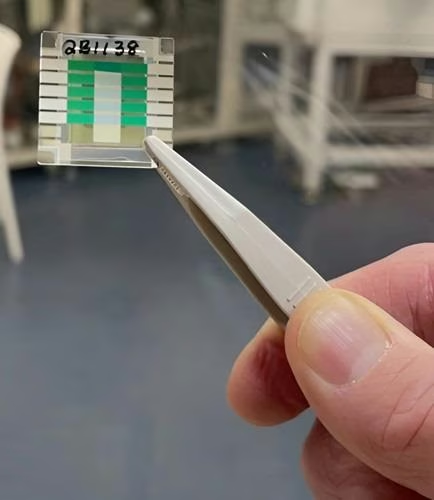
Let’s set the stage. A brilliant consortium of researchers from the Australian Space Agency, CSIRO, RMIT University, and the University of Melbourne have successfully taken quantum batteries from a chalkboard theory to a working physical prototype.
What they’ve built is a system that uses lasers to charge wirelessly. While wireless charging isn’t new to us—most of us throw our phones onto magnetic pads every night—the speed and mechanics here are entirely alien.
The prototype charges in femtoseconds. To give you an idea of how fast that is, a femtosecond is to a second what a second is to about 31.7 million years. It’s a timescale so small that the human brain can barely comprehend it. After this instantaneous charge, it can store that energy for nanoseconds.


While nanoseconds sound incredibly brief (and they are), the researchers point out a staggering ratio: the battery holds its energy about a million times longer than it takes to charge.
Chemical vs. Quantum: Why Our Current Batteries Are Hitting a Wall
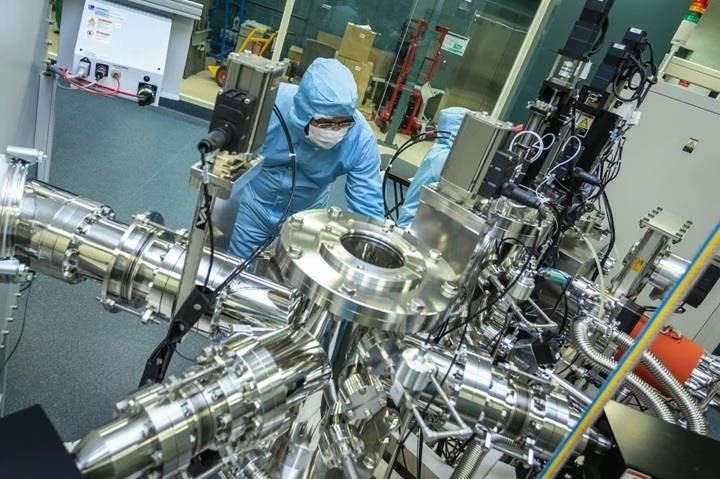
To truly appreciate why this is a massive deal, I think it helps to look at why our current batteries suck.
Right now, from your sleek smartwatch to massive electric vehicles, we rely almost entirely on lithium-ion technology. These batteries store and release energy through chemical reactions. Ions physically move from one side of the battery to the other.
Because it relies on physical chemistry, lithium-ion tech has a hard speed limit. You can only move physical matter so fast without the battery overheating, swelling, or literally catching on fire.
Quantum batteries completely bypass chemistry. Instead of relying on physical ions moving around, they leverage the mind-bending principles of quantum mechanics:
- Superposition: The ability of a quantum system to be in multiple states at once.
- Entanglement: Where particles become interconnected, meaning the state of one instantly affects another, regardless of distance.
- Super-absorption: The key mechanism in this new prototype. The system absorbs light (energy) in one massive, collective event rather than step-by-step.
Imagine a stadium full of people trying to catch tennis balls thrown from the pitch. In a classical battery, each person catches a ball one by one. It takes time. In a quantum battery using super-absorption, every single person in the stadium instantly catches a ball at the exact same millisecond.
The Mind-Blowing Math of Quantum Scaling

When I was trying to wrap my head around the practical applications of this, the researchers provided some analogies that absolutely blew my mind.
If we could scale this exact charge-to-retention ratio to the macro world—the devices we use every day—the math looks like pure science fiction:
- The Smartphone Scenario: If your phone took its usual 30 minutes to charge, a quantum battery with this ratio would hold that charge for over 100 years.
- The Instant Charge Scenario: If you wanted to plug your phone in for just one single second, that burst of energy would power your device for roughly 11 days.
The Catch: Why You Can’t Buy One Tomorrow

Now, as much as I love hyping up futuristic tech, I promised to always be straight with you. I don’t want you thinking Apple or Samsung will be dropping a quantum battery next year. We are a long way off from that, and here is why.
The current prototype is incredibly weak in terms of total capacity. It holds a few billion electron volts. That sounds like a big number, but in the realm of physics, it’s practically nothing.
To give you a real-world comparison: the energy this prototype stores is hundreds of thousands of times less than the mechanical energy of a single flying mosquito. It cannot power a smartphone. It cannot power a smartwatch. It probably couldn’t even power a single LED light. However, according to Dr. James Quach, one of the leading minds behind this research, the true victory here is that they have created the first quantum battery capable of a full cycle. It can charge, store, and discharge. The proof of concept is officially real.
The “Collective Effect”: Breaking the Laws of Scaling
Here is where the science gets truly exciting for the future.
Think about an EV (Electric Vehicle) battery. If you want an EV to drive further, you need a bigger battery. But a bigger battery takes longer to charge because there are more cells to fill up with chemical energy. It’s a frustrating trade-off.
Quantum batteries do the exact opposite.
Because of a phenomenon researchers call “collective effects,” the more cells you add to a quantum battery, the faster the entire system charges. The particles essentially work together, entangling with one another to pull in energy more aggressively.
This means that a massive quantum battery designed to power a city grid could theoretically charge faster than a tiny quantum battery designed to power a laptop. It completely flips our traditional understanding of energy storage on its head.
Where Do We Go From Here?
So, if we can’t put them in our iPhones yet, what is the roadmap for this technology? From what I’m seeing, there are three major phases of adoption we can look forward to:
- Powering Quantum Computers: This will be the first real-world application. Quantum computers are incredibly fragile and require highly stable, ultra-fast energy sources to maintain their quantum states. These tiny batteries are perfectly suited for the microscopic world of quantum processors.
- Continuous Drone Flight: Imagine a fleet of delivery drones or agricultural monitors that never have to land. Ground stations could fire specialized lasers at the drones as they fly overhead, instantly charging their quantum batteries in a fraction of a second, allowing for infinite flight time.
- The EV Revolution: Decades from now, if the storage capacity can be scaled up, we could see electric vehicles that charge by simply passing through a laser tollbooth on the highway. You wouldn’t even have to stop your car; a femtosecond laser pulse would give you enough juice to drive another 500 miles.
My Final Thoughts
Researching this topic made me realize just how deeply stuck in the “chemical age” we still are. We are trying to power space-age AI and next-generation robotics using energy storage methods that haven’t fundamentally changed in decades. This Australian prototype, despite being weaker than a mosquito right now, is the first real glimpse into the “quantum age” of energy.
I’ll be keeping a close eye on Dr. Quach and his team’s future publications. The transition from chemical to quantum power won’t happen overnight, but the foundation has officially been laid.
But I want to pass the mic to you. Think about the wild possibilities of a battery that scales inversely—where bigger means faster—and charges in a literal blink of an eye. If you had access to a device that charged in one second and lasted for an entire month, what’s the first crazy project or trip you would use it for? Let me know your thoughts down below!
You Might Also Like;