The Era of Quiet Supersonics Has Begun: NASA’s “Paper Airplane” X-59 Completes Maiden Flight


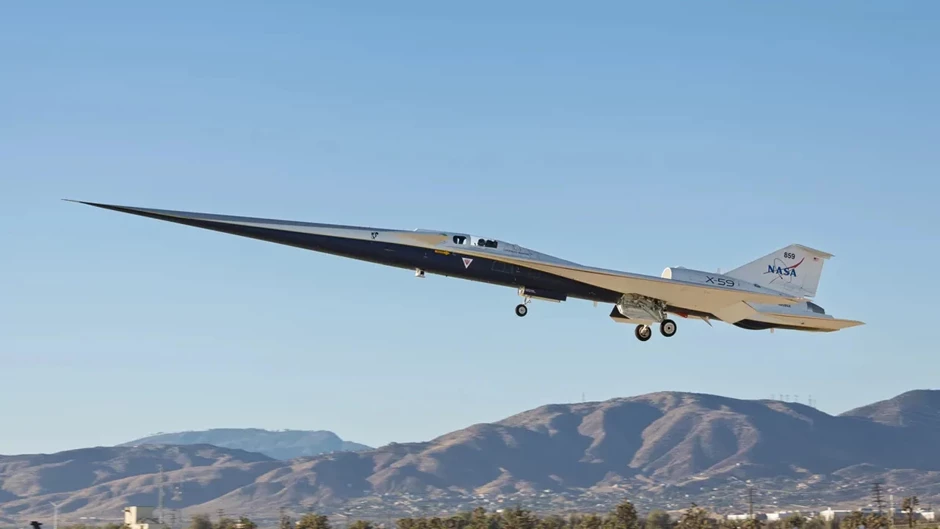
After years of development, the X-59, designed in collaboration with Lockheed Martin, successfully completed its initial flight test. The 30-meter-long, pointed-nose experimental aircraft is expected to reach 1.4 times the speed of sound but will break the shockwaves, producing only a gentle “thump” sound instead of a loud sonic boom.
The long-awaited age of quiet supersonic air travel has moved one step closer with the revolutionary experimental aircraft X-59, designed by US aerospace engineers. Following setbacks in its development process, the aircraft, designed to achieve supersonic speed without causing a sonic boom, successfully completed its initial flight test.
The X-59, developed through a partnership between NASA and Lockheed Martin, took to the skies at sunrise on Tuesday, October 28, 2025. According to the flight tracking system Flightradar24, the experimental aircraft took off from Palmdale Regional Airport and flew for 36 kilometers over the Southern California desert before safely landing at Edwards Air Force Base.
The aircraft, approximately 30 meters long, resembles a futuristic “paper airplane” with its long, pointed nose and super-aerodynamic structure. When it reaches its full potential, the aircraft is expected to reach 1.4 times the speed of sound in the air, or about 1,490 kilometers per hour. However, the truly revolutionary aspect of the X-59 is that it is designed to silently break the sound barrier, which typically produces a loud “boom” when surpassed.
🔇 City-Disturbing Sonic Booms Are Becoming History
When a moving object exceeds the speed of sound, a loud “sonic boom,” similar to thunder, is created by the accumulation and sudden release of high-energy shockwaves. This presented a major obstacle for supersonic commercial travel, as these noisy shockwaves could disturb cities, affect animals, and even potentially damage buildings.
Because of this noise issue, the US government effectively banned supersonic aircraft from conducting commercial flights over the country in 1973. This restriction limited the potential routes for the Concorde and dealt a major blow to the dreams of supersonic travel.
However, that ban has now been lifted, and the X-59 is hoped to be the spark that reignites the flame of supersonic air travel. The aircraft is designed with a unique shape that suppresses the sonic boom. Thanks to its long, pointed nose, it breaks the pressure of the shockwaves that normally cause the booming sound, turning them into a much lighter, muffled “thump.”
The success of the X-59‘s maiden flight has not yet been officially announced by NASA due to the ongoing federal government shutdown. However, Sean Duffy, Acting Associate Administrator for NASA, made a brief comment about this test flight in a statement from Lockheed Martin: “X-59 is a symbol of American ingenuity. This work continues America’s leadership in aeronautics and has the potential to transform how the public flies.”
The X-59, initially planned to take to the skies in 2023, was delayed due to “several technical challenges.” While the team behind the test flight has not yet stated whether the aircraft achieved its quiet “sonic thump” performance, they expressed satisfaction with the progress. OJ Sanchez, Vice President and General Manager of Lockheed Martin Skunk Works, said, “We are proud to be at the forefront of developing quiet supersonic technology.”
You Might Also Like;
- We Selected 10 Series Similar to Stranger Things for Those Who Love It
- Where and How is Silver Used in Electric Vehicles?
- Hyundai Unveils Its Multi-Purpose Wheeled Robot
Follow us on TWITTER (X) and be instantly informed about the latest developments…