Beyond Biology: The Bionic Hand That Survives a Volvo and Threads a Needle


I literally had to pause the video, rub my eyes, and rewind. I couldn’t believe what I was watching. We talk so much about artificial intelligence living in the cloud, generating images, or writing code, but when you put that intelligence into a physical, mechanical body, the game completely changes. I am talking about a newly showcased robotic hand that is pulling off feats I genuinely thought were still decades away.
It feels like I am watching the beginning of the end for human biology as we know it.
We’ve seen robotic hands before. Usually, they are clunky, fragile, and slow. But this? This is something else entirely. It is so incredibly precise that it can effortlessly thread a tiny needle, yet it possesses a structural integrity so insane that it survives getting run over by a massive Volvo SUV without a single scratch. Let’s break down why this specific technological leap is making me question everything I thought I knew about the future of our physical bodies.
The “Volvo Test”: Redefining Extreme Durability
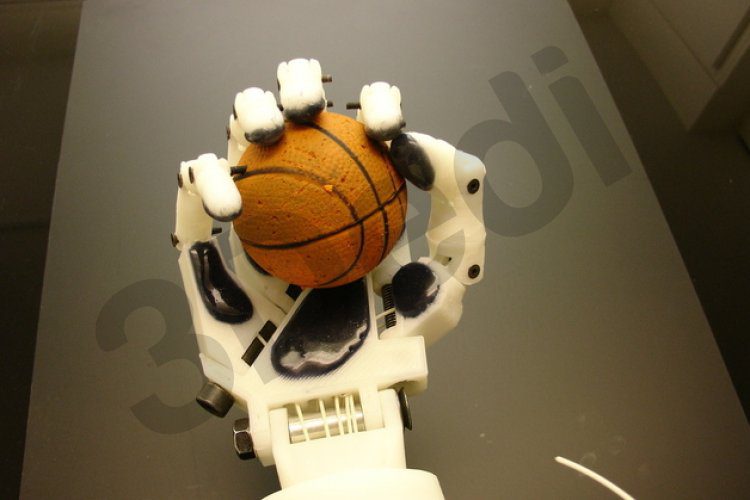
When I research bionics and prosthetics, the biggest hurdle engineers always complain about is the trade-off between weight, dexterity, and durability. If you want a hand that is light enough to wear and agile enough to type on a keyboard, you usually have to use lightweight plastics and delicate motors. If you bump it against a doorframe too hard, it breaks.
But watching a multi-ton Volvo roll directly over this robotic hand—and seeing the hand simply flex its mechanical fingers afterward as if nothing happened—completely shatters that old engineering rulebook.
- Industrial-Grade Materials: This isn’t your standard 3D-printed prosthetic. We are looking at advanced alloys and shock-absorbing synthetic joints that distribute extreme weight perfectly.
- Zero-Compromise Engineering: To survive a crush test of that magnitude means the internal actuators and micro-sensors are shielded in a way that mimics, or perhaps even surpasses, the human skeletal structure.
While researching this, I found myself looking at my own biological hand. If a car runs over my hand, it’s game over. Months of surgery, physical therapy, and permanent damage. This machine just brushed it off.
From Crushing Weight to Micro-Precision

Being indestructible is cool, but a steel anvil is indestructible. What makes a hand a hand is its dexterity.
The exact same bionic appendage that laughed off a car tire was then shown holding a tiny piece of thread and guiding it through the microscopic eye of a needle. I don’t know about you, but I struggle to do that with my own natural hands on a good day.
Achieving this requires a symphony of technology:
- Haptic Feedback Loops: The hand isn’t just moving blindly; it’s likely using advanced sensors to “feel” resistance, adjusting its grip strength on a micro-millimeter level.
- AI-Driven Motor Control: The sheer computing power required to translate intent into such minute mechanical movements is staggering. It’s not just programmed to pinch; it understands the spatial reality of the needle and the thread.
The “Spare Parts” Paradigm: Are We Upgrading?

This brings me to a realization that gave me goosebumps. We are rapidly moving away from an era of medical healing and stepping firmly into an era of medical replacement.
Think about it. Historically, if a limb was injured or failing, the entire medical field was dedicated to trying to repair the biological tissue. But when a mechanical replacement becomes objectively superior to the original biological part—when it is immune to pain, immune to fatigue, and completely indestructible—the philosophy changes.
I really think we are stepping into a crazy new era where humans will just get “spare parts.”
- Joint pain? Just swap out the knee.
- Arthritis in your hands? Upgrade to a bionic model that never cramps.
- Dangerous professions? Firefighters or construction workers could opt for reinforced limbs that can punch through debris or handle extreme heat without blistering.
It sounds like a sci-fi movie, but the hardware is literally sitting right in front of us today. We are looking at the birth of the true cyborg.
What This Means for Us
I don’t want to sound like a doomsday prophet. Actually, I’m incredibly optimistic about what this means for accessibility. For amputees, this technology isn’t just a tool; it’s a profound restoration of independence, offering a quality of life that exceeds what was lost.
But as a tech enthusiast, I can’t help but look at the broader implications. If technology continues at this pace, these “prosthetics” will soon be marketed not just to those who need them, but to those who want them. We might soon see a societal divide between the biologicals and the upgraded.
This bionic hand proves that the barrier isn’t hardware anymore. The only thing left to figure out is how seamlessly we can connect these machines to the human nervous system so they feel like a natural extension of our own minds.
I’m sitting here typing this with ten fragile, biological fingers, and honestly, it makes me wonder about our future. If you had the money and the surgical option tomorrow, would you replace your perfectly healthy, biological arm with a flawless, indestructible robotic one?
Let me know what you think in the comments—I’ll be reading every single one!
You Might Also Like;