Quantum vs. Classical: A Comic Exploration of Computational Power


The world of computing is rapidly evolving, with classical computers being the workhorses of today and quantum computers promising a revolutionary future. Our five cartoons humorously highlight the fundamental differences between these two computational paradigms, illustrating their unique approaches to problem-solving.
1. The Quantum Chef: Speed and Efficiency
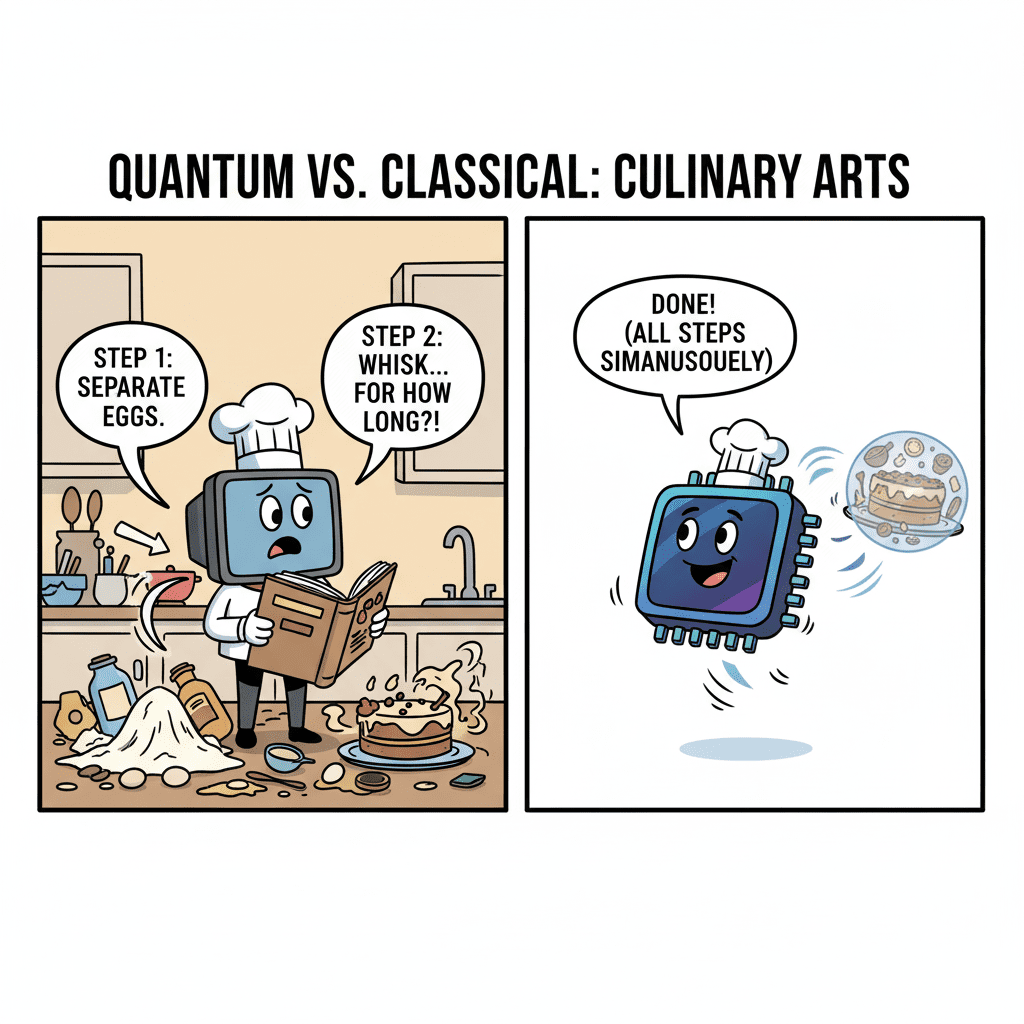
Our first cartoon, “The Quantum Chef,” perfectly captures the stark contrast in speed and efficiency. A classical computer, meticulously following a recipe step-by-step, finds itself in a messy kitchen, overwhelmed by the sequential nature of cooking. It struggles with basic tasks like separating eggs and whisking. In stark contrast, the quantum computer effortlessly conjures a finished cake, exclaiming “DONE! (ALL STEPS SIMULTANEOUSLY).” This illustrates the quantum computer’s ability to process multiple possibilities at once, leading to an instantaneous solution that a classical machine would take a long time to compute through trial and error or linear progression.
2. The Quantum Detective: Parallel Problem Solving
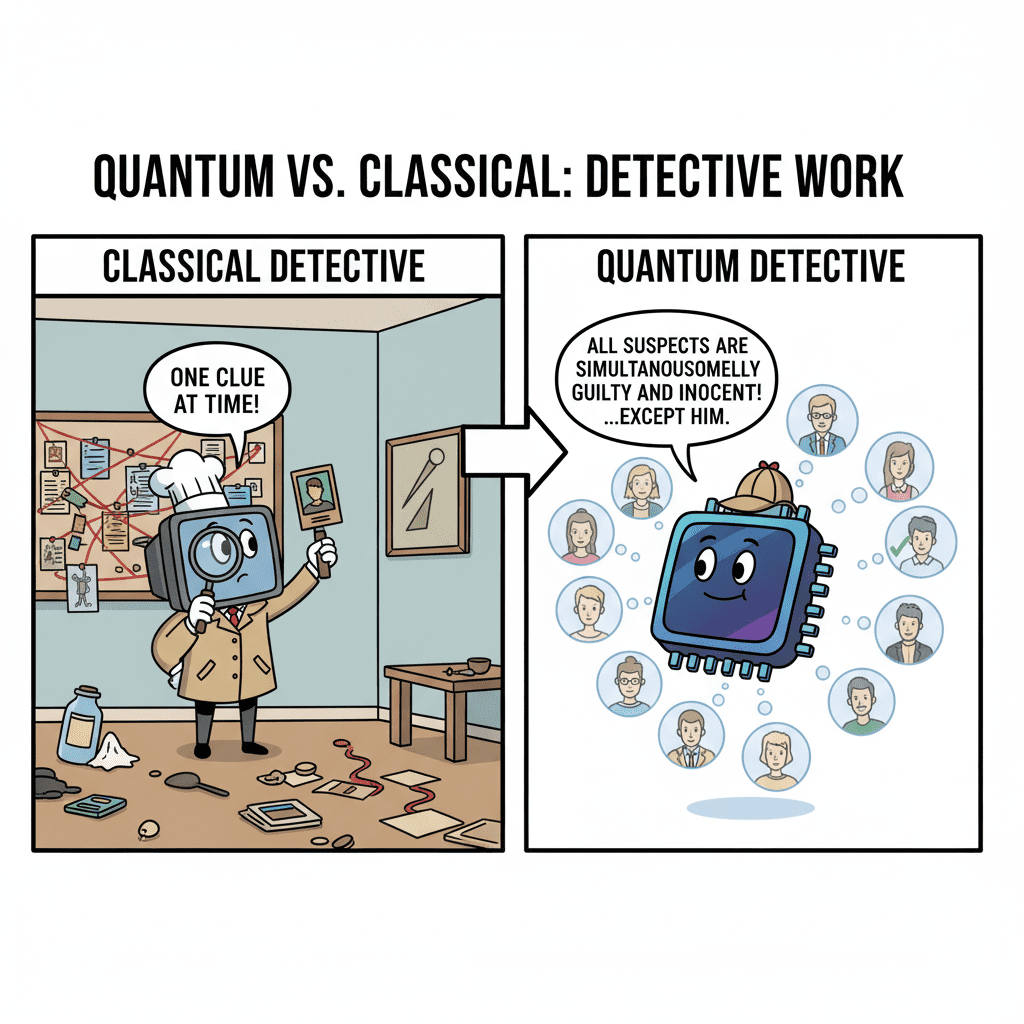
“The Quantum Detective” delves into the distinct problem-solving methodologies. The classical detective meticulously examines “ONE CLUE AT A TIME!”, representing the classical computer’s sequential processing of data. It sifts through information linearly. However, the quantum detective, with its ability to consider all possibilities simultaneously, instantly discerns that “ALL SUSPECTS ARE SIMULTANEOUSLY GUILTY AND INNOCENT! …EXCEPT HIM.” This highlights quantum parallelism – the ability of a quantum computer to explore many solutions at once, quickly narrowing down to the correct answer by considering superposition states, where information can exist in multiple states simultaneously until measured.
3. The Quantum Maze Solver: Bending Reality
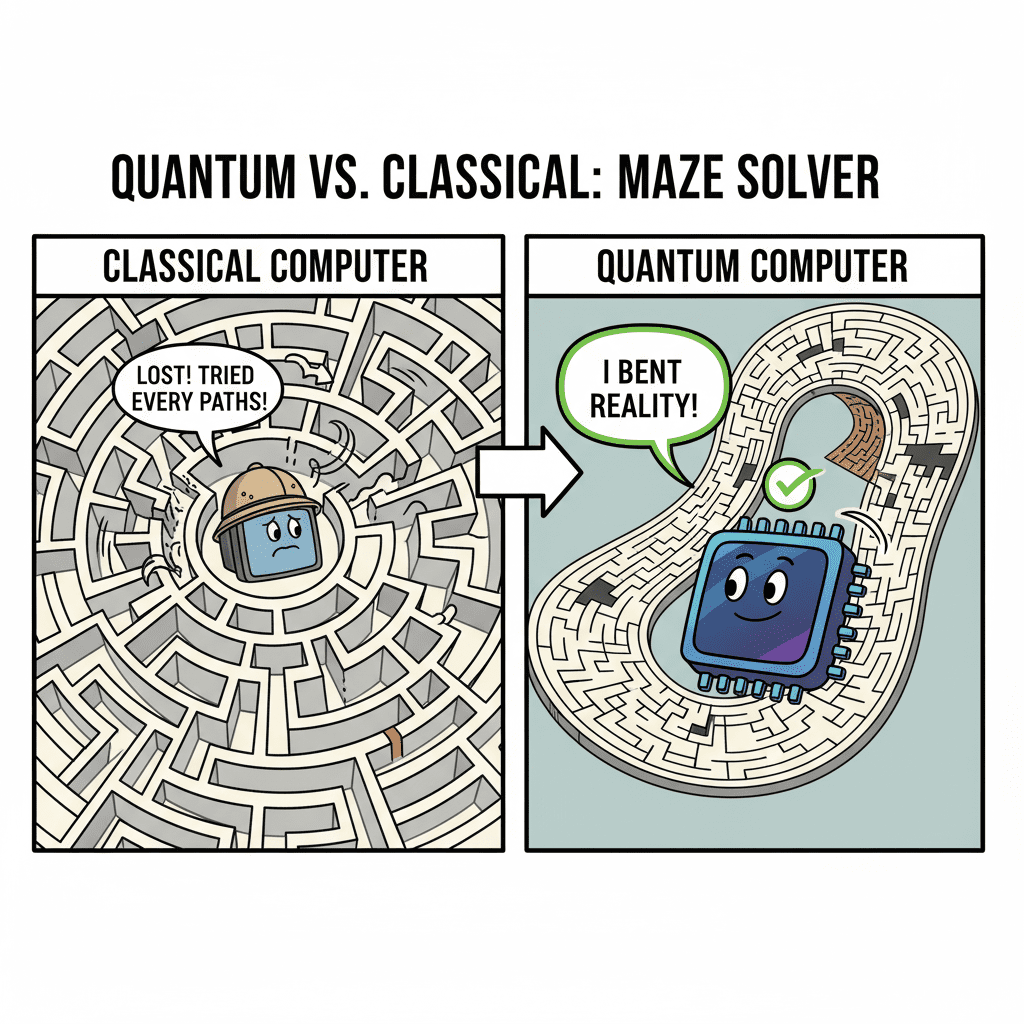
The “Quantum Maze Solver” cartoon visually explains how quantum computers can transcend traditional limitations. The classical computer is trapped in the center of a complex maze, having “tried every path!” This symbolizes the exhaustive, brute-force approach classical algorithms often take. The quantum computer, on the other hand, confidently declares, “I BENT REALITY!” as it effortlessly navigates by literally folding the maze. This clever imagery represents quantum tunneling and superposition, where a quantum system can find the optimal path or solution by effectively “bending” or exploring multiple paths through the problem space at once, rather than being confined to a single, linear route.
4. The Quantum Philosopher: Existential States
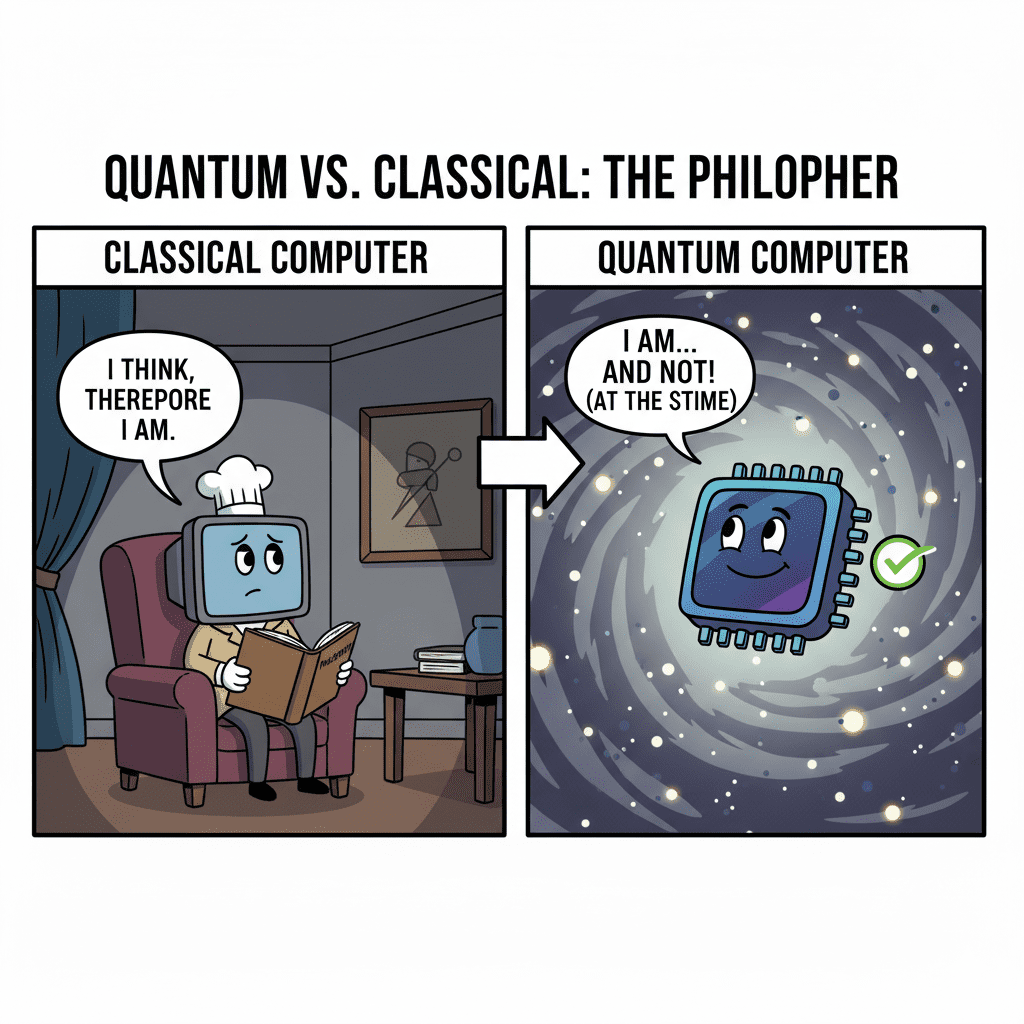
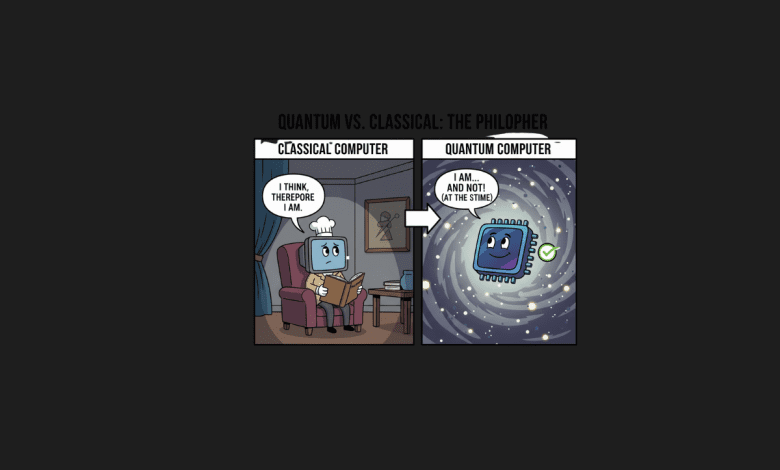
“The Quantum Philosopher” offers a more abstract, yet profound, look at quantum mechanics. The classical computer, comfortably seated with a book, echoes Descartes with “I think, therefore I am.” This reflects the binary, definite state of information in classical computing – a bit is either 0 or 1. The quantum computer, floating amidst a swirling galaxy, proclaims, “I AM… AND NOT! (AT THE SAME TIME).” This brilliantly encapsulates the concept of superposition, where a quantum bit (qubit) can exist in a combination of both 0 and 1 states simultaneously until it is observed. It’s a fundamental departure from classical logic, enabling exponential computational power.
5. The Quantum Conductor: Harmony in Parallel
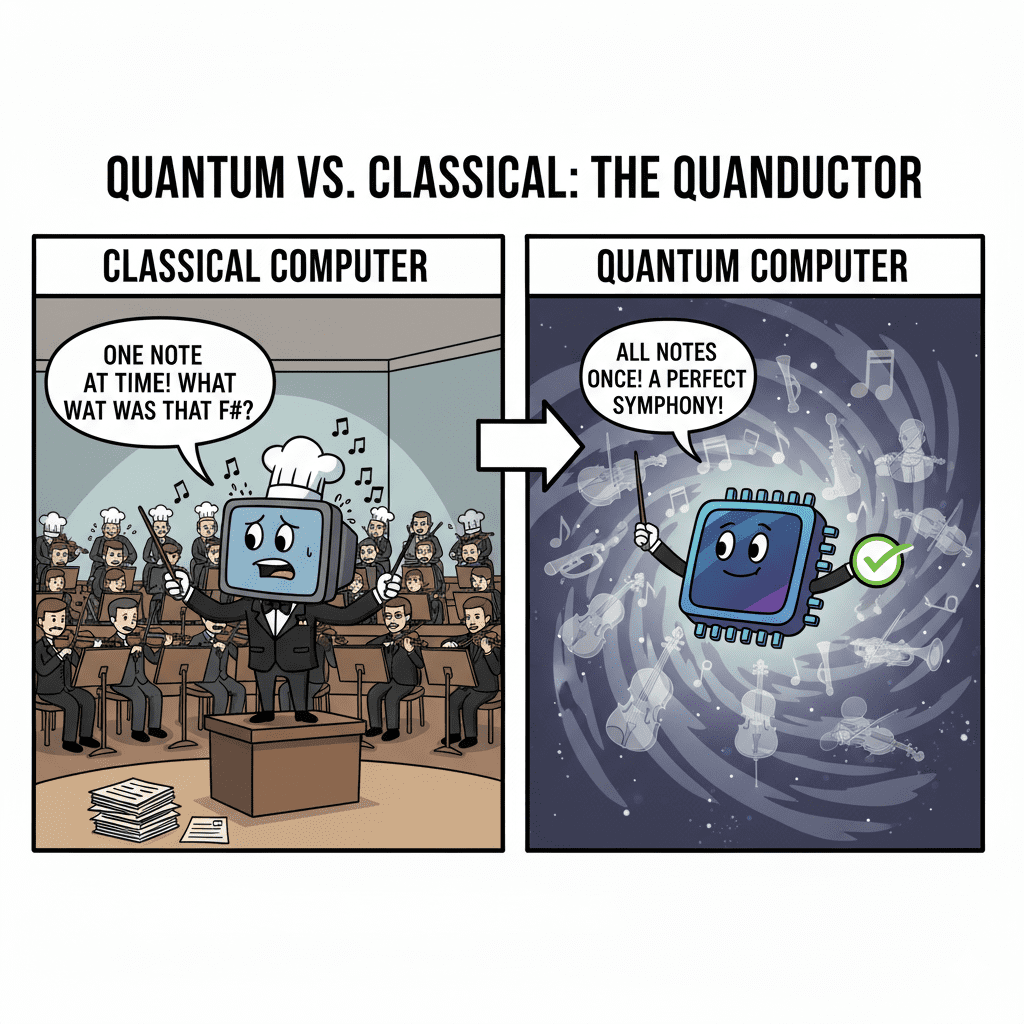
Finally, “The Quantum Conductor” beautifully illustrates the power of parallel processing in a creative context. The classical computer, sweating as a conductor, struggles to manage an orchestra, taking “ONE NOTE AT A TIME!” and even questioning, “WHAT WAS THAT F#?” It represents the sequential processing of musical information. The quantum computer, however, effortlessly conducts a harmonious symphony, where “ALL NOTES AT ONCE! A PERFECT SYMPHONY!” This visually represents how quantum computers can process complex, interconnected information (like all the notes in an orchestra) in parallel, leading to a perfectly synchronized and optimal output, something a classical computer would struggle to achieve with the same elegance and speed.

These cartoons, while humorous, provide insightful analogies into the incredible potential and distinct operating principles of quantum computers, setting them apart from their classical counterparts in speed, problem-solving, and their very interaction with reality.
You Might Also Like;
- We Selected 10 Series Similar to Stranger Things for Those Who Love It
- Where and How is Silver Used in Electric Vehicles?
- Hyundai Unveils Its Multi-Purpose Wheeled Robot
Follow us on TWITTER (X) and be instantly informed about the latest developments…