Is Our Reality Just High-End Software? Exploring the Simulation Hypothesis


I was staring at my coffee this morning, watching the steam curl in perfect, fractal-like patterns, and I couldn’t shake a thought that’s been bothering me lately: Is this all actually real? I know, it sounds like something straight out of a sci-fi flick or a late-night philosophy dorm session, but the Simulation Hypothesis is moving out of the realm of “stoner thoughts” and into serious scientific discussion. I’ve spent the last few days digging into the physics and the philosophy behind this, and honestly? It’s a bit chilling.
I’m not saying we’re definitely living inside a cosmic version of The Sims, but the evidence (or lack thereof) is enough to make anyone pause. Let’s dive into why some of the smartest people on Earth think we’re just lines of code.
The Mathematical “Pixels” of Our Universe
One thing that really tripped me up while I was researching this is the concept of Planck length. In physics, there is a minimum scale beyond which the laws of nature as we know them just… stop. It’s the smallest possible measurement.
Think about that for a second. In a video game, if you zoom in far enough, you hit the pixel. If our universe has a “minimum resolution,” doesn’t that feel a little too much like a rendering constraint?
I used to think the world was continuous, like a smooth slide. But modern physics suggests it might be discrete, more like a digital screen. When I first read about this, it gave me chills because it implies the universe might have a “hardware limit.”
Why Great Minds Are Taking This Seriously

It’s not just “Ugu” sitting here wondering about the Matrix. People like Elon Musk and astrophysicist Neil deGrasse Tyson have famously entertained this idea. Their logic usually follows a simple path:


- Progress is inevitable: Look at Pong from 40 years ago. Two rectangles and a dot.
- The Leap: Now look at photorealistic VR and AI-driven worlds.
- The Future: If technology continues to improve at any rate, we will eventually create simulations that are indistinguishable from reality.
- The Odds: If there are millions of such simulations, what are the odds that we are the “Base Reality” (the original creators) and not one of the simulated ones?
Statistically, the odds of us being “Real 1.0” are billions to one. It’s a humbling, and slightly terrifying, perspective. I personally like to think my feelings and your experiences are “organic,” but math is a stubborn thing.
The “Glitches” and the Role of the Observer
We’ve all seen those “Glitch in the Matrix” threads on Reddit—clocks jumping, objects disappearing and reappearing, or that weird feeling of déjà vu. While I’m a skeptic and usually chalk these up to brain farts or memory lapses, there’s a scientific equivalent that’s even weirder: The Double-Slit Experiment.
In quantum mechanics, particles behave differently when they are being watched versus when they aren’t. It’s as if the universe optimizes its resources, only rendering the “details” when a player (an observer) is looking at them.
My Take: This looks suspiciously like “Occlusion Culling” in game engines like Unreal Engine 5, where the computer doesn’t render what’s behind the player to save processing power. Why would the universe waste energy on things no one is looking at?
Are We Just NPCs with Better Dialogue Trees?

The rise of Large Language Models and NPCs that can actually hold a conversation makes me wonder about our own consciousness. If I can’t tell the difference between a high-level AI and a human in a digital world, how do I know I’m not the one being simulated?
I don’t think we’re “just” code—I believe there’s something more to the human spirit—but the line is getting blurrier every day. Exploring the boundaries of the Metaverse isn’t just about VR headsets anymore; it’s about asking what defines “existence.”
What Do You Think?
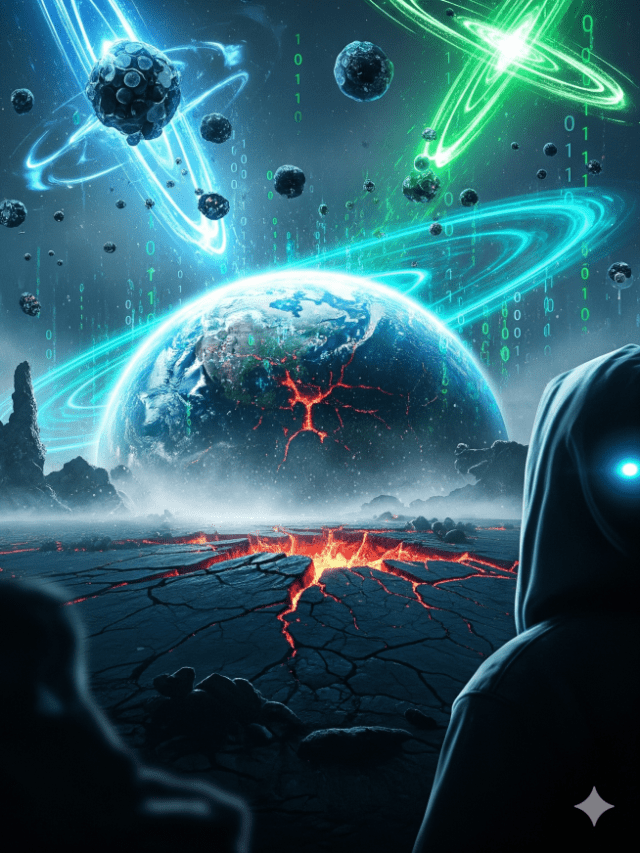
I’m still leaning towards us being “real,” mostly because I want my morning coffee to actually exist. But the more I look at the math, the more I feel like I’m looking at the source code of a very complex engine.
I’m dying to hear your thoughts on this one. Have you ever experienced a “glitch” that you couldn’t explain away with logic? Or do you think we’re giving ourselves too much credit by assuming someone would bother simulating us in the first place?
Let’s chat in the comments!
You Might Also Like;