The King Returns: Peregreen V4 Shatters the World Speed Record



If you blink, you will miss it. Actually, even if you don’t blink, you might still miss it.
I have been obsessed with FPV drones and quadcopters for years. Usually, when we talk about drones, we are discussing how stable they are for camera work or how long their battery lasts. But there is a subculture in the drone world that cares about only one thing: raw, unadulterated speed.
The crown for the “World’s Fastest Drone” has just changed hands again, and the numbers are frankly terrifying. The Peregreen V4 has officially reclaimed the Guinness World Record, clocking in at a mind-bending 657.59 km/h (408 mph).
To put that into perspective, that is faster than a Bugatti Chiron. It is faster than a Formula 1 car. It is approaching the cruising speed of a World War II fighter plane—and it’s a battery-operated quadcopter built by a father-and-son team from South Africa.
Let’s dig into how Luke and Mike Bell pulled off this engineering miracle.
Not Just a Toy: A Masterclass in Aerodynamics
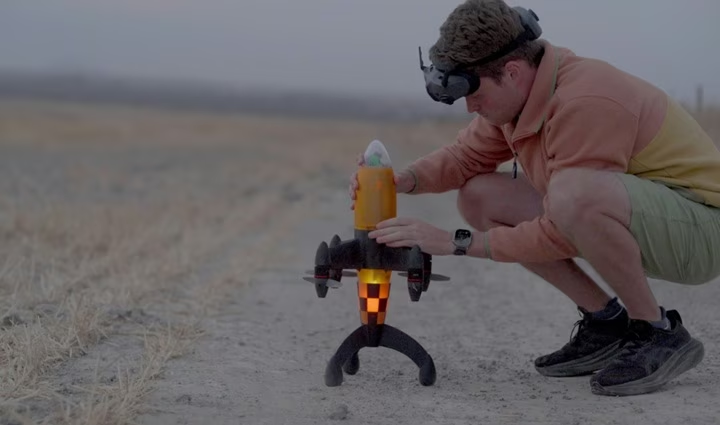
When I first saw the footage of the Peregreen V4, it didn’t look like a standard drone. It looked like a bullet. And that is exactly the point.


This record wasn’t broken by simply slapping a bigger battery onto a bigger motor. That’s the brute force method, and at these speeds, brute force fails because of air resistance. The Bells spent over two years refining this design, and the V4 is the culmination of failures, learnings, and genius engineering.
The Secret Weapon: 3D Printing
What surprised me the most while researching this project is how they built the chassis. You might expect carbon fiber molds baked in an autoclave, but they went a different route: Advanced 3D Printing.
- Monocoque Design: The drone’s body was printed as a single piece. This reduces drag because there are fewer seams and bolts catching the wind.
- Dual-Nozzle Technology: They used a high-speed, dual-nozzle 3D printer. This allowed them to mix materials in the same print. They could make the tail rigid for stability while keeping the camera mount flexible to absorb vibrations.
I have used 3D printers for hobby projects, but seeing them used to manufacture a vehicle that breaks 400 mph is a testament to how far additive manufacturing has come.
Under the Hood: The Specs That Defy Physics
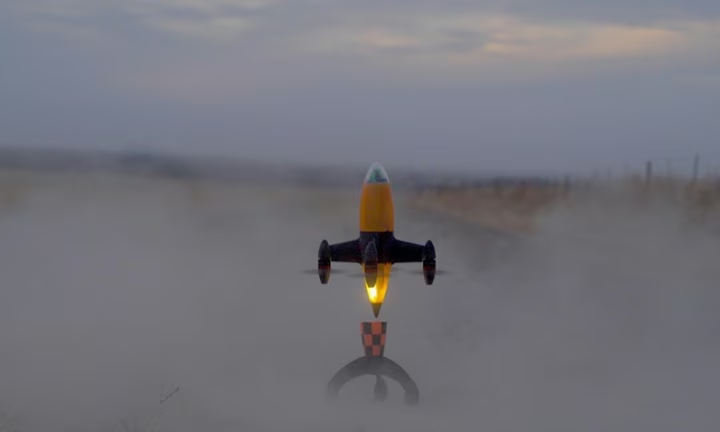
So, how do you push a small object to 657 km/h without it disintegrating? It comes down to a perfect marriage of electronics and airflow.
1. The Motors (The Heart) The team used custom brushless motors. But here is the tweak: they upgraded the windings to handle a much higher RPM (revolutions per minute). Standard drone motors would burn out or tear themselves apart at the stress levels required for this record.
2. The Battery (The Fuel) They used Lithium-Ion Polymer (Li-Po) batteries with an exceptionally high discharge rate. When you throttle up to 100% in a split second, the voltage sag can kill your run. These batteries were chosen specifically to dump massive amounts of energy instantly without blowing up.
3. The Shape (The Skin) This is where the math comes in. The team used digital flow simulations (CFD) to model how air moves over the drone.
- They minimized the frontal area to cut through the air.
- They optimized the propeller blades, making them smaller in diameter but capable of spinning at much higher speeds.
How the Record Was Validated
Guinness World Records doesn’t mess around. You can’t just fly the drone in a tailwind and claim a record. To be official, the Peregreen V4 had to perform two runs in opposite directions to negate the effect of wind assistance.
The official speed is the average of those two runs.
- Top Speed: It actually hit speeds higher than the average during the peaks.
- Official Record: 657.59 km/h.
This brings the title back to Luke and Mike Bell, who had held it previously before losing it to a rival engineer. This competitive ping-pong match is driving innovation faster than any corporate R&D department could.
Why Does This Matter?
You might be thinking, “Ugu, this is cool, but why do I care if a drone goes this fast?”
Here is my take: Racing improves the breed. Just like Formula 1 innovations eventually end up in your family sedan, the tech developed for these speed runs will filter down to the rest of us.
- Efficiency: To go fast, you need to be efficient. These motor and propeller designs could lead to delivery drones that fly longer and quieter.
- Durability: The materials that survive 657 km/h will make standard drones indestructible.
- Emergency Response: Imagine a medical drone that can deliver an EpiPen or a defibrillator to a patient 10 miles away in less than 2 minutes. That is the potential of this speed.
My Final Thoughts
I love the “garage inventor” spirit of this story. In an era where technology is dominated by trillion-dollar tech giants, it warms my heart to see a father and son using 3D printers and smart coding to smash world records.
It reminds me that innovation isn’t just about budget; it’s about passion. The Peregreen V4 is a beast, and frankly, I’d be terrified to fly it. I think I’ll stick to my camera drone for now—it moves at a snail’s pace, but at least I can see it.
What about you? If you had the controls of a drone that flies at 650 km/h, would you trust your reflexes to fly it, or would you crash it in the first 5 seconds like I probably would? Let me know in the comments!
You Might Also Like;