Miracle Material Revolutionizing Medicine, Science, and Security: CZT

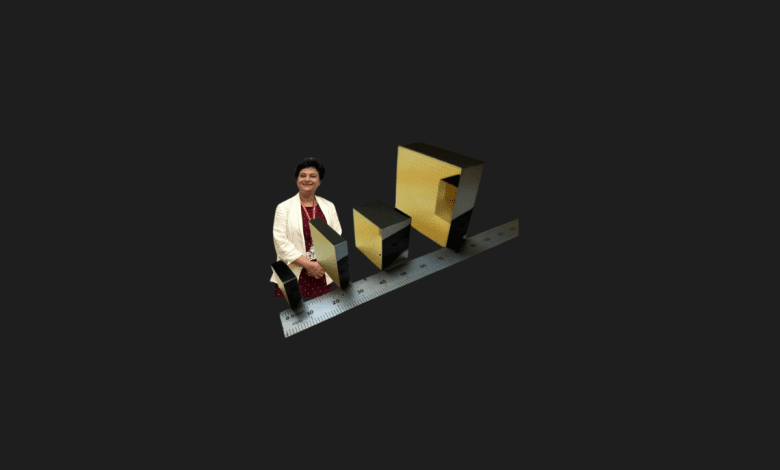

Hard-to-produce semiconductor CZT powers a revolution in technology by providing high precision in many fields, ranging from lung imaging to space research and security scans.
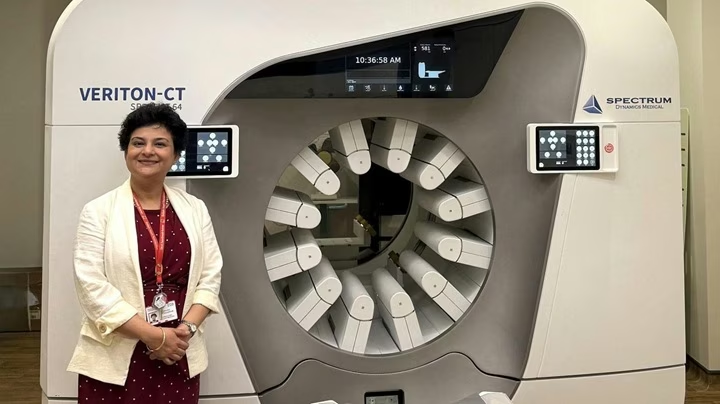
The new generation Veriton-CT SPECT/CT 64 scanner, installed last year at the Royal Brompton Hospital in London, reduced the time patients spend on lung examinations from 45 minutes to 15 minutes. Behind this remarkable acceleration is not only advancements in image processing software, but also cadmium zinc telluride (CZT), long known in the scientific world as the “hard-to-produce miracle material.”
Each Device Costs £1 Million Dr. Kshama Wechalekar, head of the hospital’s nuclear medicine and PET unit, states that the images produced by the device possess an extraordinary level of detail, calling it an impressive achievement in terms of both engineering and physics. The CZT detectors used in the scanner installed last August make it easier to detect very small clots or large vessel blockages in patients’ lungs.
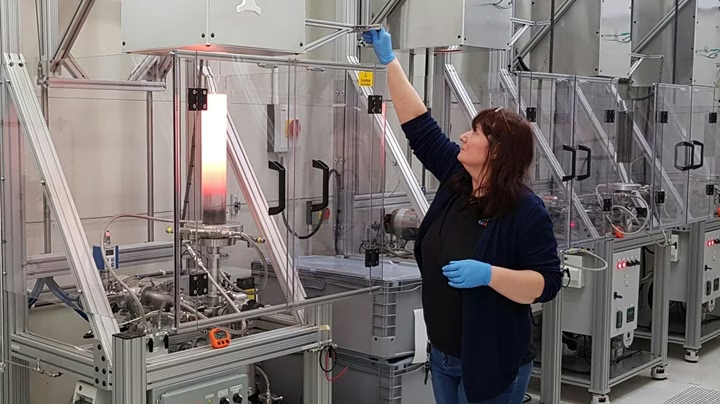
The device, worth approximately £1 million ($1.34 million), works by detecting gamma rays emitted by the radioactive substance injected into the patient. However, thanks to the high sensitivity of CZT, the radioactive dose used can be reduced by approximately 30% compared to previous systems. Integrating these detectors, previously used only in small devices, into full-body scanners is a significant new step. Although CZT itself is not new, its production is extremely laborious.
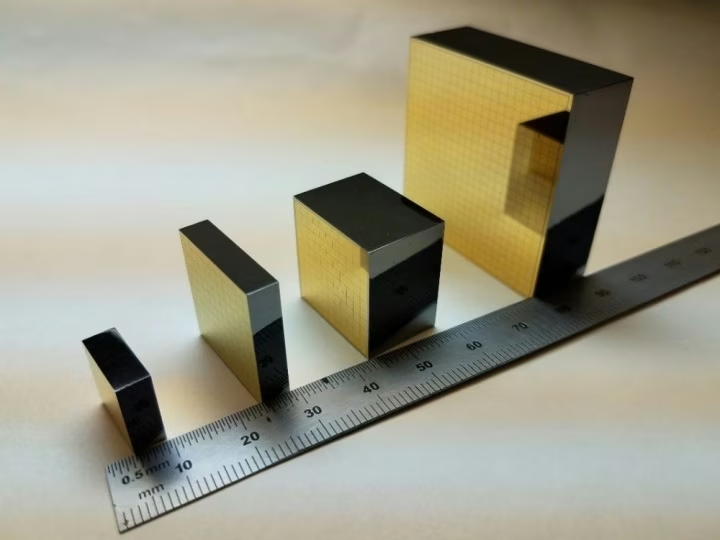
UK-based Kromek is one of the few companies in the world capable of producing this material on an industrial scale. At Kromek’s facility, a production line consisting of 170 small furnaces melts special powders and resolidifies them over a process lasting weeks to form single-crystal structure CZT blocks. The company’s founding CEO Arnab Basu emphasizes that the crystals are formed by “aligning at the atomic level.”
The resulting semiconductor material can detect photons in X-rays and gamma rays with extraordinary accuracy. When a high-energy photon hits CZT, the released electrons allow for image creation via single-step digital conversion. This ensures that energy, timing, and spectral information are processed without loss, meaning the scanner can produce “color” or spectroscopic images.


CZT technology is used not only in healthcare but also in airport security and explosive detection systems. Kromek’s sensors are currently used in some airports in the UK and are also found in baggage scanners in the USA. The company expects CZT usage in hand luggage scanners to become widespread within a few years.
Beyond these fields, CZT is also used in space sciences. For example, some research institutions use CZT in space telescopes carried by high-altitude balloons. Thin CZT layers of only 0.8 mm are needed for these detectors, which can capture X-rays emitted from plasma around neutron stars and black holes. However, since production is difficult and demand is high, project-based production is challenging.
This material is also used in particle accelerators. X-rays produced in facilities where electrons rotate around a giant ring at speeds close to the speed of light are used in material analysis. Significant increases in X-ray brightness are expected in new beamlines with enhanced electrical properties. However, existing detectors lack the capacity to handle this intensity. The Diamond Light Source cyclotron in the UK also requires this material for its half-billion-pound major upgrade.
You Might Also Like;
- How Google DeepMind’s GNoME Just Fast-Forwarded History by 800 Years
- The Growing Risk in Low Earth Orbit: Humanity’s Space Adventure Could End Abruptly
- Is Solar Powered Crypto Mining Profitable?