Elon Musk vs. Kardashev Scale: Why We Are Still Type 0


When we watch SpaceX land a Starship rocket or hear Elon Musk talk about building cities on Mars by 2050, it feels like we are living in the future. We have smartphones, artificial intelligence, and rovers on other planets. Humanity feels incredibly advanced.
But what if I told you that on a cosmic level, we haven’t even left the cradle yet?
While landing on Mars is a massive achievement for us, to an advanced alien civilization watching from afar, it would look like a baby taking its very first wobbly step.
To understand our true place in the universe, we need to stop measuring progress by our own standards and start measuring it by cosmic standards. Enter astrophysicist Nikolai Kardashev and his legendary measuring stick: The Kardashev Scale.
Here is the humbling truth about where we are, and the mind-bending potential of where we could go.
What is the Kardashev Scale?
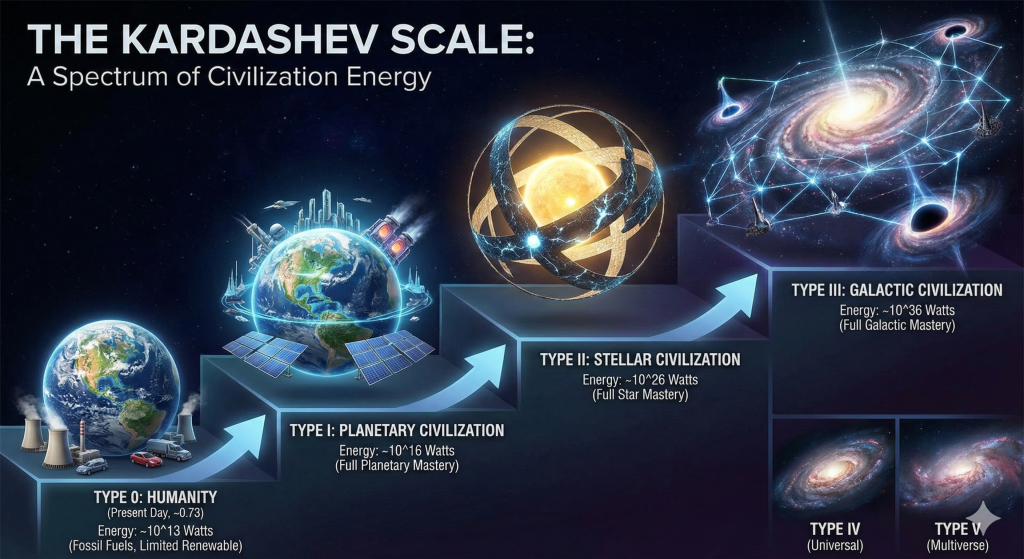
Proposed in 1964 by Soviet astronomer Nikolai Kardashev, the scale is a theoretical method for measuring an advanced civilization’s level of technological advancement.
Kardashev realized that as a civilization grows, its energy needs grow exponentially. Therefore, the best way to judge a civilization’s power isn’t by its philosophy or art, but by how much energy it can harness.
The scale originally had three categories: Type I, Type II, and Type III.
So, where does humanity fit? Get ready for a reality check.
The Reality Check: We Are Type 0.7 (Cosmic Babies)
Many people assume we are already Type 1. We are not.
According to scientists like Carl Sagan (who refined the scale), humanity is currently sitting at approximately Level 0.73.
Why are we ranked so low? A civilization at this level is still dependent on harvesting energy from dead plants and animals (fossil fuels like coal and oil) found on its home planet.
We are still subject to the whims of our planet. A massive volcano, an asteroid, or runaway climate change could wipe us out. We don’t control Earth; Earth controls us. We are still fighting over resources and have not unified as a planetary species.
Mars is a great step, but until we master our own home, we remain a “Type 0” civilization.
Type 1 Civilization: The Planetary Masters
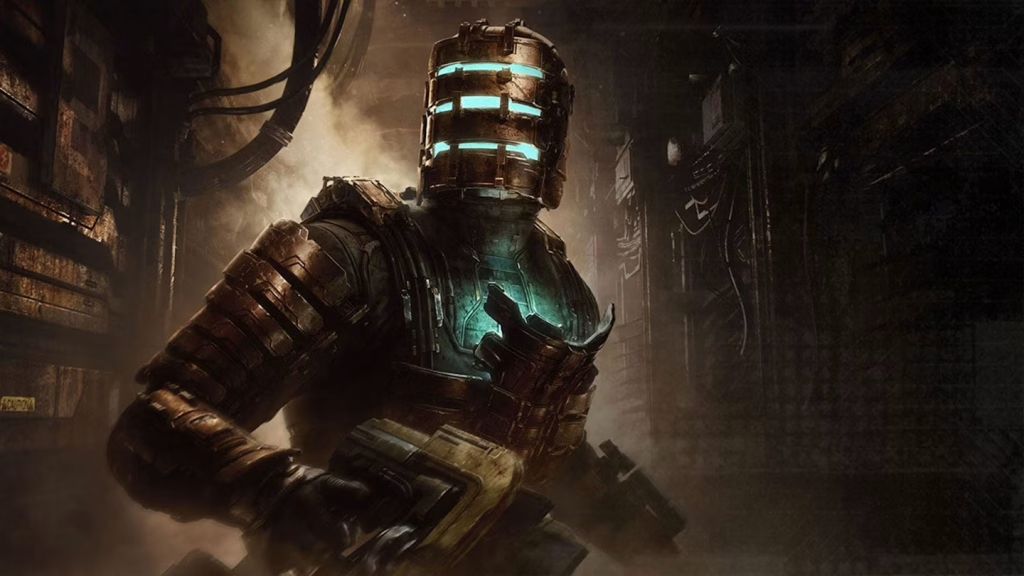
- Energy Source: 100% of the energy falling on their planet from their parent star.
- Status: We might reach this in 100–200 years.
A Type 1 civilization has completely mastered its home planet. They no longer burn fossil fuels. Instead, they have achieved perfect fusion power, advanced solar collection, and perhaps even control over geological forces.
What life looks like: They can control the weather, stop hurricanes, prevent earthquakes, and clean their oceans instantly. It is a global, unified society living in harmony with its planet’s energy systems. This is the “Star Trek” vision of Earth.
Type 2 Civilization: The Stellar Gods
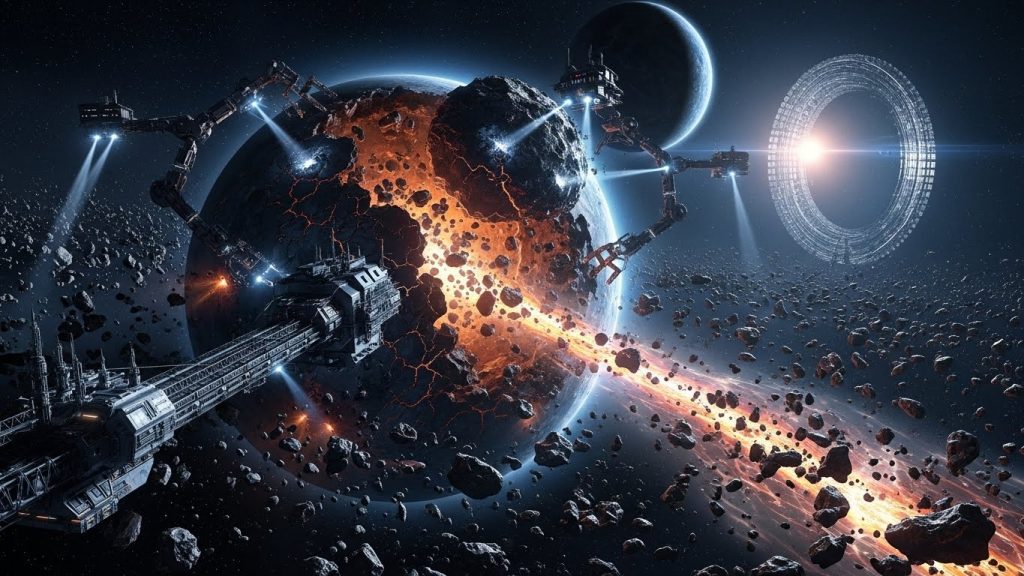
- Energy Source: 100% of the energy output of their entire star (The Sun).
- Status: Thousands of years in the future.
This is where things get mind-bending. A star produces an unimaginable amount of energy, and a Type 1 civilization only captures a tiny fraction that hits their planet.
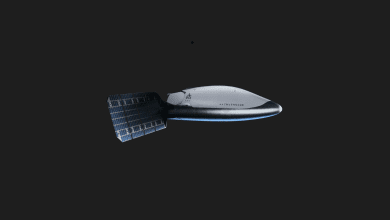
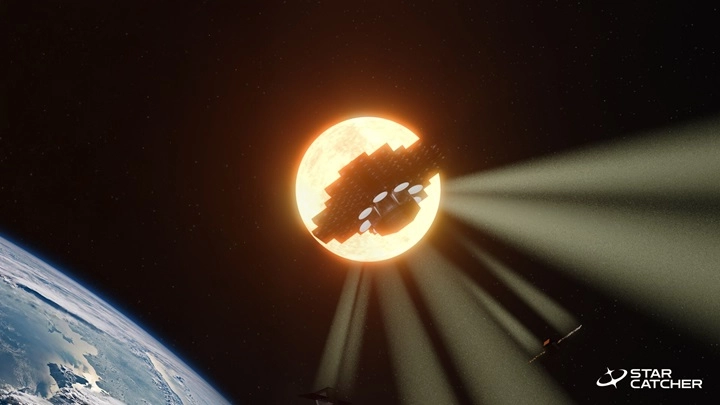
A Type 2 civilization needs all of it. To do this, they must build megastructures around their star. The most famous concept is the Dyson Sphere—a massive shell or swarm of satellites that completely surrounds a star to harvest its energy.
What life looks like: With unlimited energy, they become virtually immortal. They can terraform planets in decades, travel between nearby stars easily, and if their home star became unstable, they would have the power to literally move their planet to a safer location. They are immune to extinction events.
Type 3 Civilization: The Galactic Empire

- Energy Source: The total energy output of an entire galaxy (like the Milky Way).
- Status: Hundreds of thousands to millions of years in the future.
This is the realm of pure science fiction—think the Empire in Star Wars or the civilization in Asimov’s Foundation.
A Type 3 civilization has colonized every inhabitable system in their galaxy. They draw energy not just from billions of stars, but perhaps even from the supermassive black holes at the galaxy’s center.
What life looks like: They are god-like to us. They manipulate spacetime, travel instantly across the galaxy, and engineer entire solar systems. If we encountered them, we would likely be like ants to them—too insignificant to even notice.
Conclusion: The “Sad Truth” (The Great Filter)
Looking at this scale inspires awe, but it also brings a terrifying question: If it’s possible to become galactic gods, where is everyone? Why haven’t we seen Dyson Spheres or evidence of Type 3 empires?
This leads to the concept of “The Great Filter.”
It is the theory that there is some massive hurdle in the development of life that makes reaching Type 1, 2, or 3 incredibly rare. Perhaps civilizations destroy themselves with nuclear war, AI, or climate change (the stage we are in now) before they can graduate to Type 1.
Elon Musk’s push for Mars isn’t just about exploration; it’s an attempt to ensure humanity survives long enough to pass the Great Filter.
We are at the most critical point in human history. We will either graduate to Type 1, or we will remain a Type 0 civilization forever, buried in the fossil record of Earth.
🚀 What do you think? Will humanity survive long enough to become a Type 1 Civilization? Let us know in the comments on our YouTube channel!
You Might Also Like;
- We Selected 10 Series Similar to Stranger Things for Those Who Love It
- Where and How is Silver Used in Electric Vehicles?
- Hyundai Unveils Its Multi-Purpose Wheeled Robot
Follow us on TWITTER (X) and be instantly informed about the latest developments…