Groundbreaking Method Developed by Scientists to Control Terahertz Light

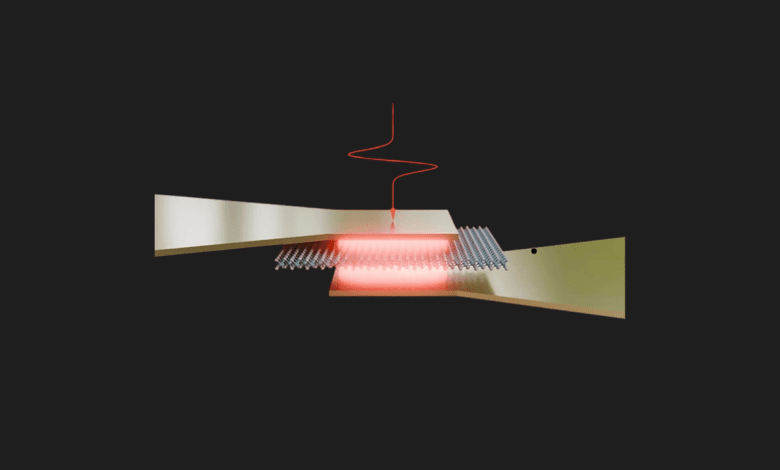

Scientists have developed a new method that allows for the control of terahertz light. This discovery holds great promise for faster communication, advanced quantum devices, and efficient energy solutions.
Scientists have developed a new method for controlling specific light waves in two-dimensional materials. This breakthrough has the potential to pave the way for both faster wireless communication technologies and innovative quantum devices.
The research focuses on a type of wave called Dirac plasmon polaritons (DPPs), where light combines with electron movement. These waves can compress light to hundreds of times smaller than its natural wavelength. This makes it possible to design optical components on a scale as small as electronic circuits.
DPPs are particularly important in the terahertz (THz) frequency range (the region between microwaves and infrared). Although this range could be used in many fields such as medical imaging, high-speed data transfer, and security screening, it has been underutilized until now because THz light could not be controlled.
A Technique That Overcomes Limitations Has Been Developed

In a new study, scientists managed to overcome these difficulties. Researchers designed special metamaterials using bismuth selenide (Bi₂Se₃), a topological insulator that is conductive only on its surfaces. The material was arranged in strips with very small gaps between them. By changing these gaps, the movement of the polaritons could be precisely adjusted.
In the experiments, a near-field microscope was used to image how the DPPs propagated in these structures. The team successfully shortened the wavelength by 20% and increased the distance the waves traveled without energy loss by more than 50% by changing the distance between the strips.


The Potential Is Huge
This advancement directly addresses two fundamental problems that have prevented the use of DPPs in the terahertz field: difficult excitation conditions and short range. This significantly increases the usability of these special light waves in real-world applications. According to experts, the finding could enable the development of smaller and more efficient terahertz detectors, modulators, and waveguides in the future. It could also form a strong basis for reconfigurable photonic circuits, highly efficient solar panels, and quantum computing technologies.
You Might Also Like;