
I woke up yesterday, checked the market tickers, and thought for a split second that the gaming industry had collapsed. It was a sea of red. Unity was down nearly 19%. Roblox took a massive hit. Even the giants like Take-Two (the folks behind GTA) were stumbling.
What caused this panic? Did gamers stop playing? Did a massive server farm explode? No.
Google just showed us a magic trick called “Project Genie.”
It’s a new AI tool that lets you create playable, interactive virtual worlds just by typing or uploading a picture. Investors took one look at this and immediately jumped to the conclusion: “If AI can build games in seconds, who needs game developers?”
But as someone who actually builds content and follows this tech closely, I’m here to tell you: Put the panic button away. While Project Genie is mind-blowing, we aren’t witnessing the death of game development. We are witnessing its mutation.
The “Panic Sell” That Shook the Market

Let’s look at the damage first. When Google announced that Project Genie (powered by their DeepMind Genie 3 model) allows users to generate interactive worlds in real-time, Wall Street freaked out.


Here is what happened to the big players:
- Unity Technologies: -18.80% (Investors fear engines will become obsolete).
- Roblox: -13% (Why build in Roblox if Google does it for you?).
- Take-Two Interactive: ~10% (Even GTA isn’t safe from the speculation).
- CD Projekt RED: -8%.
The logic here is brutal but simple: Investors believe that if an AI can generate a 3D world on the fly, the value of traditional coding and 3D modeling drops to zero. But is that actually true?
What Actually Is Project Genie?
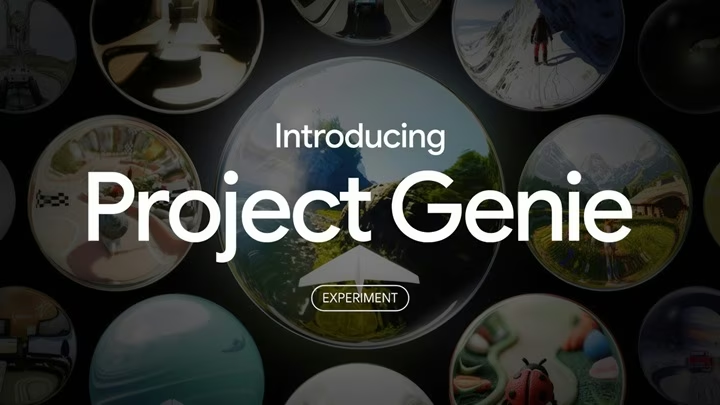
I dove into the technical documentation so you don’t have to. Project Genie isn’t just a video generator like Sora. It’s what they call a “World Model.”
Think of it like a dream. When you dream, your brain generates the world as you move through it. That is what Genie does. It predicts the next frame based on your input.
The tool offers three core features:
- World Sketching: You upload a sketch or type a prompt (e.g., “A cyberpunk city made of candy”), and it builds the foundation.
- World Exploration: As you move your character, the AI generates the path ahead of you in real-time. It’s literally building the road while you drive on it.
- World Remixing: Take an existing world and tell the AI, “Make it underwater,” and it rewrites the reality instantly.
It runs on a complex stack involving Genie 3, Gemini, and Nano Banana Pro (yes, that’s the real name).
The Reality Check: Why Developers Are Safe (For Now)
Before we declare the end of the Unreal Engine era, let’s look at the limitations. I found the fine print, and it is significant.
- The “Dream” is Short: Currently, the generation is limited to 60 seconds. You aren’t building an RPG; you’re building a Vine.
- Resolution & Speed: It runs at 720p and 24fps. That’s fine for a retro vibe, but it’s not running Call of Duty.
- No Game Logic: This is the big one. Genie creates visuals. It doesn’t understand “Health Points,” “Inventory Systems,” or “Quest Logs.” It’s a hallucination you can walk through, not a structured game.
- The Price Tag: Access requires a Google AI Ultra subscription, which costs a whopping $250 per month. This isn’t for the average kid in their bedroom yet; it’s an enterprise experiment.
My Perspective: The Future of “Soft” Gaming

Here is my take. I don’t think Project Genie kills Unity or Unreal. I think it creates a completely new genre of entertainment.
I call it “Soft Gaming.”
Right now, games are “hard.” They have rigid rules, collision detection, and scripted events. Project Genie represents a future where games are fluid. Imagine a Dungeons & Dragons session where the Dungeon Master describes a cave, and the screen instantly shows that cave, generated on the fly for the players.
The investors selling off Unity stock are missing the point. This technology will likely be integrated into game engines, not replace them. Imagine an artist sketching a level and having Unity auto-populate the 3D assets using a Genie-like plugin. That doesn’t kill the artist; it makes them 100x faster.
We are looking at a “Preview” of the future, not the final product.
The panic selling is an overreaction, but the technology is undeniably real. We are moving from “Code-Based Rendering” to “AI-Based Hallucination.” It’s messy, it’s glitchy, but it’s absolutely magical.
I’m curious: If you could type one sentence and have a playable world generated instantly, what would you build first? I’d probably start with a recreation of my childhood neighborhood—but on Mars. Let me know your ideas in the comments!
You Might Also Like;