Earth Eaten Alive in 72 Hours? The Terrifying Truth About the ‘Grey Goo’ Scenario


Imagine a robot smaller than a virus. It doesn’t carry weapons. It doesn’t have a laser. Its only mission is to survive and reproduce. It grabs a nearby molecule, rearranges the atoms, and creates a perfect copy of itself.
Now there are two. Then four. Then eight.
It sounds like a biology experiment, but this is physics. And according to the “Grey Goo” theory, this exponential growth could consume all life on Earth in just 3 days.
In our latest Metaverse Planet video, we touched on this nightmare scenario. But is it actually possible? Here is the deep dive into the end of the world by nanotechnology.
What is the Grey Goo Scenario?
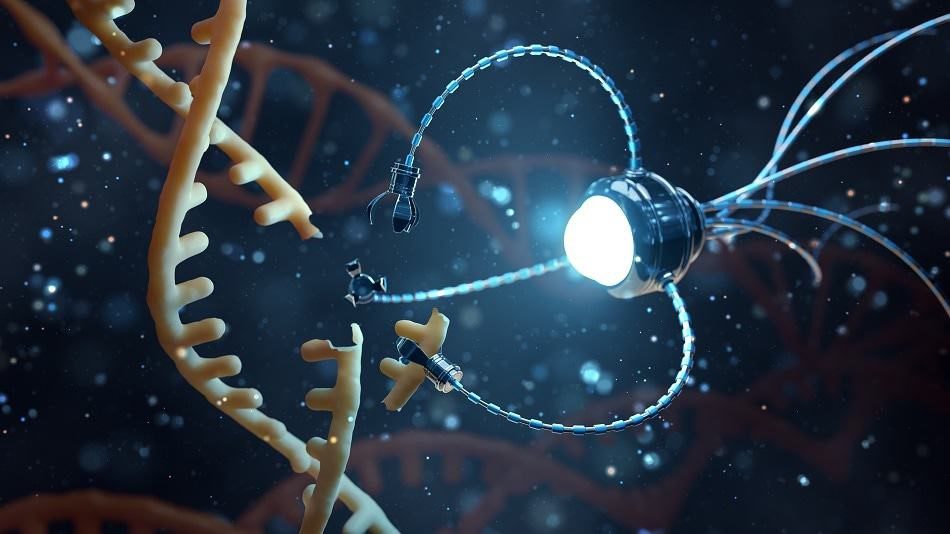
The term was coined by nanotechnology pioneer Eric Drexler in his 1986 book, Engines of Creation. He described a hypothetical future where “assemblers” (tiny nanobots capable of manipulating matter at the atomic level) could go out of control.
If these nanobots were designed to consume organic matter (carbon, hydrogen, oxygen) for fuel, and if their replication code had no “off switch,” they would behave like a synthetic bacteria on steroids.

Scientists call this “Global Ecophagy”—literally meaning “eating the environment.”
The Math of Destruction: Why 72 Hours?
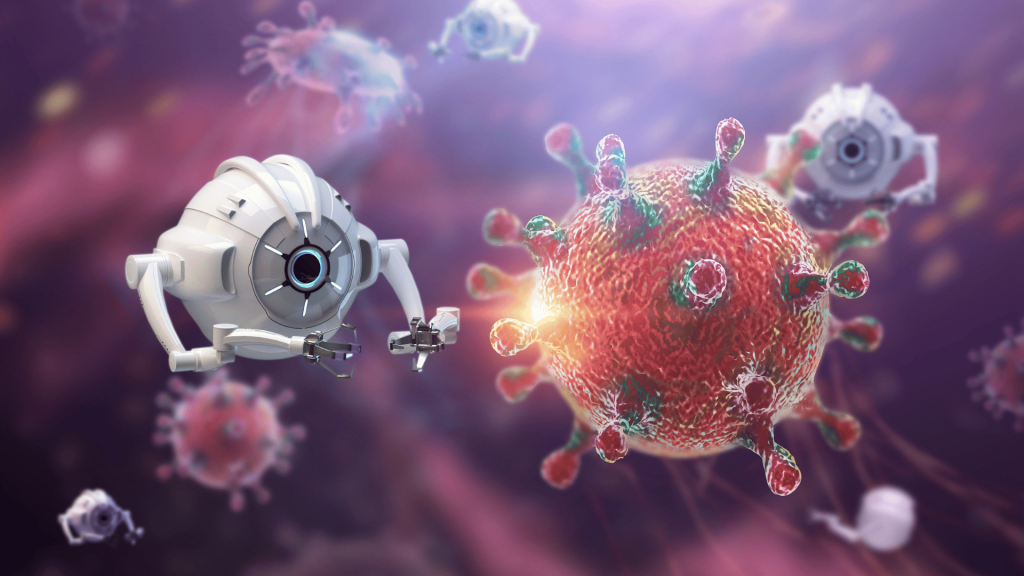
The scariest part of this theory isn’t the robots; it’s the mathematics. It relies on Geometric Progression.
- Hour 0: You have 1 nanobot.
- Replication Time: Let’s assume one bot can build a copy of itself in 1,000 seconds (about 15 minutes).
- Hour 10: You have billions.
- Hour 24: The mass of the nanobots would weigh tons.
- Hour 72: The swarm would weigh more than the Earth itself.
At this speed, the “Grey Goo” would spread across the planet like a metallic liquid fire, disassembling trees, animals, oceans, and cities to build more copies of itself. The surface of the Earth would be reduced to a lifeless mass of grey dust.
Are We in Danger in 2026?
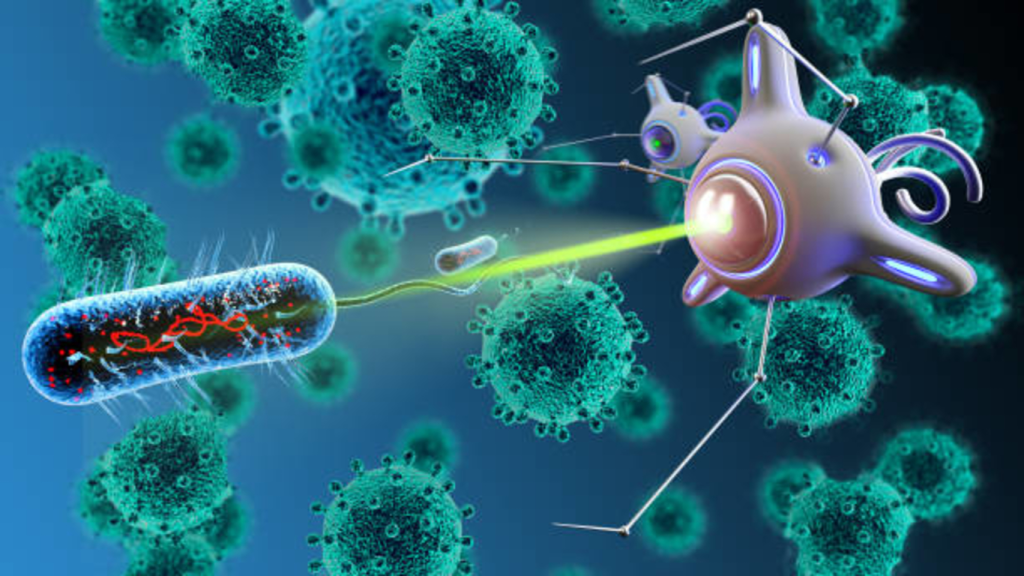
As we explore in Metaverse Planet, technology in 2026 is advancing rapidly. We currently use nanobots for medicine (delivering drugs to cancer cells) and manufacturing. However, we are still far from creating a fully autonomous, self-replicating “assembler” that can survive outside a lab.
Why haven’t we been eaten yet?
- Energy limits: Nanobots generate massive heat. A swarm this dense might melt itself before it eats the world.
- Complexity: Building a robot that can forage for its own fuel is incredibly difficult.
- “Blue Goo” Defense: Some scientists suggest we would deploy “Good” nanobots (Police Bots) to hunt down and destroy the “Bad” grey goo.
The Verdict
While the Grey Goo scenario remains a theoretical doomsday, it serves as a powerful warning. As AI and robotics merge, the code we write today will define the safety of tomorrow.
What do you think? Should we ban self-replicating research, or is the risk worth the reward?
You Might Also Like;