Deep Fission Unveils Nuclear Reactor to be Lowered 1.6 Kilometers Deep


Modular nuclear reactor technologies are opening the door to a new era in the energy sector thanks to their small size and ability to be factory-produced.
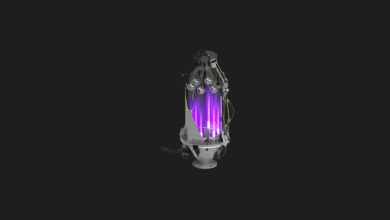
The US-based startup Deep Fission aims to revolutionize safety and cost by placing its developed reactors not on the surface, but 1.6 kilometers deep. The reactor, which is lowered into a 70-centimeter-wide well, will operate in a pressurized environment filled with water. This water serves the dual purpose of both cooling and ensuring safety and pressure stabilization.
Cost Drops by 80%
Since the security infrastructure, which is the highest cost item in conventional nuclear power plants, is no longer built on the surface, surface construction expenses are expected to decrease by 80%. According to Deep Fission, the production cost will drop to $0.05–0.07 per kWh.
For comparison, this figure is around $0.21 in existing nuclear power plants in the US, and about $0.12 at the Akkuyu Nuclear Power Plant in Turkey. The new system will offer energy as cheap as wind and solar, while having the advantage of uninterrupted production.
Compact Structure, Near-City Installation
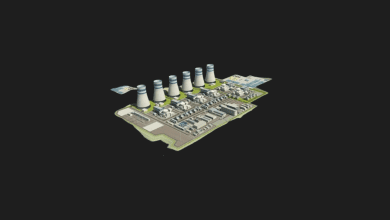
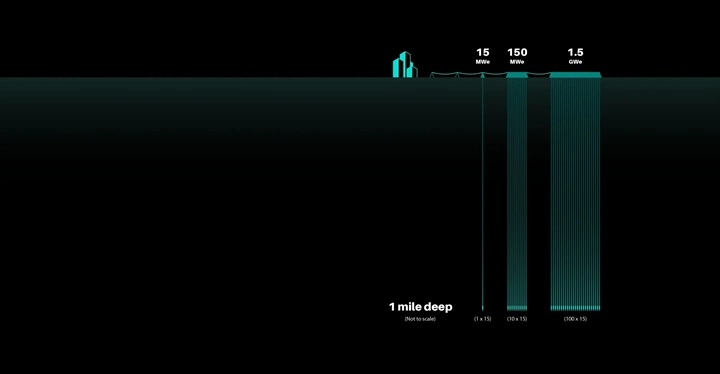
Each modular well reactor produces 15 MW of power and can be combined up to 100 units, reaching a level of 1.5 GW. The surface area covered by this system is only 12,000 square meters, meaning it can be installed near cities, and even in industrial zones.
6-Month Installation, $30 Million Investment
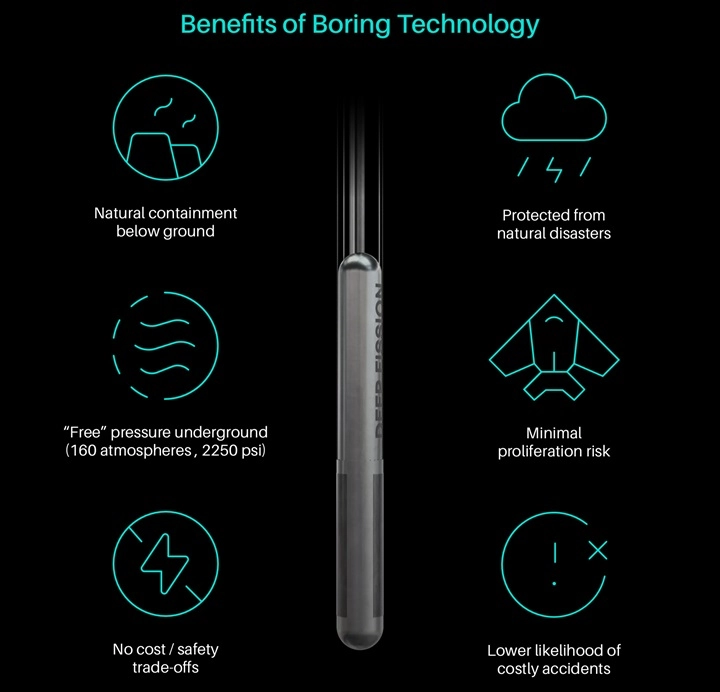
The reactors are factory-produced and sealed before being transported to the site; this minimizes the security clearances required for radioactive material. The installation time is only 6 months, compared to the 10-year construction period of conventional nuclear power plants.
Deep Fission received an initial investment of $30 million. The location of the first facility, which will consist of 12 reactors, will be determined this year; a license application is planned for 2026, and the 360 MW power plant is expected to be commissioned in 2029.
Natural Safety Underground
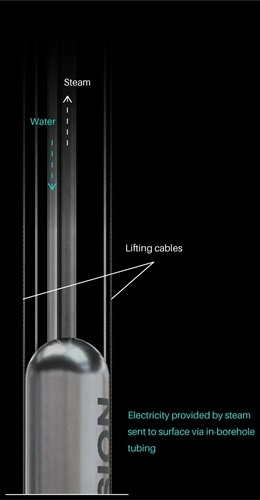
The system operates on the same principle as classic pressurized water reactors. The water sent underground turns into steam in the reactor; this steam drives the turbines on the surface, is then cooled, and sent back to the reactor. Consequently, there is no radioactive material on the surface, making the system naturally much safer.
The deep underground and water-isolated placement of the reactors provides natural protection against potential attack, leaks, or natural disasters. The fuel generates uninterrupted energy for 2 years and 3 months, and the spent fuel is permanently stored underground, with new fuel being lowered into the well.
The Idea Emerged from Waste Disposal Work
The founders of Deep Fission were engineers who previously worked on nuclear waste disposal underground. They eventually reversed this idea, starting a new company with the question, “Why don’t we turn waste into energy?”
You may recall that our government recently issued a call for nuclear technology development. A call was also made there for modular reactors, and foreign companies were invited to conduct R&D with Turkish partners.
Also, during discussions with the US last week, state permission was granted for the transfer of civil nuclear technology. In my opinion, a technology that can produce safe and cheap power using such ready-made products is an excellent candidate for such a call. I hope our companies will evaluate it.
You Might Also Like;
- We Selected 10 Series Similar to Stranger Things for Those Who Love It
- Where and How is Silver Used in Electric Vehicles?
- Hyundai Unveils Its Multi-Purpose Wheeled Robot
Follow us on TWITTER (X) and be instantly informed about the latest developments…