China’s Megawatt Flying Wind Turbine Takes To The Skies


I’ve spent a lot of time looking at tech that feels like it belongs in a “Cyberpunk” concept art gallery, but rarely do I see something that literally lifts off the ground and changes how we think about the air above us. I’m talking about flying wind turbines. While we are used to seeing those massive white giants spinning slowly on hillsides or out at sea, China just did something that makes those look a bit… grounded.
I was reading through the latest reports from Sichuan, and I have to admit, I’m genuinely floored. A Beijing-based company just successfully tested a megawatt-scale floating wind power system at an altitude of 2,000 meters. This isn’t just a prototype hobby project; it actually fed electricity into the grid.
Let’s dive into why this S2000 system is making me rethink the future of “green” energy.
Tapping into the “High-Altitude Goldmine”
The first thing I wondered when I saw the S2000 was: Why go up so high? The answer is pure physics. Down here on the surface, wind is messy. It hits trees, buildings, and hills, creating turbulence and losing speed. But as you go higher—specifically into the troposphere—the wind becomes a different beast entirely. It’s stronger, more consistent, and carries way more kinetic energy.
I recall a basic principle from my tech research: wind energy is proportional to the cube of the wind speed. This means if you double the wind speed, you don’t just get double the power— sen get eight times the power. By sending a turbine 2,000 meters into the sky, you are basically tapping into a goldmine of energy that traditional towers simply cannot reach.
What is the S2000? (And No, It’s Not a Blimp)
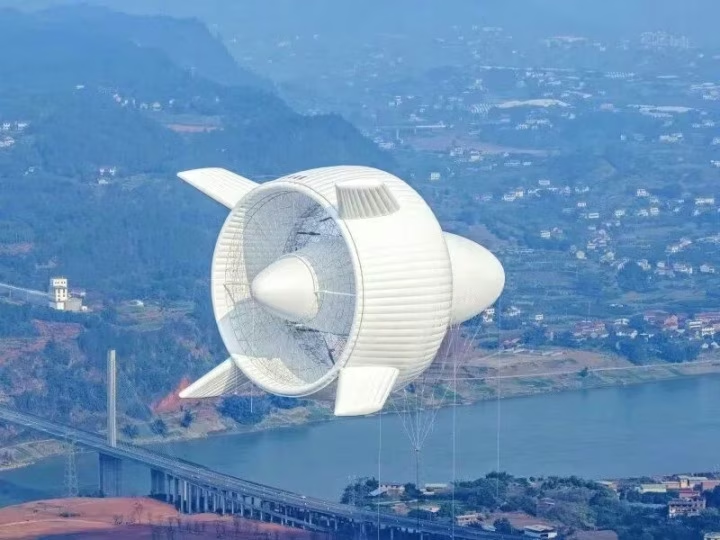
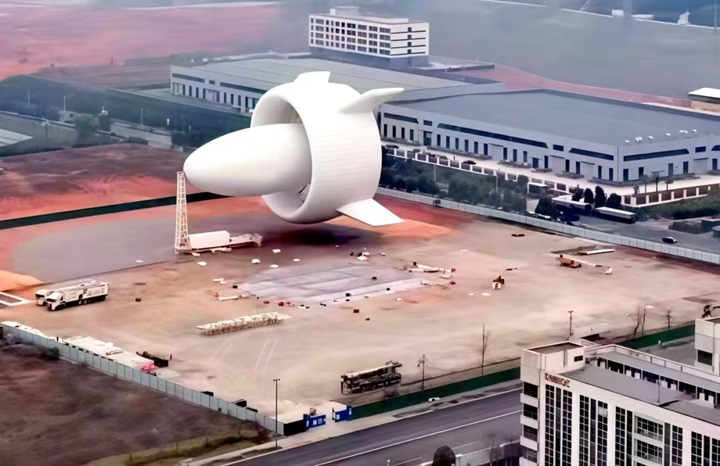
Developed by Beijing Linyi Yunchuan Energy Technology, the S2000 looks less like a traditional turbine and more like a futuristic jet engine combined with a massive balloon. Here are the specs that caught my eye:


- Size: It’s massive. We’re talking 60 meters long, 40 meters wide, and 40 meters high.
- The Lift: It uses a massive aerostat filled with helium to stay aloft.
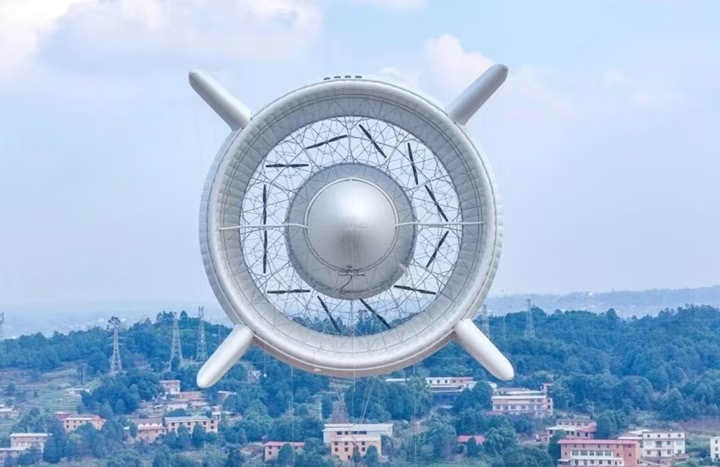
- The Powerhouse: It features a unique “ducted” design. Think of a hollow ring where the air is forced through a central channel. Inside this channel, there are 12 individual wind turbines.
- Capacity: The system is designed to reach a maximum capacity of 3 MW.
During the test in Yibin, Sichuan, the platform took about 30 minutes to reach its target altitude. Once it settled at 2,000 meters, it generated 385 kWh of electricity, which was sent straight down a high-strength tether to the ground station.
The Secret Sauce: The Ducted Design
I find the engineering here fascinating. Instead of just hanging turbines under a balloon, the S2000 uses its body to compress the air.
As the wind enters the front of the device, the shape of the “duct” (the space between the main balloon and the outer ring) forces the air to speed up before it hits the turbine blades. I’ve seen similar concepts in high-performance automotive intakes, and seeing it applied to wind energy at this scale is brilliant. It allows the system to be lighter and more efficient than if it were just a flat surface facing the wind.
Why I Think This Changes the Game
When I look at the current energy landscape, I see two massive problems that this “flying” tech solves:
- Geography is No Longer a Barrier: Traditional wind farms need specific terrain—usually flat plains or offshore sites. But what about remote mountain outposts? What about border stations or islands where building a 100-meter steel tower is impossible? You can deploy an S2000 almost anywhere you can park a truck.
- 3D Energy Infrastructure: Imagine a world where we don’t just have solar panels on roofs and turbines on hills. We could have layers of energy production. Lower-level solar, mid-level traditional wind, and high-altitude floating systems. I think this “layered” approach is how we actually hit those ambitious net-zero goals.
The Road Ahead: 2026 and Beyond
Of course, I’m a realist. There are big questions that haven’t been fully answered yet. How does this thing handle a lightning strike at 2,000 meters? What happens during a supercell storm? And then there’s the helium—it’s a finite resource, and keeping a 20,000-cubic-meter balloon filled isn’t cheap.
However, the company isn’t waiting around. They are already building a massive production facility in Zhoushan, aiming to produce hundreds of thousands of meters of high-performance balloon material by 2026. They’ve already signed deals with local governments in high-altitude and coastal regions.
My Perspective: The “Ugu” Take
To be honest, I was skeptical of airborne wind energy (AWE) for a long time. Many startups in the West tried this and failed because the controls were too complex or the tether snapped. But seeing a megawatt-scale unit actually hovering and feeding a grid feels like a “Wright Brothers” moment for the energy sector.
I don’t think these will replace traditional wind farms tomorrow. Instead, I see them as the “Special Forces” of energy. They go where others can’t. They reach the winds that others won’t. And if they can prove that these units can stay up for months at a time without constant maintenance, we might look back at 2025-2026 as the years the energy industry finally looked up.
What do you think? Would you feel comfortable living near a city powered by a fleet of giant, glowing energy balloons floating two kilometers above your head, or does the idea of “energy from the clouds” feel a bit too sci-fi for comfort?
You Might Also Like;