
What’s up, Spartans? Ugu here.
Between my daytime banker routines and late-night editorial deep dives, I’ve been analyzing the sheer volume of news dropping in the artificial intelligence sector this week. Honestly, the speed at which this ecosystem is evolving is enough to make anyone’s head spin. We aren’t just watching software updates anymore; we are watching a fundamental shift in how humanity interacts with technology.
Let’s cut right to the chase. This week, we saw massive shifts in market dominance, unexpected pushbacks from users, and a few leaks that show exactly where Apple is heading. Here is my breakdown of what happened in the AI world this week and why it actually matters.
👑 The Changing of the Guard: Anthropic Dethrones OpenAI

For the longest time, OpenAI felt like the untouchable king of the hill. But if you’ve been following my recent deep dives into generative models, you know I’ve been heavily favoring the nuanced logic of the Claude models. It seems the market agrees with me.
Anthropic has officially surpassed OpenAI in valuation. The developers behind Claude just announced a staggering $65 billion in fresh funding, pushing their post-money valuation to an eye-watering $965 billion.
- Why this matters: This isn’t just about money; it’s about the philosophy of AI development. OpenAI hit $852 billion back in March, but Anthropic’s steady focus on safety, steerability, and massive context windows has clearly won over the heavy-hitting investors. The AI race is no longer a monopoly, and this kind of fierce competition is exactly what we need to drive better, more affordable models for everyday users.
🇻🇦 A Warning from the Vatican: Pope Leo XIV Speaks Out
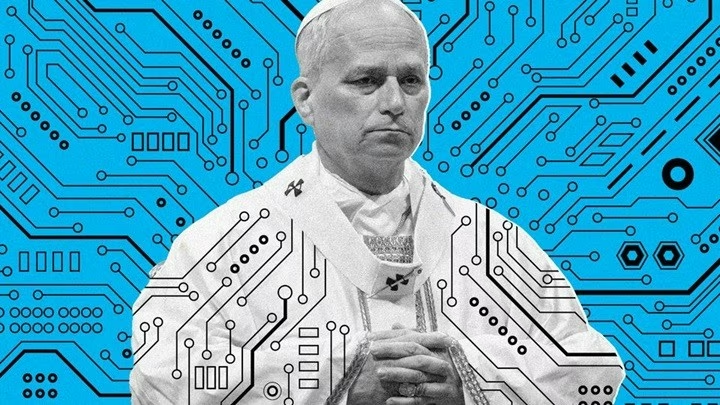
When the Pope starts talking about artificial intelligence, you know we’ve crossed a major cultural threshold. This week, Pope Leo XIV released his first encyclical letter, titled “Magnifica Humanitas” (Magnificent Humanity), and it was heavily focused on the existential risks of AI.

He isn’t completely against it—he acknowledged that AI is a powerful tool with immense benefits for humanity. However, he strongly urged global governments to implement stricter regulations. He warned that if this technology falls purely into the hands of profit-driven corporations seeking absolute power and control, the consequences for our social fabric could be devastating.
When I read this, I immediately thought of the themes we discuss regarding The Matrix or Interstellar. We are building tools that can outthink us. Keeping the human element—our “Magnificent Humanity”—at the center of these developments is going to be the hardest challenge of our generation.
🍏 First Look: Apple’s iOS 27 and the Rebirth of Siri

Thanks to a massive leak from Bloomberg, we finally got our first real look at the completely redesigned Siri coming in iOS 27. Apple has been playing catch-up in the generative AI space, but this update looks like a serious leap forward.
Here is what you need to know about the new Siri:
- Dual Interaction: You can now interact via text or voice natively within the new app interface.
- Conversational Memory: It finally works like a true chatbot (similar to Gemini or Claude), retaining the context of your ongoing conversation. You can even set expiration timers on message histories for privacy.
- Dynamic Island Integration: On iOS 27-equipped iPhones, a simple swipe down from the top center triggers a brand new “Search or Ask” interface. You can still use the traditional voice trigger or hold the power button, but this new UI looks incredibly slick and integrated.
🛑 Google’s AI Search Pushback & The DuckDuckGo Surge
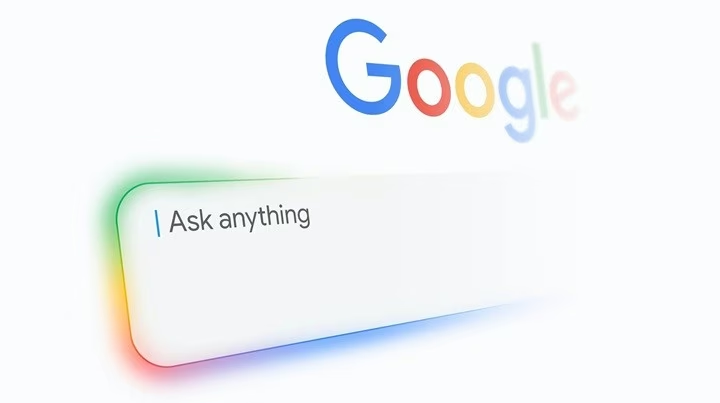
Not every AI integration is a success story. Google has been aggressively pushing its new AI-generated search overviews, and frankly, it is backfiring hard.
Users are getting frustrated with having AI-generated summaries shoved down their throats when they just want a simple list of blue links. The biggest winner of this backlash? DuckDuckGo.
- A 30% Spike: Following Google’s aggressive AI rollout, DuckDuckGo saw its app downloads skyrocket by nearly 30%.
- The “No-AI” Sanctuary: DuckDuckGo capitalized on this instantly. They are seeing massive traffic on their completely AI-free search portal (
noai.duckduckgo.com). It disables all AI-generated answers and images by default.
As a web manager, this fascinates me. It proves that while we love AI as a tool, we despise it when it is forced upon us and ruins a perfectly good user experience. Sometimes, less is more.
🕶️ Meta’s Expanding Wearable Empire

Meta is refusing to slow down its hardware ambitions. We all knew smart glasses were making a comeback, but Mark Zuckerberg’s team is taking it a step further.
- The AI Necklace: Meta is reportedly developing an AI-powered necklace. We don’t have all the specs yet, but imagine a screen-less wearable that constantly listens, analyzes, and assists you through an earpiece.
- Four New Smart Glasses: They are preparing to drop four new models by the end of the year.
- “Modelo”: Slated for a June release.
- “Luna” & “RBM2 Refresh”: Expected in the fall.
- “Mojito VIP”: A high-end model coming right before the holidays.
The hardware ecosystem is shifting from the smartphone in your pocket to ambient AI devices you wear on your body.
🛠️ New AI Tools Dropped This Week

The open-source and developer communities were busy this week. Here are the most critical tool updates you should care about:
- Claude Opus 4.8: Anthropic dropped a quiet but powerful update. Opus 4.8 brings dynamic workflows, better effort control, and beefed-up security protocols.
- ControlLight: This is an open-source absolute game-changer for designers. It allows you to dynamically alter the lighting in any photograph. It is remarkably good at rescuing underexposed, dark images.
- Nvidia Alpamayo 2 Super: Nvidia is pushing hard into autonomous systems. This new system allows robotaxis to not only analyze their environment but actually explain the reasoning behind their driving decisions. This kind of transparency is crucial for the future of self-driving tech.
- Nvidia PiD: If you need to upscale images without losing quality, Nvidia just released PiD. It is currently testing as one of the best upscaling models on the market.
⚡ Quick Bytes from the Industry
To wrap things up, here are a few rapid-fire developments you shouldn’t miss:
- Google Gemini Limits Changed: Google ditched the classic “message count” limit for Gemini. They are now using a compute-power consumption model. If your prompts are simple, you can talk to it all day. If you ask it to code a heavy app, you’ll hit the wall faster.
- Yandex Vibecraft: Yandex is teasing a new tool that lets you build full websites and apps using only text descriptions—zero coding required. I’ll be testing this as soon as it drops.
- Google AI Studio Goes Mobile: You’ll soon be able to develop AI applications directly from your Android or iOS device.
- YouTube AI Labels: YouTube is cracking down on undisclosed AI content. Highly generated videos will now feature much more prominent, unmissable warning labels.
- Huawei Thanks the US: In a bizarre twist, Huawei’s Chairman Xu Zhijun publicly thanked the US for their AI chip export bans. He claims the sanctions actually accelerated China’s domestic semiconductor industry rather than crippling it.
- A $500 Million Surprise: And finally, the craziest story of the week. A company that forgot to put a spending cap on their Claude API usage woke up to a half-a-billion-dollar server bill. Let that be a lesson to all the developers out there: always set your API limits!
I honestly think the pushback against Google’s AI search is the most telling story of the week. It shows that as much as we love the future, we still demand agency over how we consume information.
What about you, Spartans? Are you embracing the AI search summaries, or are you one of the thousands migrating to DuckDuckGo to get your clean search results back? Let me know in the comments.
You Might Also Like;