AI Diaries: What Happened in the World of AI This Week? (2 December 2025)



Artificial intelligence technologies, which have recently started to be used much more widely in daily life, continue to develop rapidly. While a remarkable development takes place in this field almost every day, important thresholds are being crossed one by one. In our “AI Diaries“ series, we continue to regularly record the development of this technological revolution, which has the potential to significantly change life on earth in the coming period.
What Happened in the World of AI This Week?
Google‘s rise in the artificial intelligence world continued this week. Google, which made a name for itself with software such as Gemini 3 and Nano Banana in previous weeks, raised the stakes on the hardware side this week. The fact that the company’s AI-specific TPUs have become a serious alternative to Nvidia’s GPUs showed that Alphabet will be ambitious in this field as well. On the other hand, important developments took place on the OpenAI front this week. In parallel with all this, as every week, new artificial intelligence tools entered our lives. Here are the prominent developments of this week in the world of artificial intelligence:
Google is Getting Stronger in the AI World

Google, which has achieved great success with artificial intelligence tools such as Gemini 3 Pro and Nano Banana Pro released recently, is closing the gap with OpenAI on the one hand, and becoming increasingly assertive on the hardware and infrastructure side on the other.
Google’s special artificial intelligence chips known as TPU (tensor processing unit) are becoming a serious alternative to Nvidia‘s artificial intelligence chips, which have been seen as almost the only option until now. As a matter of fact, information received this week revealed that Meta is preparing to invest billions of dollars to buy TPUs from Google. While this news had a doping effect on Alphabet‘s (Google’s parent company) shares, it caused a serious decline in Nvidia shares. Although Nvidia emphasized that its own GPU architecture is still a generation ahead of the sector to calm concerns after this news, this development showed that Google has started to strengthen its hand in this field as well.
Chinese Open Source AI Models Surpass US Rivals in Global Download Counts

Chinese open-source artificial intelligence models have surpassed American open models in global download counts for the first time. According to a joint study by MIT and Hugging Face, while China-based AIs took 17 percent of the open model market, US open models remained at 15.8 percent. This change shows that China is starting to get ahead in at least this part of the race, thanks especially to the cost-effectiveness and frequent updates of DeepSeek and Alibaba’s Qwen models. The fact that these open models are good enough to compete even with closed models like ChatGPT and come at very low costs seems to continue to make things difficult for Western artificial intelligence companies.
Anthropic’s New Flagship Model Claude Opus 4.5 Takes the Top Spot in Performance Tests
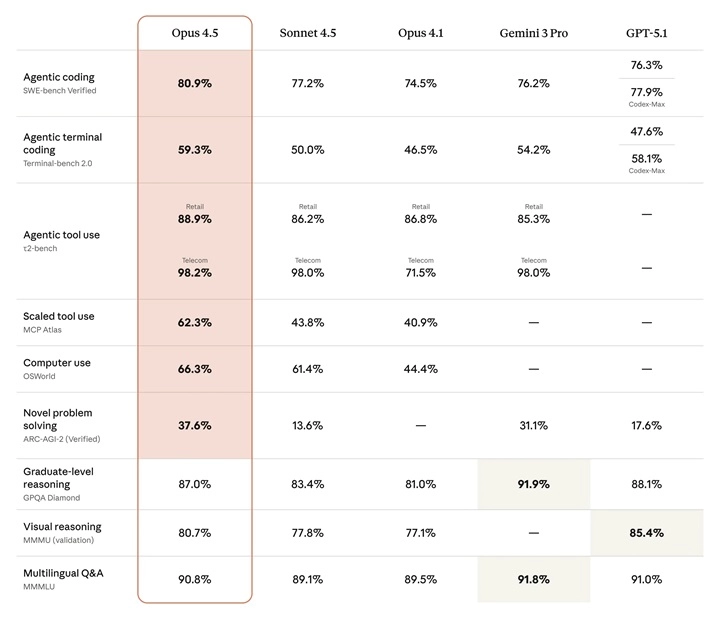
Anthropic, which has done remarkable work in the field of artificial intelligence, introduced its new flagship model Claude Opus 4.5. The new model stands out especially in software-oriented evaluations. Scoring 80.9 percent in the SWE-Bench Verified test, the highest score achieved so far, Opus 4.5 has thus surpassed both Gemini 3.0 and GPT‑5.1‑Codex‑Max models. The model also demonstrates superior performance in Terminal-bench, tool usage tests tau2-bench and MCP Atlas, and ARC-AGI 2 and GPQA Diamond tests in the field of general problem solving.


OpenAI’s First Hardware Prototype Is Almost Ready

OpenAI‘s first artificial intelligence device, prepared under the leadership of former Apple designer Jony Ive, is taking a more concrete form. Sam Altman and Jony Ive announced at an event they attended this week that the design of the device is almost complete and the first hardware prototype will be ready soon. The device’s launch could happen within two years. The device, the details of which are largely kept secret, is rumored to be screenless and designed to be about the size of a smartphone. Describing the design as “simple, beautiful, and fun,” Altman stated that although the previous prototype created excitement in him, it did not arouse the desire to pick it up and touch it, whereas the final design gives exactly this feeling.
OpenAI Adds Two Remarkable Features to ChatGPT

Although OpenAI continues its work on its first AI device, its main focus continues to be ChatGPT. As a matter of fact, the company added two remarkable features to ChatGPT this week. First, the way the “voice mode” works in ChatGPT‘s web version and mobile application has been changed. With the new update, it is now possible to use voice chat directly within the existing conversation screen. Thus, users can see the written transcript of the chat and follow the visuals supporting what ChatGPT is explaining at the same time.
The second innovation added to ChatGPT this week was the research tool called “Shopping Research”. Offering detailed shopping guides for ChatGPT users, this tool will bring together details such as featured products, key differences between products, and current retail information.
DeepSeek Released Another Impressive AI: DeepSeek Math-V2

DeepSeek, which showed that Chinese AIs can compete head-to-head with their Western rivals with the large language model it released at the beginning of this year, continues to produce remarkable work in the field of artificial intelligence. The company released a model playing for the top in mathematical reasoning this week. This new model, named DeepSeek Math-V2, has mathematical reasoning capabilities at a level that can win a gold medal in the International Mathematical Olympiad. Tested with both the questions in this year’s International Mathematical Olympiad and the exam in the Chinese Mathematical Olympiad, Math-V2 managed to perform at the gold medal level in both.
Offering a performance equivalent to the smartest models of OpenAI and Google in this respect, DeepSeek Math-V2 was published as open-source on platforms such as Hugging Face and GitHub.
AI Tools Introduced This Week
- Black Forest Labs introduced its new model FLUX.2, which can generate high-resolution images from text. Positioned as a direct competitor to Nano Banana Pro, FLUX.2 will be able to run on many more PCs than normal thanks to the collaboration with NVIDIA.
- A remarkable image generation tool came from Alibaba this week. Z-Image Turbo, developed by Tongyi-MAI under the umbrella of Alibaba, can produce extremely impressive images despite being a compact model that can be run locally on many PCs.
- Hunyuan‘s new artificial intelligence tool Hunyuan ORC can detect all kinds of text within an image and present it to users as plain text.
- Fara-7B, published by Microsoft, can see and analyze the computer screen just like a human and perform operations on this screen by managing the mouse. This gives Fara-7B the ability to perform some simple tasks autonomously.
News Snippets from the AI World
- The presence of codes belonging to the advertising infrastructure in the latest beta version of ChatGPT‘s Android application indicates that OpenAI will soon integrate ads into the platform.
- Elon Musk‘s artificial intelligence company xAI aims to close a $15 billion investment round in December with a valuation of $230 billion. The newly provided funds will be used for GPU investments for artificial intelligence models.
- OpenAI denied responsibility in the lawsuit regarding the suicide of a 16-year-old teenager, arguing that the incident occurred as a result of incorrect and unauthorized use. The family blames ChatGPT‘s design choices.
- WhatsApp announced changes to its terms of service that will ban users from using artificial intelligence chatbots other than Meta AI. This means that any third-party chatbot will no longer be allowed on the messaging app.
- YouTube is testing an AI-powered custom homepage tool that allows users to personalize video recommendations in the main feed with simple commands.
- The US administration announced the launch of a national science initiative on the scale of the Manhattan Project by combining artificial intelligence and comprehensive federal data sets with the Genesis Mission.
- Intel‘s former CEO Pat Gelsinger argued in an interview this week that the artificial intelligence chip race will be broken by quantum computers in the near future. According to Gelsinger, graphics cards will lose their importance within ten years.
- Amazon is building a $50 billion artificial intelligence and high-performance computing infrastructure for the US government. The system will be used in a wide range of areas from automation to intelligence.
You Might Also Like;
- We Selected 10 Series Similar to Stranger Things for Those Who Love It
- Where and How is Silver Used in Electric Vehicles?
- Hyundai Unveils Its Multi-Purpose Wheeled Robot
Follow us on TWITTER (X) and be instantly informed about the latest developments…