Quantum Breakthrough: Multiplying Laser Impact 20x Without Extra Power



I’ve always been fascinated by how we traditionally try to brute-force our way through physics problems. Need to see smaller particles? Pump more energy into the system. Need a stronger reaction? Build a bigger, more dangerous laser. But while digging through the latest research published in Nature, I stumbled upon a breakthrough that completely flipped my perspective.
Chinese physicists have figured out how to boost laser-matter interactions by over 20 times. The kicker? They didn’t use more power. Instead, they got incredibly clever with quantum mechanics.
As someone who closely follows the evolution of optical technologies, I can tell you this isn’t just another incremental lab update. It’s a fundamental shift in how we handle light, and it has the potential to revolutionize everything from ultra-fast imaging to the very limits of quantum physics. Let’s break down exactly what this means and why it matters.
The Brute-Force Problem in Laser Physics
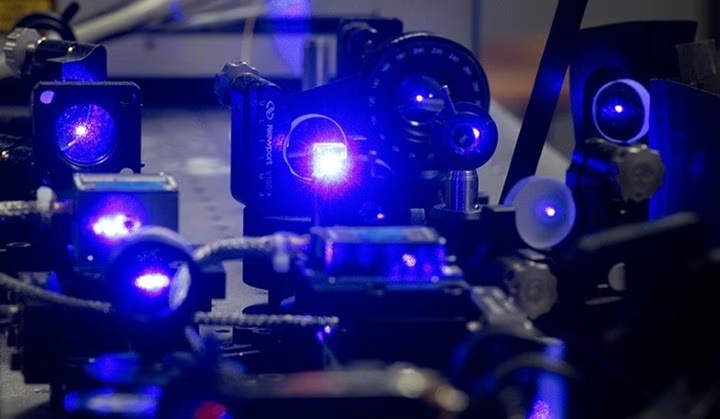
For decades, scientists have been locked in an arms race to build more intense lasers. We need these massive power outputs for cutting-edge fields like high harmonic generation and attosecond physics.
However, there is a massive roadblock when you rely purely on raw power:
- The Damage Threshold: As laser intensity increases, the physical materials being studied—along with the expensive optical lenses and mirrors—literally start to melt, burn, or shatter.
- Energy Inefficiency: Generating astronomical amounts of power for fractions of a second requires massive, highly specialized, and incredibly expensive infrastructure.
- The Plateau Effect: We are physically reaching the upper limits of what traditional optical materials can withstand.
We needed a smarter way to interact with matter at the microscopic level without vaporizing our own equipment. That’s exactly the problem a research team led by Jian Wu at East China Normal University decided to tackle.


Enter the “Bright Squeezed Vacuum”

Instead of turning the dial up to 11 on a traditional laser, the Chinese research team changed the statistical properties of the light itself. They utilized a highly specialized quantum light state known as a bright squeezed vacuum.
To understand why this is so brilliant, we have to look at how light travels:
- Traditional Lasers: Think of the photons in a standard laser like soldiers marching in a perfectly spaced, orderly line. It’s consistent, predictable, and delivers a steady stream of energy.
- Bright Squeezed Vacuum: In this quantum state, the photons don’t march evenly. Instead, they experience massive, chaotic quantum fluctuations. They bunch together in extreme clusters.
Because these photons group up so intensely, they create incredibly powerful, instantaneous spikes in density. Even if the overall average energy is very low, the momentary, instantaneous power is off the charts.
Testing the Theory: The Sodium Atom Experiment
To prove this wasn’t just mathematical theory, the team tested their concept on sodium atoms using a quantum mechanical process called tunneling ionization.
In simple terms, a strong electromagnetic field bends the “walls” of an atom, allowing electrons to literally tunnel through the barrier and escape.
When I was reading the results of this specific test, I was genuinely amazed:
- The team used a bright squeezed vacuum pulse carrying a mere 300 nanojoules of average energy.
- Despite this incredibly low energy footprint, the ionization effect on the sodium atoms was massive.
- The results mirrored what you would expect from a traditional laser operating at 20 times the effective intensity.
They achieved a sledgehammer’s impact using the energy of a gentle tap.
Why This Blows My Mind: Attosecond Physics and Beyond
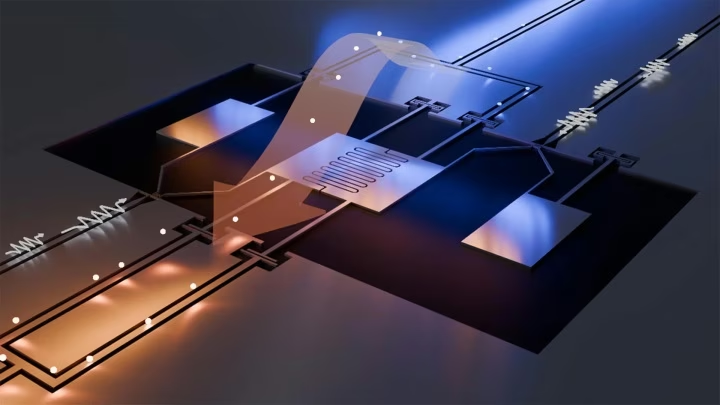
You might be wondering, “Okay, but what do we actually do with this?”
The immediate and most exciting answer is attosecond physics. An attosecond is one quintillionth of a second. It is the time scale at which electrons actually move and react. If we want to film chemical reactions occurring in real-time or watch electrons jump between atoms, we need lasers operating at the attosecond scale.
Before this breakthrough, creating these observations required pushing our traditional lasers to the absolute brink of destruction. Now, by using bright squeezed vacuums, scientists can achieve the same ultra-powerful interactions at a fraction of the energy.
This means:
- Safer Experiments: We can examine delicate quantum materials without accidentally destroying them.
- Higher Precision: Lower background energy means less thermal noise, leading to much cleaner, more precise measurements.
- Democratization of Physics: Facilities that couldn’t afford massive, room-sized mega-lasers might soon be able to perform advanced quantum optics experiments using smarter, lower-power setups.
Turning Quantum “Noise” into a Weapon
There’s a beautiful irony in this discovery. For the longest time, physicists viewed quantum fluctuations as an annoying bug—a source of background noise that needed to be suppressed and smoothed out.
Now, we are realizing that this “noise” is actually a feature. By harnessing the chaotic, bunching nature of quantum light, we are unlocking doors that brute-force engineering simply couldn’t open. It’s a perfect example of working smarter, not harder, on a subatomic level.
I honestly believe we are just scratching the surface of what quantum-manipulated light can do for medicine, data transmission, and material science.
If we can multiply the effect of a laser by 20 without increasing its power, what other limits of physics are we about to shatter by simply changing our perspective? I’d love to hear your thoughts—do you think the next big leap in technology will come from raw power, or from bending the bizarre rules of quantum mechanics to our advantage? Drop a comment below and let’s discuss!
You Might Also Like;