The Magic of Self-Healing Concrete: How Bacteria Are Saving Our Cities


Every time I walk past scaffolding clinging to an aging bridge or notice the deep fractures in the sidewalks of my city, I find myself thinking about a fundamental flaw in human engineering. We have built our entire modern world on concrete. It is the second most consumed material on Earth after water. Yet, it has a fatal weakness: it cracks.
For decades, we’ve just accepted this as an inevitable fact of life. Concrete cracks, water seeps in, the steel reinforcements rust, and eventually, the whole structure needs a massive, expensive overhaul. But while I was digging into the latest advancements in construction technology, I stumbled upon a breakthrough that honestly blew my mind.
We are no longer just relying on steel and cement to hold our cities together. We are recruiting biology. Today, I want to talk to you about smart concrete—specifically, bio-concrete that literally heals its own wounds using dormant bacteria.
Let’s dive into how this incredible intersection of biotechnology and engineering is about to rewrite the rules of architecture.
The Anatomy of a Flawed Giant

To understand why bio-concrete is such a game-changer, we first need to look at why traditional concrete fails.
When I look at a massive skyscraper, it seems invincible. But at a microscopic level, concrete is constantly under stress. While it can handle an immense amount of compression (weight pushing down on it), it is terrible at handling tension (being pulled apart).


- Micro-cracks are inevitable: Changes in temperature, ground settling, and heavy loads cause tiny fractures.
- The water invasion: These micro-cracks act like highways for rainwater and moisture.
- The rust factor: Once water reaches the steel rebar hidden inside the concrete, the steel rusts, expands, and blows the concrete apart from the inside out.
The traditional solution? Send out a crew, block traffic, tear out the bad concrete, and pour new stuff. It is ridiculously expensive and incredibly disruptive. I’ve always thought there had to be a smarter way, and it turns out, nature had the blueprint all along.
Enter the Microscopic Masons: What is Bio-Concrete?

When I first read the term “living concrete,” I pictured a sci-fi scenario where buildings are grown like trees. The reality is far more practical, but just as fascinating.
Bio-concrete is essentially standard concrete mixed with a very special, secret ingredient: spores of specific bacteria (usually from the Bacillus family) and a food source called calcium lactate.
Here is the part that genuinely amazed me during my research: these bacteria are naturally found near active volcanoes and highly alkaline lakes. They are extreme survivors. When mixed into the wet concrete, they don’t die. Instead, they form thick-walled spores and go to sleep.
They can lie completely dormant inside a dry concrete wall for up to 200 years, just waiting for their moment to strike.
How the Healing Magic Happens

So, how do these sleeping microbes fix a bridge? Let’s walk through the process. It’s an elegant, automated response system built directly into the material.
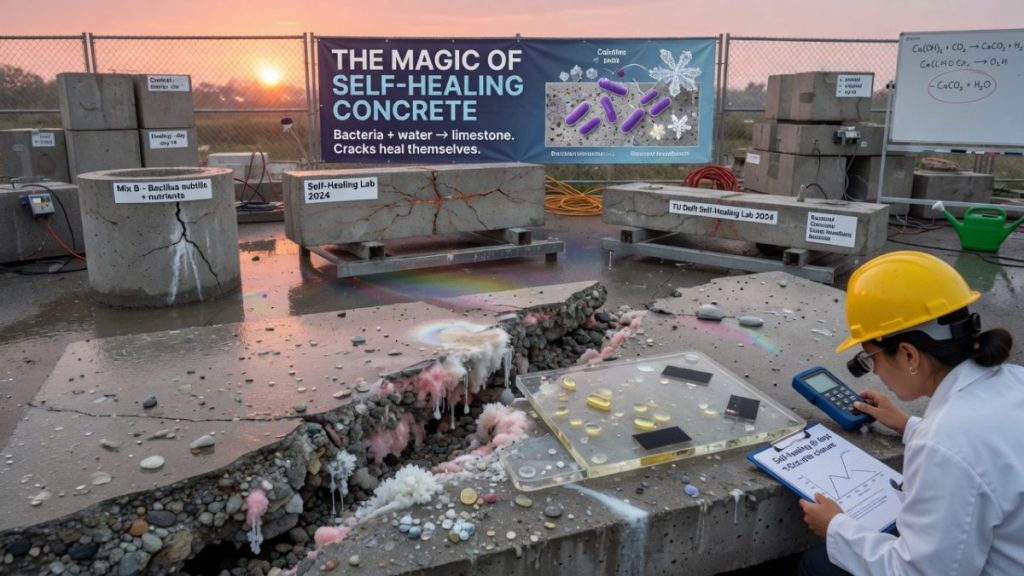
- The Trigger: A micro-crack forms in the concrete due to stress or weathering.
- The Wake-Up Call: Rainwater seeps into the crack. As soon as moisture and oxygen touch the dormant spores, the bacteria wake up.
- The Feast: The newly awakened bacteria start consuming the calcium lactate that was mixed into the concrete alongside them.
- The Repair: As the bacteria digest their food, a chemical reaction occurs. They excrete calcium carbonate—which is, essentially, hard limestone.
Within a matter of weeks, this limestone builds up and completely seals the crack, preventing water from reaching the steel rebar inside. Once the crack is sealed and the moisture dries up, the bacteria simply go back to sleep.
It’s an infinite loop of self-maintenance. When I think about the sheer genius of using biology as an automated repair crew, it makes traditional concrete look like a relic of the stone age.
Why This is a Massive Deal for Our Future
It’s easy to look at this as just a cool science experiment, but the implications are staggering. If we start building our infrastructure with bio-concrete, the ripple effects will change our economies and our environment.
1. Slashing Maintenance Costs
Governments and private companies spend billions of dollars every single year just patching up decaying infrastructure. If a bridge can autonomously heal its own micro-cracks before they become structural failures, the lifespan of that bridge could double or triple. The cost savings over a few decades would be astronomical.
2. The Ultimate Sustainability Move
This is the angle that resonates with me the most. Cement production is one of the dirtiest industries on the planet, responsible for roughly 8% of global carbon dioxide emissions.
If we can make our buildings and bridges last 100 years instead of 50 years, we dramatically reduce the amount of new cement we need to produce. Self-healing structures aren’t just cheaper to maintain; they are a critical weapon in the fight against climate change.
3. Conquering the Impossible Environments
Imagine underwater tunnels, offshore wind turbine foundations, or deep underground bunkers. Repairing concrete in these environments is currently dangerous and nearly impossible. Bio-concrete thrives exactly where traditional maintenance fails. When water attacks an underwater column, the bacteria simply wake up and reinforce the wall.
The Reality Check: What’s Holding Us Back?
As much as I love this technology, I always want to keep things grounded in reality. So, why aren’t all new buildings made of bio-concrete today?
The short answer is the price tag.
Currently, adding these bacterial spores and calcium lactate to the mix makes the concrete roughly twice as expensive as traditional concrete. For developers looking to cut upfront costs on a residential building, that’s a tough pill to swallow.
However, from what I’m seeing in the industry, researchers are aggressively looking for cheaper food sources for the bacteria (like agricultural waste) to bring costs down. And when you calculate the total “lifecycle cost” of a structure—including decades of zero maintenance—bio-concrete is actually a bargain. It just requires a shift in how we invest in our infrastructure.
The Cities of Tomorrow
We are standing on the edge of a new era in construction. The idea of “dead” materials is fading. In the future, I believe our cities will function more like living organisms—structures that sense damage, react to their environment, and heal their own wounds.
This isn’t just about mixing bugs into cement; it’s a fundamental shift in engineering philosophy. We are finally learning to work with nature rather than just paving over it.
I’m incredibly excited to see the first major skyscrapers and bridges built entirely from self-healing materials. But I’m curious about how you view this shift.
If you were buying a house today, would you feel safer knowing the walls were “alive” and capable of healing themselves, or does the idea of living bacteria in your living room walls feel a little too strange? Let me know what you think!
You Might Also Like;