NASA is Putting a Nuclear Reactor on the Moon: What Could Go Wrong?


When you look up at the Moon at night, you probably see a peaceful, silent, glowing rock. It’s the ultimate symbol of tranquility.
But if NASA gets its way, that silence might soon be accompanied by the faint hum of a nuclear fission reactor.
I know what you’re thinking because I thought the same thing: “Nuclear power? In space? Have we learned nothing from sci-fi movies?” But after digging into the details of NASA’s Fission Surface Power Initiative, I realized this isn’t just a wild experiment. It is the absolute prerequisite for humanity’s future among the stars.
By the end of the decade, the United States plans to have a 500-kilowatt (kWe) nuclear reactor running on the lunar surface. Let’s dive into why they are doing this, how they plan to pull it off, and the terrifying question everyone is asking: What happens if it melts down?
Why Solar Panels Aren’t Enough
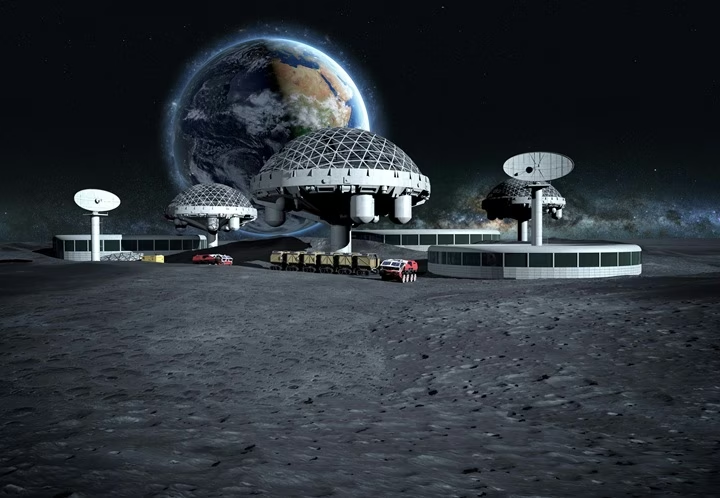
We are used to seeing the International Space Station (ISS) with those massive, beautiful solar wings. So, why can’t we just slap some solar panels on a Moon base and call it a day?
The problem is the Lunar Night.

On Earth, night lasts about 12 hours. On the Moon, the night lasts for 14 Earth days. Two weeks of absolute darkness and freezing temperatures. Batteries simply aren’t efficient enough to store two weeks’ worth of power for a habitat, rovers, and life support systems.
To survive the lunar night, you need a power source that doesn’t care if the sun is shining. You need the atom.
From “Warm Rocks” to Real Fission
We have actually been using nuclear tech in space for decades, but not like this.
- The Old Way (RTG): Rovers like Curiosity and probes like Voyager use Radioisotope Thermoelectric Generators. These are basically chunks of decaying plutonium that generate heat, which is converted into a trickle of electricity. They are safe, but weak.
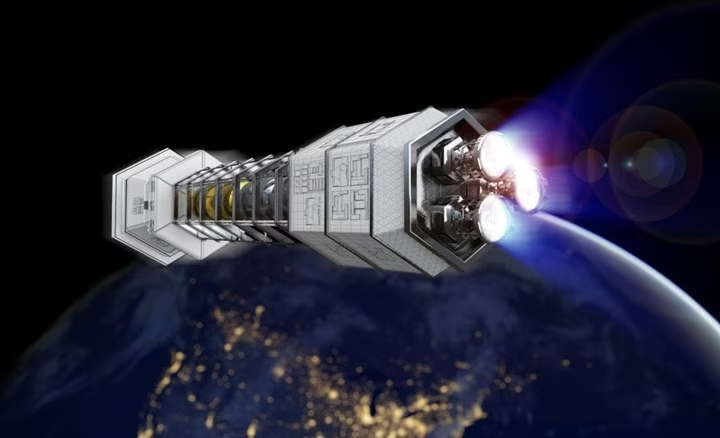
- The New Way (Fission): NASA wants to build a mini version of a terrestrial nuclear power plant. We are talking about actually splitting uranium atoms to generate massive amounts of heat and electricity.
A 500 kWe system is a game-changer. It’s enough juice to power a habitat, run industrial mining equipment to extract water from lunar ice, and keep the lights on permanently.
The Three Strategies on the Table
While researching this, I found that the US isn’t just throwing darts at a board. They have developed three distinct “roadmaps” to achieve nuclear dominance on the Moon.
- “Go Big or Go Home”: This is the aggressive approach. Led by NASA or the DoD (Department of Defense), this plan pushes for immediate development of high-power reactors (100-500 kWe). The goal here is simple: Establish overwhelming energy superiority in space before other nations (like China) catch up.
- “The Chessmaster’s Gambit”: This is a split strategy. NASA works on a reactor for the Lunar surface, while the DoD works on a separate system for spacecraft propulsion. It spreads the risk but complicates the logistics.
- The Cautious Approach: This involves starting small—really small. They would build a sub-1 kWe system just to test the regulatory and technical framework before scaling up. (Personally, I think this is too slow for the current space race).
Engineering Impossible: The Cooling Nightmare

Here is where the engineering gets tricky. On Earth, nuclear plants are built next to rivers or oceans because they need massive amounts of water for cooling.
There are no rivers on the Moon.
If you can’t dump the heat into water, and there is no atmosphere to carry the heat away (convection), how do you stop the reactor from melting? NASA has to rely on radiation (not the bad kind, but thermal radiation). They have to design massive, lightweight radiators that glow red-hot, shedding waste heat into the vacuum of space.
And then there is the weight problem. Every kilogram we launch into space costs a fortune. These reactors need to be:
- Lightweight: No heavy concrete containment domes.
- Rugged: Able to survive the violent vibrations of a rocket launch.
- Autonomous: There are no repair crews if a valve gets stuck.
The “Kilopower” Proof
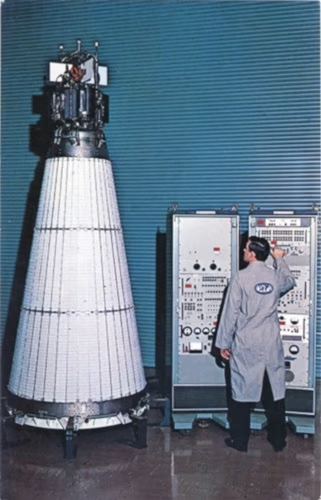
In 2018, NASA proved it wasn’t just dreaming. They successfully tested “Kilopower,” a reactor the size of a paper towel roll. It used a Uranium-235 core and passive sodium heat pipes for cooling. It ran flawlessly.
NASA believes four of these units could power a small lunar outpost. It’s elegant, simple, and crucially, it turns itself off if things go wrong.
The Horror Scenario: A Moon Meltdown
Now, let’s address the elephant in the room. What if it blows up?
We have all seen Chernobyl. We know what a nuclear disaster looks like on Earth. But physics on the Moon is different.
1. No Mushroom Cloud Explosions and mushroom clouds require an atmosphere to create a shockwave. On the Moon, there is no air. If a reactor breached, there would be no booming explosion, no shockwave knocking over astronaut habitats. It would be a silent event.
2. No Spreading Cloud On Earth, the wind carries radioactive dust (fallout) across continents. On the Moon, there is no wind. If the core melted and breached containment, the radioactive material would just… sit there. It would likely spill out, cool down rapidly in the vacuum, and solidify into a radioactive puddle.
The Verdict: A lunar meltdown would be a local tragedy, not a global one. It would create a permanent “No Go Zone” around the base, but it wouldn’t poison the entire Moon.
A Blast from the Past (Literally)
While digging into the history of space nukes, I found two fascinating tidbits that show how far we’ve come.
- SNAP-10A (1965): The US actually launched a reactor into orbit in the 60s. It worked for 43 days before an electrical failure shut it down. It is still up there, circling Earth, a frozen nuclear relic.
- Project A119: This is the crazy one. During the Cold War, the US Air Force seriously considered detonating a nuclear bomb on the Moon. Why? Just to show the Soviet Union that they could. Thankfully, cooler heads prevailed, and they realized that nuking the moon for PR was a terrible idea.
My Final Thoughts
We are standing on the precipice of a new era. For the first time in history, humans are planning to export our most powerful—and dangerous—energy source to another celestial body.
It feels risky. It feels aggressive. But if we want to go to Mars, we have to master this. The Moon is our sandbox; it’s where we learn how to live off-world. If we can’t manage a small reactor on the Moon, we have no business trying to survive on the Red Planet.
The technology is ready. The question is, are we ready for the responsibility?
I want to hear your take. Do you trust NASA to put a nuclear reactor on the Moon, or do you think we are playing with fire (or fission) in a place we should leave alone?
Drop a comment below and let’s debate!
You Might Also Like;