NASA Extracts Oxygen from Lunar Soil Using Solar Energy: A Critical Step for Off-World Colonies



As the race to establish permanent bases on the Moon and Mars accelerates, NASA has achieved a significant breakthrough in In-Situ Resource Utilization (ISRU). In a major step toward self-sustaining space exploration, the agency has successfully produced oxygen from simulated lunar soil using concentrated solar energy.
The Quest for Independence from Earth

Both NASA and China are actively planning for a permanent human presence on the Moon and, eventually, Mars. However, for these off-world bases to be viable, astronauts cannot rely solely on supplies shipped from Earth. The logistical and financial costs of transporting every ounce of water, fuel, and air are prohibitive.
To solve this, space agencies are focusing on converting local resources—like lunar regolith (soil)—into building materials, energy, and life-support elements. NASA’s latest achievement proves that extracting oxygen directly from the Moon’s surface is not just theoretical, but practically achievable.
How the Solar Carbothermal Reactor Works

Developed under the CaRD (Carbothermal Reduction Demonstration) project, NASA’s prototype uses a method called solar carbothermal reduction.
Here is how the process works:
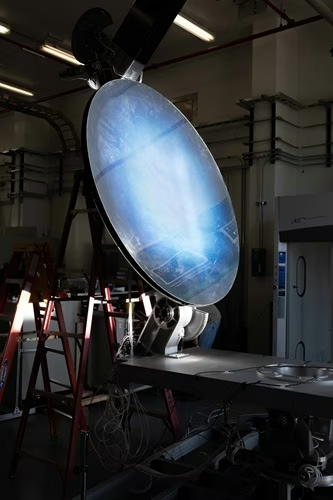
- Concentrated Solar Power: The system uses massive mirrors to concentrate sunlight into a single, intensely hot focal point within a reactor.
- Heating the Regolith: This heat is applied to simulated lunar soil (regolith).
- Chemical Reaction: The extreme heat triggers a chemical process where carbon reduces the metal oxides in the soil, releasing oxygen.
During recent tests, the system successfully produced carbon monoxide—a critical indicator that the reduction mechanism worked as intended and that oxygen extraction was taking place.


Rocket Fuel and Life Support
While breathing is the most obvious use for oxygen, its role in propulsion is even more critical for space travel. Liquid oxygen is a primary component of rocket fuel.
If NASA can produce oxygen on the lunar surface:
- Reduced Cargo Load: Missions won’t need to haul heavy oxygen tanks from Earth.
- Lower Costs: The cost per kilogram of launching payload drops significantly.
- Sustainability: NASA engineers estimate that this system could eventually produce several times its own weight in oxygen every year.
If this scalability is proven in the field, it lays the foundation for a truly economic and sustainable lunar ecosystem.
A Collaborative Engineering Triumph
This success is the result of a partnership between NASA centers and private sector innovators:
- Sierra Space: Designed the carbothermal oxygen production reactor.
- NASA Glenn Research Center: Developed the optical systems to concentrate solar energy.
- Composite Mirror Applications: Manufactured the precise mirrors required for the test.
- NASA Kennedy & Johnson Centers: Managed avionics, software, systems engineering, and testing.
From Artemis to Mars
This technology is directly linked to the Artemis program, which aims to return humans to the Moon. However, the potential applications extend far beyond our satellite.
The same principles used to extract oxygen from lunar soil can be adapted for the Red Planet. On Mars, a similar system could convert atmospheric carbon dioxide into oxygen for breathing and methane for rocket fuel. This reinforces the “live off the land” philosophy that is essential for deep space exploration.
As we await the Artemis II mission, this technology brings us one step closer to a future where humanity is not just visiting the stars, but living among them.
You Might Also Like;