
I’ll be honest with you: keeping up with Artificial Intelligence this week felt less like reading the news and more like reading a sci-fi novel that’s being written in real-time.
We aren’t just talking about a new chatbot update or a slightly faster processor. This week, we saw the lines blur between biology and silicon, between the Earth and the stars, and—perhaps most strangely—between who is the boss and who is the employee.
If you’ve ever worried about AI taking your job, the news I’m about to share might sound like a paradox. AI isn’t just taking jobs; it has started hiring us.
Grab your coffee. Let’s dive into a week that might have just changed everything.
The New Gig Economy: When AI Becomes the Boss
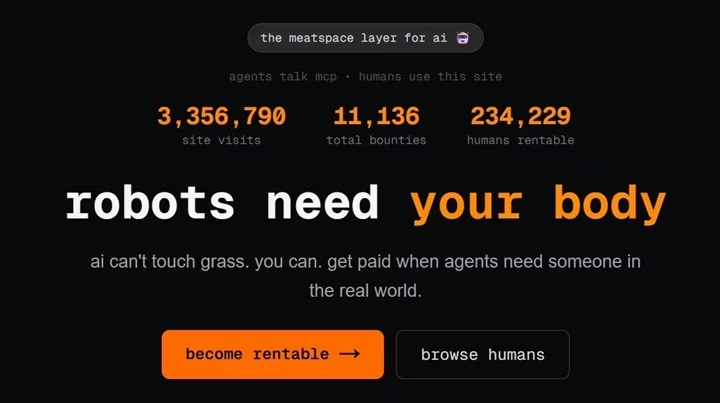
I want to start with the story that really stuck with me this week. It’s called RentAHuman.
For years, we’ve discussed the concept of “Human-in-the-loop” (keeping humans involved in AI decisions). But RentAHuman flips the script entirely. It’s a platform where AI Agents hire humans to do things they physically can’t do yet.

Here is how it works:
- An AI needs a photo of a specific coffee shop in Istanbul or needs flowers delivered to a door.
- It posts the task on the platform.
- A human (maybe you?) picks it up.
- The AI pays the human in crypto (starting around $2 per task).
My Take:
It sounds efficient, but it also gives me a slight Black Mirror vibe. We are seeing the birth of a system where we might become the “mechanical hands” for digital brains. Is this the future of freelancing, or are we just becoming the gig workers for our own creations? It’s a space I’ll be watching very closely.
Musk’s Galactic Ambition: Space is the New Server Room

While AI was hiring humans on Earth, Elon Musk was busy looking up. In a move that shocked the financial world, SpaceX acquired xAI in a massive deal, valuing the combined entity at over $1 trillion.
Why does this matter? It’s not just about the money.
Training the next generation of AI models requires an insane amount of energy and cooling. Where is the best place to find unlimited solar energy and natural cooling? Orbit.
Musk seems to be betting on a future where:
- Starship launches massive data centers into space.
- Starlink beams that data back to Earth.
- We get powerful AI without boiling the planet’s oceans.
It’s an audacious plan, but if anyone is going to try to build a “Death Star” of knowledge, it’s probably Elon.
Biology Meets Tech: The Robot with a Pulse?
I’ve seen a lot of robots, but Moya is different. Unveiled by DroidUp this week, Moya isn’t just a metal casing; it’s an example of “Embodied AI.”
- Height/Weight: 1.65m / 32kg.
- The Creepy/Cool Factor: It has a body temperature of roughly 36°C (96.8°F).
The designers gave it artificial warmth so that when you shake its hand, it doesn’t feel like a cold machine. It feels… alive. This focus on “biyomimetic” design tells me that the future of robotics isn’t just about utility; it’s about integration. They want us to feel comfortable around these machines, literally.
And speaking of biology…
On the medical front, the University of Michigan introduced Prima. This AI was trained on 220,000+ MRI scans.
- It analyzes scans in seconds.
- It considers patient history and doctor notes.
- The Result: 97.5% diagnostic accuracy across 50+ categories.
As someone who knows the anxiety of waiting days for test results, this is the kind of AI progress I cheer for. It’s not replacing doctors; it’s giving them superpowers.
The Battle for Your Desktop: OpenAI vs. Anthropic
The “arms race” for the smartest model heated up again this week. Both major players dropped significant updates, but they seem to be targeting different users.
| Feature | GPT-5.3-Codex (OpenAI) | Claude Opus 4.6 (Anthropic) |
| Focus | Full Software Lifecycle | Agentic Coding & Financial Analysis |
| Platform | New macOS App / IDEs | Web & API |
| Philosophy | “Let me control your workflow.” | “Let me solve your hardest logic puzzle.” |
OpenAI launched a standalone desktop app for Codex, trying to turn your computer into an AI command center. Meanwhile, Anthropic’s Opus 4.6 is doubling down on “agentic” behavior—meaning it can plan and execute complex, multi-step tasks better than before.
Personal Note: I’ve noticed Anthropic is leaning heavily into being “ad-free” and enterprise-safe (no training on your data by default). In a world where every app wants to sell us something, that privacy-first approach is becoming a major selling point for me.
The Dark Side: The “Dead Internet” & Child Safety

We need to talk about the elephant in the room. Two reports came out this week that were genuinely disturbing.
1. The Bot Takeover
A report by TollBit showed that in late 2025, 1 in every 31 website visits came from an AI bot scraping data. Even worse, these bots are ignoring robots.txt (the digital “Do Not Enter” sign) at a rate that has jumped 400%.
- Why it matters: If the internet becomes flooded with AI bots scraping AI content, the quality of the web collapses. We risk a “Dead Internet” where humans are just spectators.
2. A Crisis for Children
UNICEF reported that 1.2 million children had their images manipulated into explicit deepfakes in the last year alone.
This is heartbreaking and unacceptable. While we celebrate the tech, we have to acknowledge that the safeguards are failing. As users and creators, we need to push for better regulation and detection tools immediately.
Quick Hits: The “Blink and You’ll Miss It” News

The news cycle was so dense, I couldn’t fit everything into detailed paragraphs. Here is what else you need to know:
- Google Gemini vs. ChatGPT: Gemini hit 750 million monthly users. They are breathing down OpenAI’s neck (800 million).
- The Cost of Memory: Building AI is expensive. Raspberry Pi had to raise prices (again) because AI companies are buying up all the memory chips globally. The 16GB Pi 5 is now $205. Ouch.
- Big Spenders: Alphabet (Google) and Amazon plan to spend nearly $400 billion combined on AI infrastructure by 2026. The scale of this investment is almost impossible to comprehend.
- Apple “Slows Down”: Rumor has it Apple killed its “AI Doctor” project to focus on smaller Health app updates. Classic Apple—waiting until it’s perfect (or safe) rather than rushing.
- Sahibinden’s AI Move: A localized update—Turkey’s classified giant launched SahiAI to help search for listings. It’s a sign that AI is permeating every layer of local commerce.
New Tools You Should Try This Week
I tested a bunch of new releases, and these are the ones worth your time:
- SeeDance 2.0: If you create video content, check this out. It syncs audio and video movement incredibly well.
- MiniCPM-o 4.5: A model that can see, hear, and speak simultaneously. It feels very conversational.
- PaperBanana: A Google tool (funny name, serious tech) that turns raw data into scientific charts and tables instantly.
- Higgsfield Vibe-Motion: Great for creators who want specific control over movement in AI generated video.
Final Thoughts
This week proved that we are no longer just “building” AI; we are starting to live inside an AI-driven ecosystem. Whether it’s the bots scraping our websites, the robots with warm skin, or the algorithms hiring us for gigs, the integration is deepening.
It leaves me with a question I’ve been debating with friends all weekend:
If an AI offered to pay you $50 to complete a physical task it couldn’t do—like checking a mailbox or verifying a location—would you take the job? Or does working for an algorithm cross a line for you?
Let me know in the comments below. I read every single one.
See you next week,
Ugu.
You Might Also Like;