Breaking the Hypersonic Threshold: The Rotating Detonation Ramjet Arrives



I have always been fascinated by speed. From the early days of breaking the sound barrier to the modern obsession with Mach 5, humanity has a relentless drive to go faster. But for a long time, hypersonic technology (flying at 5x the speed of sound or more) felt like it hit a wall. It was too expensive, too heavy, and frankly, too complicated to be practical on a mass scale.
Well, that wall just got smashed.
This week, two titans of the aerospace world, GE Aerospace and Lockheed Martin, revealed a propulsion breakthrough that legitimately gave me goosebumps. They haven’t just tweaked an old engine; they’ve successfully demonstrated a Rotating Detonation Engine (RDE) combined with a Ramjet.
If you are wondering why defense analysts and tech geeks are losing their minds over this, stick with me. We are looking at a technology that could shrink missiles, double their range, and eventually, revolutionize how we fly.
The “Efficiency Gap”: Why Hypersonics Have Been Stuck
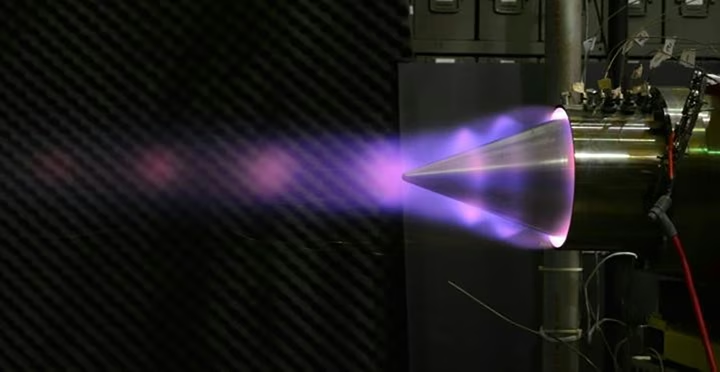
To understand why this is such a big deal, we have to talk about the problem. I love the engineering behind Ramjets. They are elegant in their simplicity: they have no moving parts. They use the sheer speed of the aircraft to “ram” air into the engine, compress it, and ignite it.
But there is a catch. A Ramjet is like a shark; if it stops moving, it dies. It cannot start from a standstill. In fact, a traditional Ramjet is useless until you are already moving at about Mach 3.


Because of this, current hypersonic missiles are bulky beasts. They require massive, heavy rocket boosters just to get them up to the speed where the main engine can take over.
- The Result: You have a heavy missile with limited range because half the weight is just the “starter” motor.
- The Problem: Engineers call this the “Efficiency Gap.”
For years, we’ve been waiting for a solution that bridges the gap between a standing start and Mach 5. It looks like GE and Lockheed just built that bridge.
Enter the “Rotating Detonation” Engine

GE Aerospace has introduced a concept that sounds like it belongs in a sci-fi movie: The Rotating Detonation Engine (RDE).
Let me try to explain this without getting bogged down in complex physics. In a normal jet engine or car engine, fuel burns. It’s a controlled, relatively slow burn (deflagration).
In an RDE, the fuel doesn’t just burn; it detonates. Imagine a supersonic shockwave of explosions chasing itself in an endless circle inside a cylinder. It’s a self-sustaining storm of energy.
Why is this better?
- Pressure Gain: Because the explosion creates its own massive pressure, the engine doesn’t need as much help from the outside air flow or heavy compressors.
- Efficiency: This method is roughly 25% more efficient than traditional combustion.
- Versatility: Unlike the stubborn Ramjet, an RDE can fire up and generate thrust at lower speeds.
By combining this RDE technology with a dual-mode Ramjet, GE and Lockheed have created a hybrid beast. It’s an engine that can start working earlier, transition smoothly as speed increases, and maintain incredible efficiency at Mach 5 and beyond.
Shrinking the Missile, Stretching the Range

This is where the rubber meets the road (or rather, where the shockwave meets the sky). The implications of this test are massive for defense technology.
Because the Rotating Detonation Ramjet creates its own high pressure, we don’t need those massive, heavy rocket boosters anymore. We can use much smaller, lighter boosters to get the missile off the ground.
Here is the domino effect of that change:
- Lighter Launch: Since the booster is smaller, the overall weight drops.
- More Fuel: The space saved by shrinking the booster can be filled with more fuel for the actual journey.
- Longer Range: More fuel + a 25% more efficient engine = a missile that can fly significantly farther than anything we have today.
This solves the biggest headache of hypersonic weapons: Range vs. Size. Previously, if you wanted a hypersonic missile to go far, it had to be huge. Now, we are looking at compact designs that can fit on standard fighter jets but still strike distant targets.
Lockheed’s Secret Sauce: The Air Intake

While GE focused on the explosive engine core, Lockheed Martin tackled the other nightmare of hypersonic flight: The Airflow.
Flying at Mach 5 isn’t just “fast wind.” The air behaves like a solid object. Shockwaves can destroy an engine if they aren’t managed perfectly. Lockheed developed a new tactical air inlet specifically for this project.
Think of this inlet as the lungs of the system. It has to breathe smoothly whether the missile is flying low and slow or high and screaming fast.
- It manages the shockwaves.
- It ensures the RDE gets a steady stream of air.
- It allows the engine to switch between “Ramjet” mode and “Scramjet” mode without choking.
Randy Crites, the VP of Advanced Programs at Lockheed, mentioned that this demonstration is a turning point to get these systems into the field faster. And he is right. This isn’t just a paper theory anymore; they are running the hardware.
Beyond Weapons: The Future of Flight?
I know, right now we are talking about missiles. That is where the funding is, and that is where the urgency lies for countries like the US, China, and Russia. But as I read through the technical reports, I couldn’t help but dream a little bigger.
If we can master Rotating Detonation Engines, we unlock a new tier of propulsion for aircraft. Imagine a plane that takes off from a standard runway, uses an RDE to climb efficiently, and then transitions to hypersonic cruise.
We are still years away from seeing a passenger plane with this tech—nobody wants to ride inside a tube powered by continuous explosions just yet—but the physics work. This successful test proves that we can tame the instability of detonation engines.
Final Thoughts
We often talk about technology moving fast, but in aerospace, things usually move at a glacial pace. That is why this news hit me so hard. The switch from “burning” fuel to “detonating” it is a fundamental shift in how we generate power.
The “Efficiency Gap” has been the bottleneck holding back the true age of hypersonics. GE and Lockheed just popped the cork.
I’ll be watching closely to see when this moves from ground tests to flight tests. The sky is about to get a whole lot faster.
I’m curious: When we talk about “detonation engines” in commercial travel, does the idea of riding a series of explosions scare you, or does the promise of flying New York to Tokyo in 2 hours outweigh the fear? Let’s discuss in the comments!
You Might Also Like;